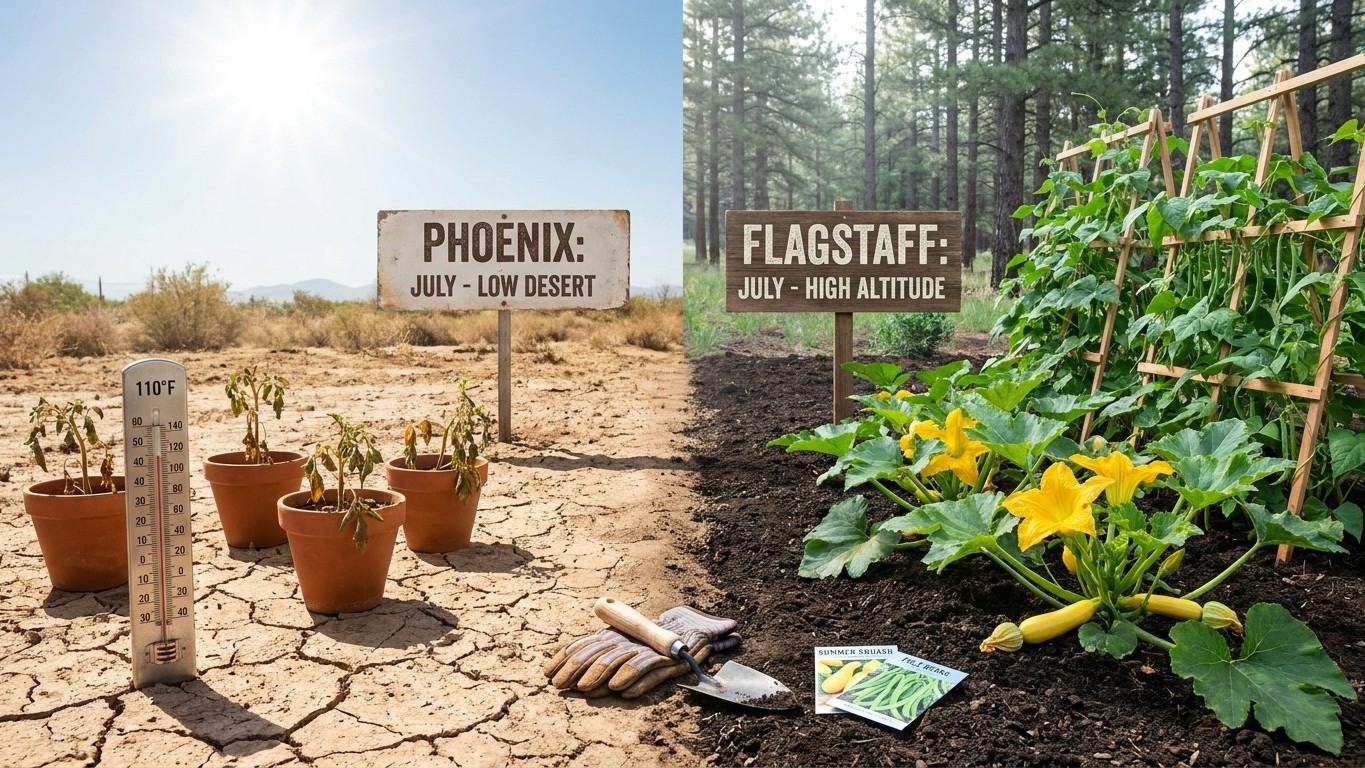

July splits Arizona into two different gardens. In the low desert around Phoenix and Yuma, heat shuts down new planting in open soil almost entirely until the sun eases up. Above roughly 5,000 feet, in places like Flagstaff, Prescott and the White Mountains, July is the heart of the growing season, with warm-season crops thriving and still time for another round of beans or squash. Which garden you’re standing in decides everything this month.
What goes in the ground in July

The calendar says July is midsummer everywhere, but Arizona doesn’t have one midsummer. It has several, stacked by elevation. The USDA Plant Hardiness Zone Map places the state anywhere from zone 4b in the high country to 10b in the low desert, a range built on a single measurement: the average coldest temperature a location sees in a typical winter. That number tells you almost nothing about July. What decides planting this month is soil temperature and heat stress, not frost risk.
In the low desert, NOAA’s climate data for the region shows a frost-free season that runs essentially all year, with a freeze reaching the ground in only a handful of recent winters. That sounds like an invitation to plant anything, anytime. It isn’t. By July, soil surface temperatures in full sun routinely climb high enough to cook seedling roots and stall germination before it starts. Transplanting a tender seedling into that ground is close to a death sentence. The plants that tolerate it are the ones built for heat: okra, black-eyed peas (cowpeas), Armenian cucumber, Malabar spinach, and heat-tough okra relatives like roselle. These can still go in, ideally in late afternoon, with immediate shade cloth and deep watering to get roots established before the worst of the day hits.
In the high country, the season works the opposite way. Growing conditions there resemble a shortened version of a Midwest summer, and July is prime time rather than a pause. Warm-season crops planted after the local frost window has passed are actively producing, and there’s still a workable stretch left for a second sowing of bush beans, summer squash, or a fast cucumber variety, timed to mature before cooler nights slow things down. The trade-off is a shorter runway: a variety that needs 75 days to mature has less room to work with in the high country than it would at lower, warmer elevations.
What to start under cover
“Under cover” means something different depending on which Arizona you’re gardening in. In the low desert, the useful cover this month isn’t a cold frame, it’s air conditioning. Seed trays started indoors, out of the heat, give fall crops like tomatoes, peppers and brassicas a head start without exposing tender roots to lethal soil temperatures. The arithmetic runs backward from when the desert actually cools, which typically arrives well after Labor Day. Counting back from that point, most seed packets’ stated weeks-to-transplant size tells you when to start: an eight-week-old tomato transplant needs its seed started roughly two months before you plan to set it out, meaning trays go in now for plants that will move outside once the heat breaks.
The two ways this goes wrong mirror each other. Start too early and the tomato seedlings sit indoors for weeks past their prime, turning leggy and rootbound in a tray that was never meant to hold them that long. Start too late and there isn’t enough season left before the desert’s brief mild window closes and heat returns the following year. Neither mistake is fatal on its own, but both cost weeks of harvest.
In the high country, cover in July usually means row cover or a shade cloth over recently transplanted seedlings, protecting them from intense midday sun rather than cold. Anyone still wanting to start slow-maturing crops indoors for a fall planting should count backward from the local first fall frost, which varies by elevation and isn’t the same number for Flagstaff as it is for a lower valley town thirty miles away. That specific date isn’t published in a single statewide figure, which is exactly why a local extension office check matters more here than almost anywhere else in the state.
What is ready to pick
In the low desert, harvest this month is really the tail end of the spring planting, not anything new. Melons and watermelons seeded in early spring are hitting peak ripeness, okra started earlier is producing steadily and needs picking every couple of days to keep pods tender, and black-eyed peas are filling out their pods. Tomatoes are a different story: once daytime highs stay elevated for extended stretches, blossoms stop setting fruit at all, so any tomato harvest now is likely the last batch before the plants shift into pure survival mode until temperatures ease.
The high country’s July harvest looks much closer to a textbook Midwestern summer garden. Summer squash comes in fast enough to check plants every day or two, since a zucchini left unpicked for a week turns into a baseball bat overnight. Bush beans are ready when pods snap cleanly rather than bend, and early sweet corn planted right after the local frost window will be filling out ears, tested by peeling back a bit of husk to check for plump, milky kernels.
Whichever elevation, stored crops from earlier harvests deserve a check this month too. Onions and garlic cured and stored after a spring harvest should be inspected for any soft necks or sprouting, since heat speeds up spoilage in storage just as it slows down growth outdoors.
The jobs that matter this month
Mulch is the single job that pays back the most in July, and it works in both climates for different reasons. In the low desert, a thick layer around the base of surviving plants keeps root zones several degrees cooler and slows the punishing evaporation that comes with triple-digit afternoons. In the high country, mulch conserves moisture during a season when afternoon monsoon storms can be unpredictable, arriving heavy some weeks and skipping others entirely.
Watering rhythm matters more than watering volume. Deep, infrequent watering that pushes moisture down to the root zone beats a daily light sprinkle in every part of the state, because shallow watering trains roots to stay near the surface where heat damage is worst. Early morning is the right window almost everywhere in Arizona during July, giving plants moisture before the heat of the day and reducing the fungal problems that come with evening watering in humid monsoon stretches.
Pest scouting can’t wait this month. Spider mites thrive in hot, dry conditions and can strip a pepper plant of vigor within a couple of weeks if they go unnoticed, showing up first as fine speckling and faint webbing on leaf undersides. Squash vine borer is a high-country concern worth checking for at the base of squash stems, where a small hole with sawdust-like frass is the giveaway.
Shade cloth deserves attention too, not just installation but maintenance. Cloth that shifted or tore in a wind gust needs fixing immediately in the low desert, where even a few unshaded afternoons can scorch leaves that were otherwise holding up fine.
What not to do in July
The most common mistake in the low desert is treating July like any other warm month and transplanting tender seedlings straight into open soil because the morning felt manageable. Soil temperature, not air temperature, is what kills roots, and by midday that same soil can be dramatically hotter than the air above it. The fix is starting those seedlings under cover indoors and holding them until conditions cool, not forcing them into ground that won’t support them yet.
A second mistake is pulling back shade cloth or row cover too soon after a mild or cloudy stretch, assuming the worst of the heat has passed. Arizona’s summer heat doesn’t retreat in a straight line; a few milder days are often followed by a return to extreme highs, and plants that lost their protection during that lull can suffer real damage fast.
Fertilizing heavily during heat stress is another trap. Nitrogen pushed onto a plant that’s already struggling to manage water loss through its leaves encourages soft new growth the plant can’t support, and that new growth wilts and burns faster than established foliage. Better to hold off on heavy feeding until temperatures ease and the plant is actively growing again rather than just surviving.
In the high country, the classic error runs the opposite direction: gardeners sometimes hold back on succession sowing because it “feels late” for a second planting, when in fact July still leaves enough season for a quick-maturing variety to finish before fall cooling sets in.
Checking this against your own county
A statewide answer for July is a starting point, not an instruction. Arizona runs from below sea level near Yuma to elevations over 12,000 feet, and that range moves growing conditions by weeks, not days, between one county and the next. A hardiness zone map built on winter extremes, spanning 4b to 10b across the state, can’t capture how differently one valley handles a July afternoon compared to a ridge thirty miles away.
The most reliable next step is checking conditions against the local extension office rather than a general calendar. The University of Arizona Cooperative Extension publishes county-level guidance that accounts for exactly this kind of elevation swing.
Common questions
Can you plant tomatoes in Arizona in July?
In the low desert, no, not as transplants into open ground; extreme heat stops fruit set and stresses roots. Starting seed indoors for a fall transplant once temperatures ease is the better path. In the high country, tomatoes planted earlier in the season are usually still producing through July.
Does Arizona get a frost in July?
No. NOAA climate data for the low desert shows an essentially frost-free season year-round, and July sits at the peak of summer heat rather than anywhere near a frost risk. High-elevation areas follow a separate, cooler pattern not covered by that same dataset.
What vegetables tolerate Arizona’s July heat?
Okra, black-eyed peas, Armenian cucumber and Malabar spinach are among the few crops that can go into low-desert soil this month with reasonable success, provided they get shade cloth and deep, consistent watering while roots establish.
Is July too late to plant in the Arizona high country?
Not necessarily. There’s usually still enough season left for a fast-maturing succession crop like bush beans or summer squash, though the exact cutoff depends on local elevation and is best confirmed through the county extension office rather than a fixed statewide date.