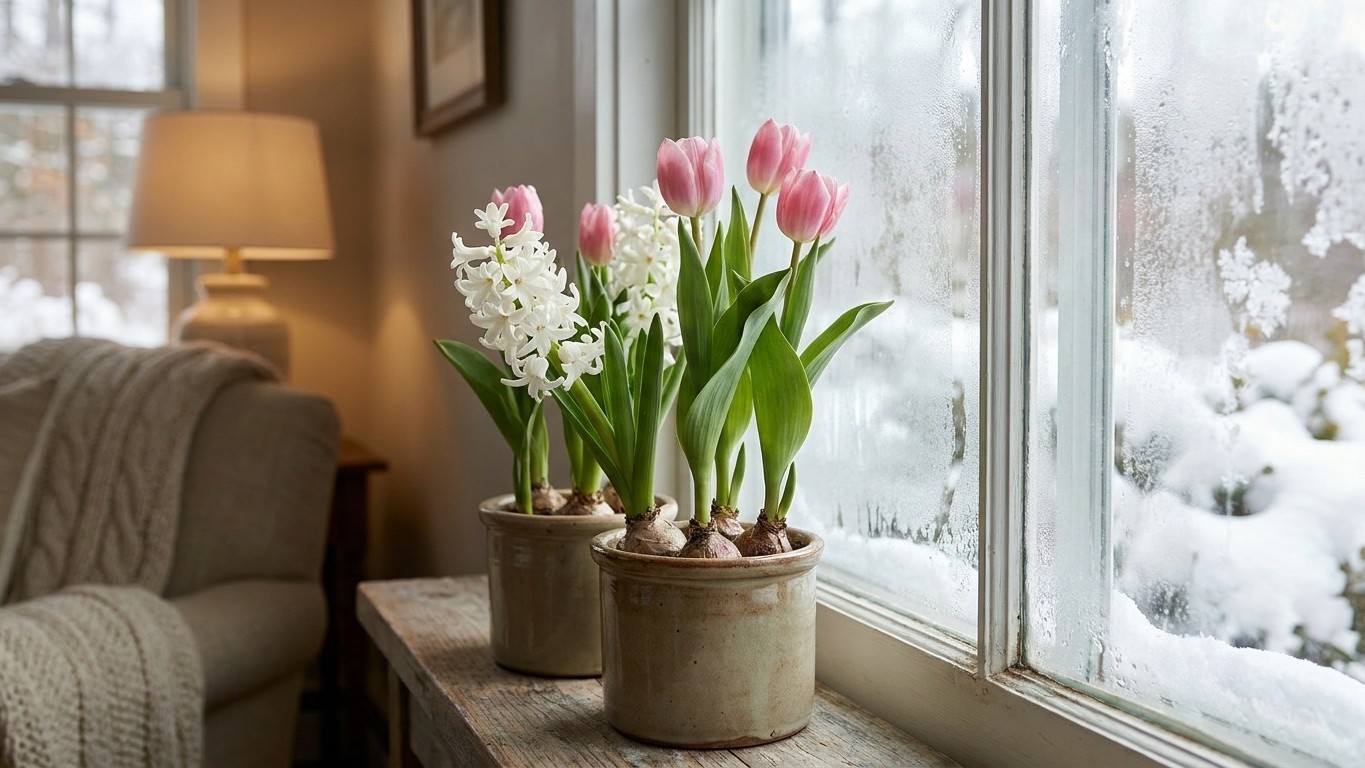

Forcing works in Connecticut, but not because winter here is too mild. The region’s coldest-month average minimum sits at 24.4F, more than enough chill for any spring bulb. What forcing actually solves is timing and Containers: getting blooms in January instead of April, and keeping potted bulbs alive through a freeze that behaves nothing like garden soil.
Why this matters in Connecticut

The coldest month here averages a minimum of 24.4F, according to NOAA’s 1991-2020 climate normals for the Bridgeport reference station. That number matters because it tells you something specific: whether a bulb planted in the ground gets its required chilling period at all. A tulip or hyacinth needs roughly twelve to fourteen weeks below 45F to complete the biochemical process that lets it flower. At 24.4F average, Connecticut soil clears that threshold easily, usually by late November and often well before Christmas.
So the shortage-of-cold scenario, the one that drives forcing in places like coastal Georgia or Southern California, doesn’t apply here. Gardeners in this territory aren’t fighting a climate that refuses to deliver winter. If anything, the opposite problem shows up: winter delivers plenty of cold, sometimes more than a container can survive.
That’s the real hazard in Connecticut, and it’s the second scenario the brief distinguishes. Garden soil freezes from the top down. Below a few inches, the ground retains enough residual warmth and insulation that bulb roots stay protected even when the surface is frozen solid. A container doesn’t have that buffer. A pot sitting on a porch or patio freezes through, roots included, exposing the bulb to air temperatures rather than the moderated temperatures a few inches underground. Connecticut’s hardiness range spans USDA zones 6a to 7b, with milder pockets along the coast near Bridgeport and colder inland and northern areas running toward 6a. A bulb rated hardy to zone 6 in the ground can still die in a container in the same yard, because the pot experiences something closer to zone 4 or 5 conditions during a hard freeze.
This is the distinction worth keeping straight before doing anything else: forcing indoors in this territory isn’t compensating for missing winter cold. It’s either a technique for moving natural bloom time indoors and earlier, or it’s a workaround for the fact that a container never behaves like open ground once temperatures drop.
How to do it here
The method itself doesn’t change by region, but where you find the cold, and how much of it you actually have available, does. In Connecticut, that cold source is usually one of two places: an unheated garage that stays above freezing on all but the harshest nights, or a spare refrigerator drawer that holds a steady temperature regardless of what’s happening outside.
- Select bulbs sold specifically for forcing, top-size and firm, with no soft spots or mold.
- Pot them in a container with drainage holes, using a well-draining potting mix, pointed end up, with the bulb tips just at or slightly above the soil surface.
- Water the pot thoroughly until it drains from the bottom, then let the surface dry slightly before moving it.
- Move the pot into cold storage: an unheated garage if it reliably stays above freezing through the coldest stretch, or a refrigerator drawer kept well away from ripening fruit, since the ethylene gas apples and pears release can kill the flower bud forming inside the bulb.
- Leave the bulbs in cold storage for the full chilling period the species requires, typically twelve to fourteen weeks, checking the garage thermometer periodically since a hard freeze in this territory can occasionally push an unheated space below 32F on the coldest nights.
- Check for readiness: a root system visible through the drainage holes and one to two inches of pale shoot growth signal the chilling is complete.
- Move the pot to a cool, dim spot around 60F for a few days to let the shoots green up gradually, rather than shocking them straight into full light.
- Transfer to a bright window with normal room warmth, where flowering typically follows within two to four weeks.
For anyone planning to force bulbs in a container that stays outdoors instead of moving to storage, the pot needs to be rated at least two hardiness zones tougher than the bulb itself, or it needs to come indoors, into an unheated but insulated space, before the hardest freezes arrive. Given the 6a-7b range across this territory, that’s not optional in most winters; it’s the difference between a bulb that reblooms and one that doesn’t survive January.
Which bulbs are worth it
Not every bulb repays the effort of forcing, and the reasons come down to two plant traits: how long the chilling requirement runs, and how tall and sturdy the flower stem grows. A bulb that needs a short cold period forces faster and with less risk of failure along the way. A bulb that throws up a tall, heavy stem is more likely to flop in a pot, where there’s no surrounding foliage or wind resistance to keep it upright the way there is in a garden bed.
Several also happen to be bulbs gardeners buy fresh each year anyway, since they don’t reliably return after forcing. For those, there’s effectively no long-term cost to using them up indoors; they were a one-season purchase whether forced or planted outside.
- Paperwhite narcissus, which needs no chilling at all and flowers in three to five weeks
- Hyacinths, with a relatively short chilling window and a sturdy, compact stem
- Crocus and species tulips, both short-stemmed and reliable under indoor light
- Muscari (grape hyacinth), compact and quick once chilling is done
- Iris reticulata, low-growing and rarely toppled by its own weight
- Large trumpet daffodils, whose tall stems tend to lean or fall over indoors
- Fritillaria, which has a long, exacting chilling requirement and a low forcing success rate
- Large Darwin and Triumph tulips, prone to toppling once the flower opens fully
- Alliums, both slow to chill and too tall for most indoor containers
What goes wrong, and when you can still fix it
Leaves but no flower
This means the chilling period was cut short. The bulb produced enough energy to push leaves but never completed the internal process that forms the flower bud. There’s no fix for the bulb in hand this season; the only remedy is starting over next year with the full recommended chilling window, tracked from the day the pot goes into cold storage rather than estimated.
Short stem, flower barely visible
This happens when the pot moved from cold storage into full warmth and bright light too fast. Stem elongation depends on a gradual transition, and skipping the cool, dim acclimation stage locks the stem at a stunted height even as the flower still opens. The flower on that bulb won’t get any taller this season. Next time, hold the pot in a 60F room for several days before moving it to a sunny window.
Rot in the pot
Rot almost always traces back to drainage. A container without enough drainage holes, or a mix that stays soggy through the entire chilling period, keeps the bulb sitting in water it was never built to tolerate. Once rot sets in, that bulb won’t recover this season or any other. The fix applies only to the next batch: drainage holes that actually drain, and a potting mix that dries slightly between waterings even while in cold storage.