
A March pink bloom in the north Georgia mountains can still meet a hard freeze that a Piedmont orchard forty miles south never sees that year, and that mismatch is what ruins a season — buds killed, thinned fruit set, a harvest that never fills the baskets it should have. Growers who plan apples off a single date on the wall, instead of the freeze window their spot actually sits inside, lose crop this way every few years without understanding why.
The short answer for Georgia
For most of the state, apple trees break dormancy and reach green tip in late winter, move through pink and bloom by the time NOAA’s 1991-2020 normals put Atlanta’s last spring freeze at March 11 to March 29, and finish harvest well ahead of the first fall freeze, which lands between November 13 and December 1 on the same normals. That’s the frame the whole season sits inside, and every decision on this page gets checked against that frost window, not against a month on the wall.
What the answer depends on is where in the state you’re standing. Atlanta’s reporting station sits in the Piedmont, and NOAA itself flags this as an urban airport site that reads warmer than the surrounding countryside. North Georgia’s mountains freeze several weeks earlier in fall and hold frost several weeks later in spring than this figure suggests, and the coastal plain runs milder in both directions. The frost window above is a planning baseline, not a date to circle on your own orchard’s calendar.
It also depends on which apples are in the ground. Georgia’s winters are too mild for extreme high-chill northern cultivars to flower reliably, and NOAA’s Atlanta normals put the coldest month’s average daily minimum at 34.3°F, a mild-winter reading rather than a hard-freeze one. That figure alone doesn’t tell you the chill hours a given orchard accumulates, but it’s a useful gut check on whether a variety bred for a harsh northern winter belongs in a Georgia planting at all. Everything else on this page assumes you’ve already matched variety to climate rather than transplanted a northern nursery list wholesale.
Working through it

Once a tree is planted and past its first year or two of establishment (see Growing Apples in Georgia if you haven’t gotten that far), the yearly cycle runs through seven recognizable stages. Each one is triggered by the tree’s own accumulated warmth, not by a date, which is why the same stage can land a week or two earlier or later depending on the winter just past.
- Dormancy
- Green tip
- Pink
- Bloom
- Petal fall
- Fruit set
- Harvest
Dormancy

The tree stands leafless from late fall through midwinter. This is when the bulk of pruning happens, since the branch structure is visible without leaves in the way, and dormant oil goes on now for scale and mite eggs, before any green shows. This stage runs through Georgia’s coldest weeks, well ahead of NOAA’s spring freeze window opening on March 11.
Green tip

Buds swell and split to show a sliver of green leaf tissue. This is the last safe point for a delayed dormant spray aimed at aphids and mites, since green tissue burns more easily once it expands further. Green tip in the Piedmont typically arrives well ahead of the last spring frost window, which is exactly why an early-blooming cultivar carries risk here.
Pink

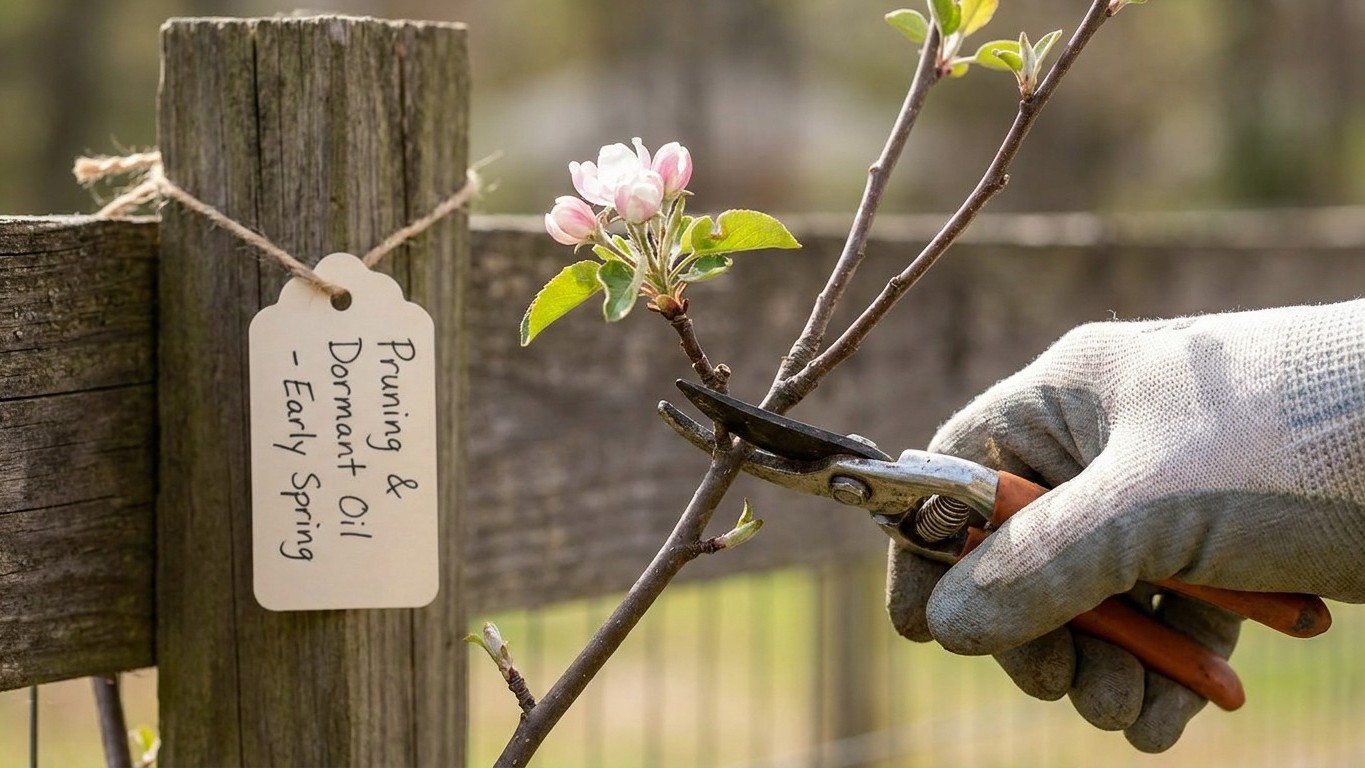
Unopened flower buds swell into a visible rose-pink cluster at the branch tips. Fungicide programs for scab usually start here, since the fungus infects as soon as petals separate, and this stage sits close enough to the March 11 to March 29 window that a late cold snap can still reach it.
Bloom

White, five-petaled blossoms open fully and pollinators go to work. This is the stage most exposed to frost damage. Because Atlanta’s last spring freeze runs anywhere from March 11 to March 29 in a given year, per NOAA’s normals, a variety that blooms on the early side of that window carries real frost risk in a cold spring, which is one of the things worth weighing when choosing cultivars in the first place (see The Best Apple Varieties for Georgia).
Petal fall

Spent petals brown and drop, leaving a small swollen ovary behind. A second fungicide pass often goes on now, and this is the first point where you can judge how much of the bloom actually set fruit.
Fruit set

Fruitlets swell to marble size over the following weeks. Thinning happens now, pulling the smaller or damaged fruit so the tree isn’t carrying more than it can size properly, and this is also the stage where a late, heavy nitrogen feeding does the most damage by pushing soft new growth instead of fruit development.
Harvest
Fruit color and firmness, not the calendar, tell you when to pick, and timing varies by cultivar by as much as two months. Harvest for the earliest varieties can start in midsummer, while later cultivars hang on the tree well into fall, and either way the goal is to finish well ahead of the first fall freeze, which NOAA’s Atlanta normals place between November 13 and December 1.
What changes across Georgia
The frost figures above come from Atlanta’s airport station, and NOAA notes plainly that this is an urban heat island reading, warmer than the open countryside around it. Three parts of the state move meaningfully off that baseline.
| Region | Fall frost timing | Spring frost timing | Winter chill |
|---|---|---|---|
| North Georgia mountains | Earlier than Atlanta | Later than Atlanta | Higher, more reliable |
| Piedmont (Atlanta reference) | NOAA 1991-2020 normals: Nov 13 to Dec 1 | NOAA 1991-2020 normals: Mar 11 to Mar 29 | Moderate |
| Coastal plain | Later than Atlanta | Earlier than Atlanta | Lower, sometimes marginal |
Up around Blue Ridge, Helen, and the higher parts of the Appalachian foothills, elevation and cold air pooling in the valleys push both frost dates outward. NOAA’s own caution on the Atlanta normals states that north Georgia and the mountains freeze several weeks earlier in fall than the Atlanta figures show, and by the same logic they hold frost later into spring. An orchard up there should plan pink and bloom later than the Piedmont dates above, not on the same schedule.
Down toward Albany and Valdosta, the coastal plain runs milder in both directions: later fall frost, earlier spring frost, and a shorter hard-freeze stretch in between. That helps at bloom, but it cuts the other way for winter chill. Warm winters there accumulate fewer chill hours, and a variety that needs a long, cold dormancy can bloom thin or not at all, regardless of how well it survives the winter itself.
Even within the Piedmont, low spots that collect cold air on a still night, the bottom of a slope, a field ringed by trees, read colder at bud break than a site on a gentle rise a mile away. Local topography moves the effective frost date on a piece of property more than most gardeners expect, and it’s worth tracking a home thermometer through a few springs before trusting any single station figure for your own ground.
The mistakes this climate punishes
An early-blooming variety chosen for a short growing season is the most common mistake in this climate. If a cultivar reliably reaches bloom near the early end of NOAA’s Atlanta frost window, it is exposed to a hard freeze in a meaningful share of years, and the damage shows fast: blossoms that were white and open the day before turn brown and limp within a day or two of a freeze, with no fixing a lost bloom once it happens.
A long-chill variety, planted on the assumption that a cold winter is a cold winter, is the second mistake, and it shows up the opposite way: a tree that looks perfectly healthy but blooms sparsely, unevenly, or weeks behind its neighbors. With Atlanta’s coldest month averaging a minimum of 34.3°F per NOAA’s normals, Georgia is a mild-winter climate by northern standards, and a cultivar selected for a harsher winter simply doesn’t accumulate enough chill here to break dormancy cleanly. This mistake doesn’t show up until the following spring, which is exactly why it gets planted in the first place, since the tree looks fine all summer and fall before that.
Late-season nitrogen is the third, quieter mistake. Feeding a tree in mid to late summer pushes a flush of soft new shoot growth right when it should be hardening off for winter, and that soft tissue is what gets hit hardest when the first fall freeze arrives. In a year where the freeze lands on the early side of Atlanta’s November 13 to December 1 window, or earlier still in the mountains, the dieback can set a tree back a full season. The fix is timing, not the fertilizer itself: stop feeding well before the stage where growth should be slowing and hardening for cold.
Checking this against your county
Every figure on this page is a regional average pulled from one Atlanta station, and it will run off for a given piece of ground by anywhere from a few days to a few weeks. The University of Georgia Cooperative Extension keeps county-level guidance on chill hours, frost dates, and spray timing that reflects your actual location rather than the Piedmont baseline used here. Find your local office through the UGA Extension directory, and ask specifically for frost and chill data for your county rather than a general apple care sheet, since that’s the number that actually determines when your own trees hit pink and bloom.
Common questions
My apple tree bloomed but never set fruit, what happened?
The two most common culprits in Georgia are a late frost that killed the open blossoms before pollination, and a variety that needs more winter chill than your winter delivered, which produces weak or uneven bloom that pollinates poorly. A lack of a compatible second variety nearby for cross-pollination is worth ruling out too, since many apples don’t set well on their own pollen.
Can you even grow apples in south Georgia?
Yes, but the mild winters on the coastal plain accumulate less winter chill than the Piedmont or the mountains, so success there depends on choosing lower-chill cultivars rather than assuming any apple variety will do. No figure in this article covers exact chill-hour totals for south Georgia specifically, so check with UGA Extension for what’s realistic in your county before planting.
How do I tell if a frost actually killed my blossoms?
Split a few open flowers with a thumbnail a day or two after the freeze. A healthy center is firm and pale, while a frost-killed one turns brown and mushy inside even if the petals still look fine from a few feet away.
Do I really need to spray at every one of these stages?
No, spray needs depend on the pest and disease pressure in your own yard, not on hitting every stage listed here. Pink and petal fall are the two stages most growers can’t skip if scab or insect pressure is a known problem on their property, while the others are opportunities rather than requirements.