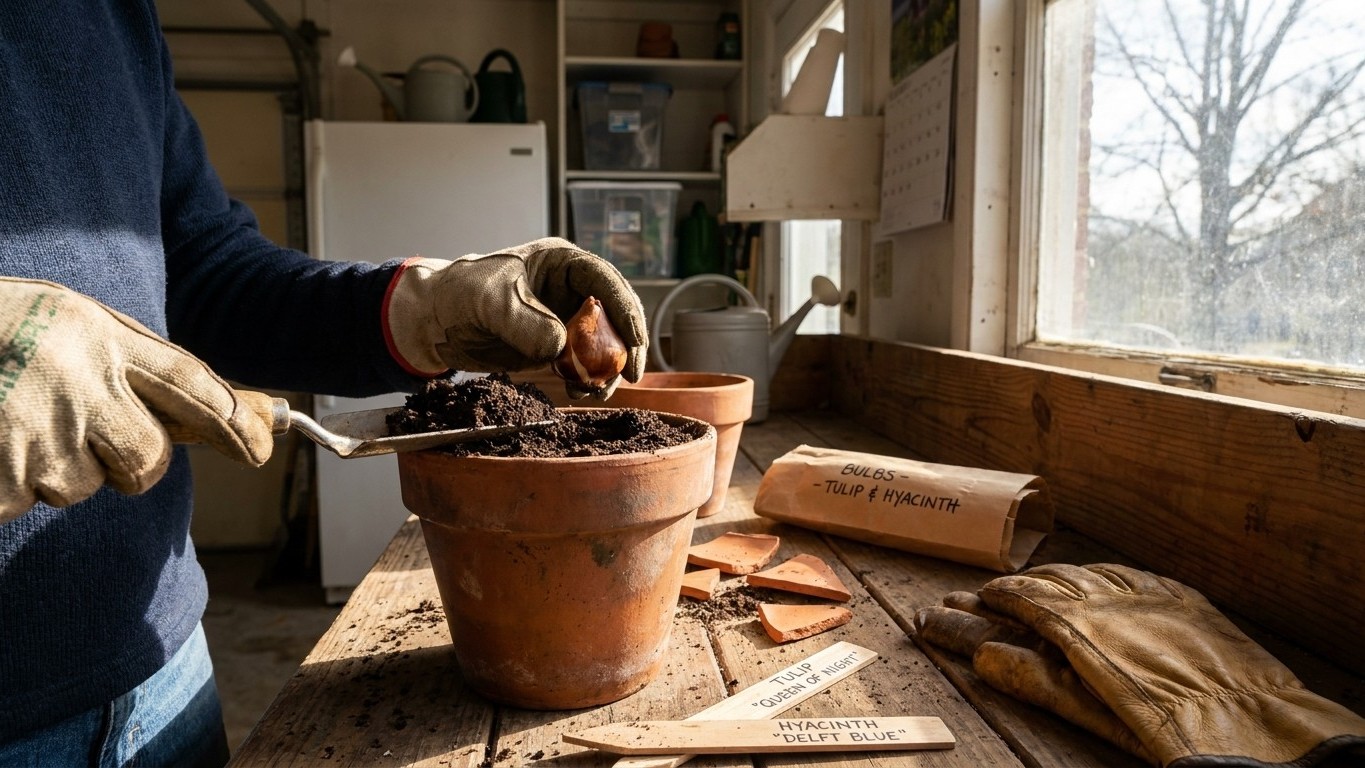

Spring Bulbs in pots work in Georgia, but the mild winters here mean the cold those bulbs need rarely arrives on its own. Forcing, done in a garage or a refrigerator, fills that gap. The container adds a second variable: a pot doesn’t behave like garden soil once temperatures drop, so the same bulb that survives a bed can struggle in a pot unless the gardener manages the difference.
Why this matters in Georgia

The mean daily minimum for the coldest month in the Atlanta area sits at 35.6°F, according to NOAA NCEI’s 1991-2020 climate normals. That number looks cold enough at first glance. It isn’t. A spring bulb like a tulip or hyacinth needs roughly twelve to fourteen weeks of temperatures consistently below 45°F to complete its internal chilling process and set a flower bud. A mean minimum of 35.6°F for one month tells you the coldest overnight lows average just under freezing, but it says nothing about the daytime highs bouncing back into the 50s and 60s the very same week, which is exactly what happens across most of Georgia in a typical winter. That back-and-forth breaks up the sustained chill a bulb is counting on.
This is where the state’s answer diverges from what a gardener in Minnesota or Vermont deals with. USDA places Georgia across hardiness zones 6a through 9b, using the 2023 Plant Hardiness Zone Map built on 1991-2020 averages. That’s a wide range for one state: the far northern mountains sit in 6a, while the coastal south stretches into 9b. But the reference city, Atlanta, lands solidly in the warmer half of that range, and so does most of the state’s population. In warmer zones, winter simply doesn’t deliver the sustained sub-45°F stretch bulbs evolved to expect. That’s the forcing problem, and in Georgia, it’s the dominant one.
Container freeze-through, the issue where a pot’s soil freezes solid from all sides because it has no earth insulating it, is the other classic bulb problem. It’s real in colder states, where an unprotected pot can drop to lethal temperatures overnight while the ground three feet away stays workable. In Georgia, outside that northern 6a pocket, it’s a secondary concern. The coldest-month average minimum staying near 35.6°F means most container soil doesn’t sit at damaging depth-of-freeze temperatures for long stretches. The exception is the mountainous north, where a pot left exposed on a porch through a hard cold snap deserves the same caution a colder-zone gardener would use: treat the container as two zones less hardy than the ground, and either insulate it or bring it in.
How to do it here
Forcing is a sequence, not a single trick, and skipping a step is the most common reason a pot of bulbs produces leaves and nothing else. Here’s the order that matches Georgia’s climate rather than a generic guide written for a colder state.
- Pick bulbs suited to forcing. Buy them in early fall, firm and free of soft spots, since a bulb that’s already begun to dry out won’t rebuild the reserves it needs for a full bloom.
- Pot them at the depth the bulb itself calls for (roughly its own height, tip up), using a container with drainage holes, since standing water in a pot rots a bulb faster than cold ever will.
- Water once after potting, then find twelve to fourteen weeks of cold. An unheated garage that stays above freezing but below 45°F works well for most of the state. A refrigerator crisper drawer works too, provided it’s kept away from apples, pears, or any ripening fruit, since the ethylene gas they release will damage the flower bud forming inside the bulb.
- Check the pot every couple of weeks and water lightly if the soil has dried out. The bulb is dormant, not inactive; it still needs some moisture through the chilling period.
- Watch for the first pale shoots, usually near the end of the chilling window, as the signal that the bulb has banked enough cold.
- Move the pot into bright, cool light first, not straight into a warm, sunny window, so the stem has a chance to grow before the leaves and flower race ahead of it.
- For containers left outdoors over winter in the state’s cooler northern zones, either sink the pot into a mulched trench or move it against a sheltered wall, since a freestanding pot has no soil mass around it to buffer a sudden cold snap.
Which bulbs are worth it
Not every bulb rewards the effort of forcing or the confines of a pot. The ones with a short natural chilling requirement come out of dormancy faster and more predictably, and short, sturdy stems hold up in a container far better than tall, top-heavy ones that lean or snap once they’re in bloom. There’s also a practical angle specific to warmer Georgia zones: tulips in particular rarely rebloom reliably in zone 8a and warmer, since they don’t get the sustained cold they’d need to reset naturally in the ground. If the bulb was never going to come back next year anyway, forcing it once in a pot costs nothing in the long run.
Bulbs that force reliably in containers here
- Crocus, thanks to a shorter chilling requirement and a stem too short to topple
- Hyacinth, which forces predictably and holds its shape well in a pot
- Daffodils and narcissus, especially miniature varieties
- Muscari (grape hyacinth), compact and sturdy
- Paperwhite narcissus, which needs no cold period at all and can be forced straight into a bowl of pebbles and water
Bulbs that tend to sulk
- Tall Darwin and Triumph tulips, which often flop in a pot once the flower opens
- Giant ornamental alliums, top-heavy on a stem a container can’t anchor
- Fritillaria imperialis, which has a reputation for irregular, unreliable forcing
- Tall Dutch iris, prone to leaning once the bloom’s weight sets in
What goes wrong, and when you can still fix it
Leaves, but no flower
This is a chilling problem: the bulb built enough energy to send up foliage but never banked the full twelve to fourteen weeks below 45°F needed to form a flower bud. There’s no fix once the leaves have emerged. The bulb needs to finish its natural cycle, be left to store energy through its leaves, and go through a complete, uninterrupted chilling period next fall.
A flower on a stem too short to see
This usually means the pot was moved into warmth too soon, before the stem had a chance to elongate in cool, bright light. It can’t be corrected once the bloom is already stunted this season. Next time, hold the pot in a cooler spot for a week or two after the shoots appear, before moving it to full warmth and sun.
Rot in the pot
Soft, mushy bulbs or a sour smell in the soil point to drainage failure, not cold damage. Standing water around a dormant bulb through weeks of chilling is enough to break it down before it ever gets the chance to sprout. This one isn’t salvageable this season. For the next attempt, use a container with real drainage holes and a potting mix that doesn’t stay saturated, and check that water is actually running through and out, not just sitting at the bottom.