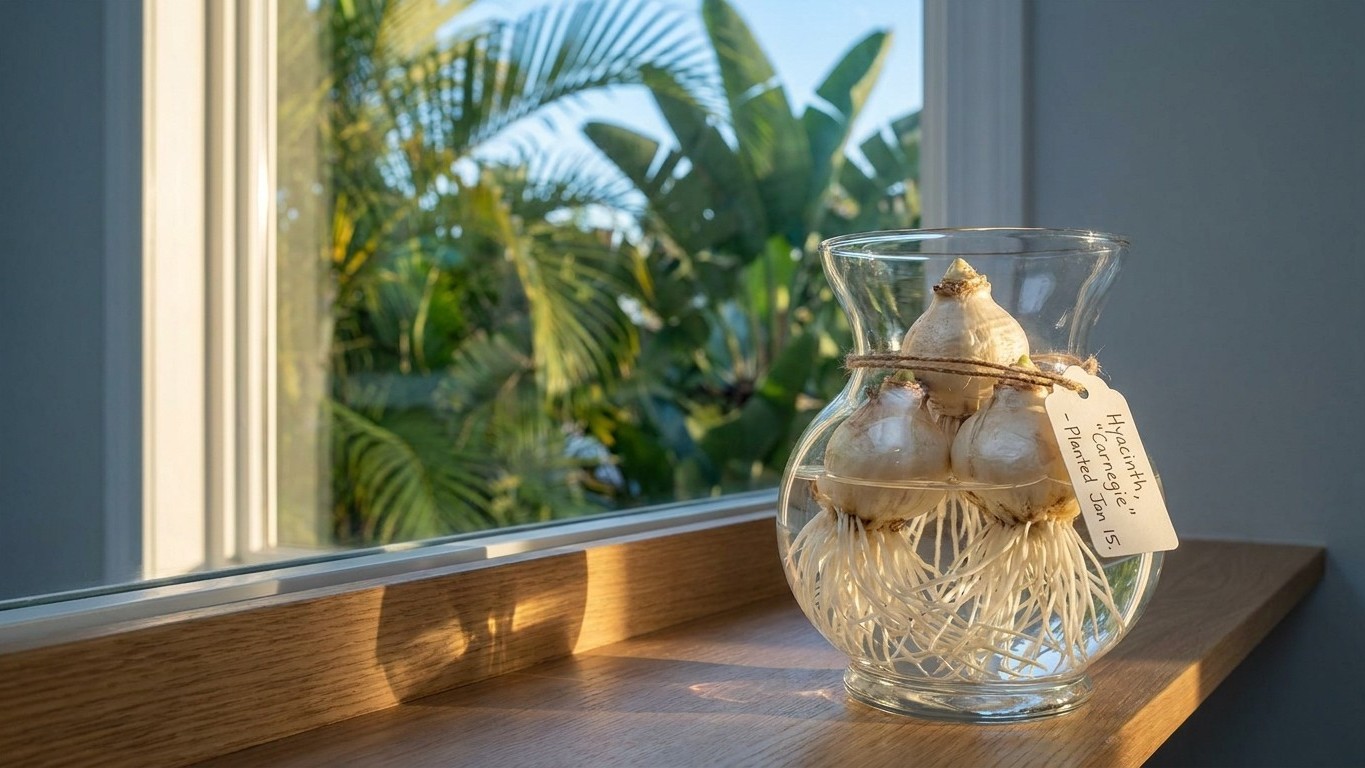

Spring bulbs need weeks of steady cold to set a flower, and Honolulu’s coldest month averages a minimum of 66.8°F, nowhere close. Forcing indoors is how most gardeners in Hawaii get a tulip or hyacinth to bloom at all: chill the bulbs artificially in a refrigerator for the required stretch, then let a pot and some warmth finish the job. Containers here don’t freeze; the real problem is that the climate never supplies the cold in the first place.
Why this matters in Hawaii

A tulip or hyacinth bulb reads temperature the way a thermostat reads a room: below roughly 45°F, it starts the biochemical countdown toward a flower stalk. That countdown needs to run for twelve to fourteen weeks before the bulb will push up anything worth looking at. According to NOAA NCEI Climate Normals for 1991-2020 at the Honolulu reference station, the coldest month of the year still averages a nighttime low of 66.8°F. That’s warmer than a mild spring evening in most of the continental United States. The countdown never starts on its own.
This puts Hawaii squarely in the first of two situations a spring-bulb grower can face. One is a climate where winter arrives but never quite dips into the range the bulb needs, so the gardener supplies the missing weeks in a refrigerator. The other is a climate cold enough to satisfy the bulb in the ground, but where a container freezes clean through, roots and all, because a pot has none of the insulating mass of open soil. Hawaii is the first kind, not the second. Ground here doesn’t freeze, and neither does a pot left outside. The obstacle isn’t surviving cold. It’s finding any.
The USDA Plant Hardiness Zone Map, built on the average annual extreme minimum temperature, places the islands across a striking range, from zone 9a up to 13a. That spread matters more here than almost anywhere else in the country, because a recommendation calibrated to Honolulu’s mild lowland climate says very little about the cooler upper elevations found on the Big Island or in parts of Maui. A gardener working near sea level should treat Honolulu’s number as the working reference and expect zone figures to shift noticeably at higher elevation, even without a separate published figure for those sites here.
None of that changes what forcing has to do. The bulb has no idea it’s on a tropical island. It only knows whether it’s been cold long enough, and in Hawaii the answer, left to nature, is always no.
How to do it here
The mainland trick of stashing bulbs in an unheated garage doesn’t translate to the islands. That method works in colder states because a garage there stays above freezing but still drops well under 45°F through the winter. In Hawaii, ambient air rarely falls into that range even overnight, so a garage is functionally room temperature as far as the bulb is concerned. The refrigerator becomes the only practical cold source, not just the convenient one.
- Order bulbs suited to forcing, since local nurseries typically don’t stock the pre-chilled or spring-blooming varieties in volume. Refrigerate them as soon as they arrive rather than letting them sit at room temperature.
- Store the bulbs loose or in a mesh or paper bag in the refrigerator’s vegetable drawer, kept well away from apples, bananas, or any ripening fruit. Ripening fruit releases ethylene gas, and ethylene damages the flower bud forming inside the bulb long before you ever see a leaf.
- Hold that temperature, typically between 35°F and 45°F, for the full window the bulb requires. Tulips and daffodils generally need twelve to sixteen weeks; hyacinths run closer to ten to twelve; crocus can need anywhere from eight to fifteen. Mark a start date so you’re not guessing later.
- Once the chilling period is complete, pot the bulbs in a well-draining mix, in a container with real drainage holes. In Hawaii’s humidity and rainfall, waterlogged soil is a far greater risk to the bulb than any cold ever was.
- Set the newly potted bulbs somewhere cool and dimly lit indoors for one to two weeks so roots and shoots can establish before the plant is asked to do anything else.
- Move the pot into bright, indirect light as growth appears, avoiding a hot windowsill. A pane of glass under Hawaii’s midday sun can heat the soil far faster than it would in a cooler mainland climate, scorching tender forced growth.
- Expect bloom within roughly two to four weeks of leaving cold storage, once the plant is established in warmth and light.
The usual container rule, that a pot needs to be roughly two hardiness zones tougher than the bulb or else moved and mulched against freezing, simply doesn’t apply here. Nothing in Hawaii is asking the container to survive a freeze. The container’s job is drainage and shade, not insulation.
Which bulbs are worth it
Bulbs with a short chilling requirement force faster and forgive a compressed timeline better than bulbs that need a long, uninterrupted cold spell. Height matters too: a bulb that throws up a tall, top-heavy stem is a poor match for a pot indoors, where there’s no surrounding planting to hold it upright. And because Hawaii’s climate never delivers the winter chill a bulb needs to build next year’s flower, none of these plants are coming back regardless of how they’re handled. Treating them as a one-season purchase isn’t a compromise; it’s simply what they already were.
- Paperwhite narcissus, which need no chilling period at all and are the best-suited bulb for this climate for that reason alone
- Hyacinths, with a relatively short ten-to-twelve-week requirement and a compact, sturdy stem well suited to a pot
- Crocus, small enough that a toppling stem is never an issue, with a chilling window as short as eight weeks
- Standard daffodils, reliable once the full chilling period is respected, though shorter cultivars perform better in containers than tall trumpet types
- Tall Darwin hybrid tulips, which frequently topple in a pot even when the chilling was done correctly
- Ornamental alliums, which demand a long, uninterrupted cold period that’s hard to sustain in a shared refrigerator
- Fritillaria imperialis, notoriously temperamental about both chilling length and pot drainage, with a rot rate that discourages first-time growers
What goes wrong, and when you can still fix it
Leaves but no flower
Plenty of green growth with no bud forming almost always means the cold period ran short, whether the fridge door was opened too often, the bulbs got pulled early, or the storage temperature crept above the 45°F threshold. There’s no rescuing this season’s display. The fix is procedural: track the start date next time and hold the full chilling window without interruption.
Short stem, flower hidden in the foliage
A bloom that opens low and half-buried in leaves usually means the bulb was warmed too quickly after coming out of the cold, jumping straight from the refrigerator to a bright, hot window. This flower won’t stretch out after the fact. Next time, give the bulb that one-to-two-week stint in cool, dim light before moving it into bright warmth.
Rot at the base of the bulb
A bulb that’s gone soft or mushy at the base almost always points to standing water, either from a container without drainage holes or a mix that stays soggy in Hawaii’s humidity. That bulb is not salvageable this season. The container itself is fine to reuse, just pair it with a mix and drainage setup that lets water move through rather than pool.