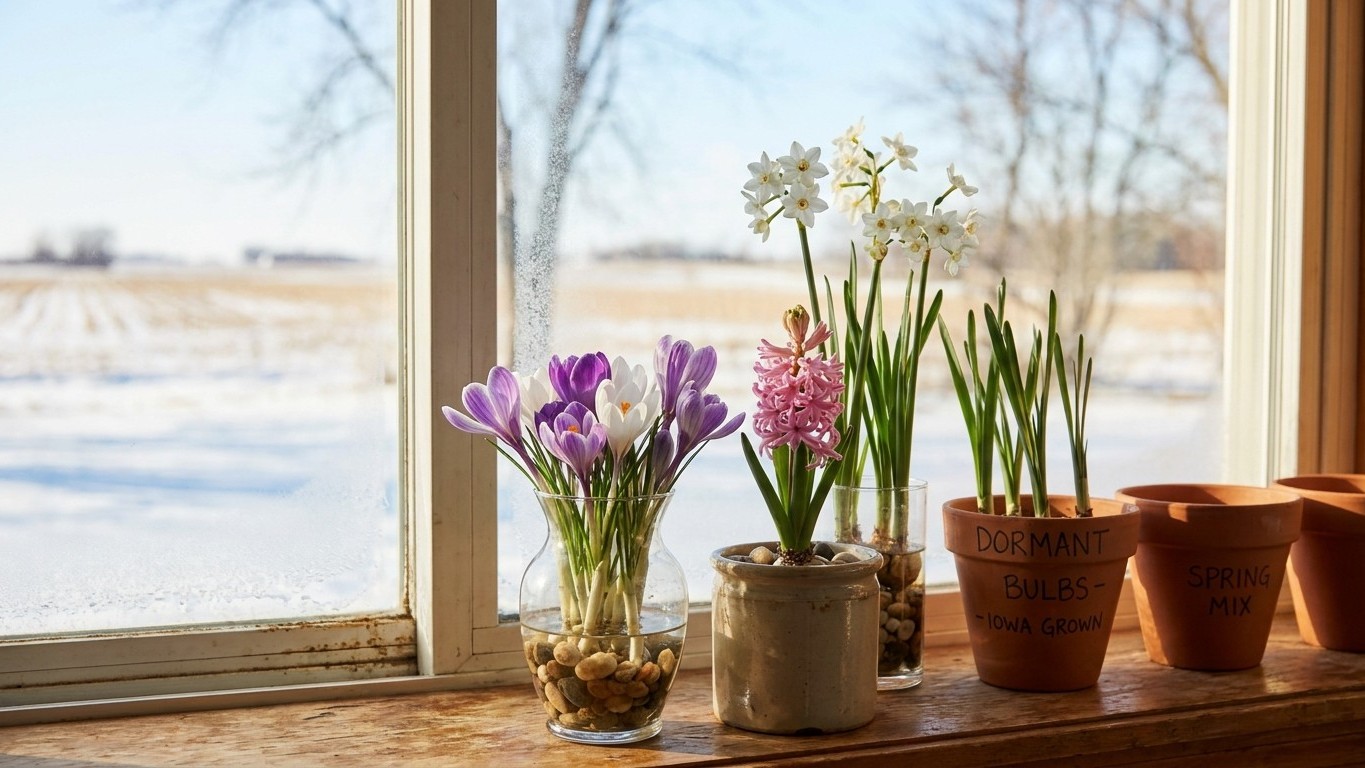

Yes, forcing spring bulbs indoors works reliably in Iowa, and the state’s hard winters actually make it a smart trick rather than a gamble. Crocus, hyacinth, and paperwhite narcissus take well to the process. Tall daffodils and Darwin tulips are the ones that usually disappoint on a windowsill.
Why this matters in Iowa

Des Moines’ coldest month averages a minimum of 13.8°F, according to NOAA NCEI Climate Normals for 1991-2020. That number sits far below the 45°F ceiling a spring bulb needs to break winter dormancy, which means Iowa isn’t short on cold. If anything, it has more than any bulb requires. The USDA Plant Hardiness Zone Map (2023, built on 1991-2020 normals) places the state across zones 4b to 6a, with Des Moines as a reasonable reference point and other parts of the state running colder or milder.
That changes the whole calculation. In places where winter never gets cold enough, forcing bulbs indoors means manufacturing chill from nothing, usually with a refrigerator running for months. Iowa doesn’t have that problem. An unheated garage here will do the job on its own, no compressor required. The real complication shows up with containers, not cold. A garden bed freezes only at the surface, insulated by the soil mass below. A pot sitting outside has no such buffer. It freezes clear through, roots and all, at temperatures the same bulb would shrug off in open ground.
That’s the situation Iowa gardeners are actually in: cold in generous supply, but a container problem layered on top of it. A hyacinth rated hardy to zone 5 can die in a pot left on a porch through a Des Moines winter, even though the identical bulb would sail through in a garden bed two feet away. The fix isn’t more cold. It’s controlling where that cold reaches the bulb, and that’s the whole logic behind forcing bulbs indoors here: not creating chill, but timing and containing it.
How to do it here
The process is mechanical, not mysterious, and every step can be checked with a thermometer instead of a guess.
- Pot the bulbs in fall in a well-draining mix, in a container with a drainage hole, setting the bulb so it doesn’t sit directly against that hole.
- Move the pot to a space that holds steadily between 35°F and 45°F. An unheated Iowa garage usually settles into that range through the coldest stretch of winter, unlike a bare pot left outdoors, which tracks closer to that 13.8°F average minimum and can freeze the root ball solid.
- If no garage or similarly cold, frost-free space is available, use a refrigerator’s vegetable drawer instead, kept well away from apples, pears, or bananas. Ripening fruit gives off ethylene gas, and that gas kills the flower bud forming inside the bulb before it ever gets a chance to bloom.
- Leave the pot chilling for 12 to 14 weeks, depending on the species, checking the soil every few weeks so it doesn’t dry out completely during that stretch.
- For a container that has to stay outdoors rather than in a garage or refrigerator, treat it as needing protection two USDA zones milder than the bulb’s own rating, or move it against a house foundation and bury it in mulch. Given Iowa’s 13.8°F coldest-month minimum, an unprotected pot left exposed doesn’t get the insulation a garden bed provides, and that’s the gap that kills bulbs a hardiness zone map would otherwise call safe.
- Once the chilling window closes, bring the pot into bright but cool indoor conditions, around 60°F to 65°F, for one to two weeks before moving it to a warmer, sunnier spot to finish blooming.
Which bulbs are worth it
Not every bulb rewards the effort equally, and the difference usually comes down to two things: how long a chill period the species demands, and how tall its stem grows once it’s forced. A short chilling requirement means faster results and less time tying up refrigerator or garage space. A short stem also means the flower stands up in a lightweight pot instead of flopping over the rim.
Bulbs that are already treated as one-season purchases in Iowa gardens, tulips especially, cost nothing extra by being forced. They were unlikely to perform a strong second year outdoors anyway, so using them up in a pot indoors isn’t really a loss.
- Crocus
- Hyacinth
- Paperwhite narcissus
- Dwarf iris (Iris reticulata)
- Grape hyacinth (Muscari)
These share short chilling windows and compact growth, which keeps them upright without staking and gets them to bloom sooner than the alternatives below.
- Large trumpet daffodils
- Darwin hybrid and other tall tulip types
- Fritillaria
The tall daffodils and tulips need long chilling periods and grow tall enough that they lean or topple in a standard pot without support. Fritillaria has a reputation for rotting in containers before it ever gets the chance to bloom, which ties directly into the drainage problem covered next.
What goes wrong, and when you can still fix it
Leaves but no flower
This means the chilling period ran short. The flower bud inside the bulb needs the full 12 to 14 weeks below 45°F to finish developing before it’s ever exposed to warmth and light. Cut that short and the bulb sends up green growth with nothing behind it. There’s no fixing it this season. The bulb can be planted out in the garden this fall to try again on nature’s own schedule, but this round of forcing is over.
A flower on a stem too short to see
The bulb was warmed too fast after coming out of the cold. Skipping the cool transitional stage and moving straight into a warm, bright room forces the flower to open before the stem has had time to elongate. Nothing rescues that stunted bloom this season. Next time, hold the pot at 60°F to 65°F for the full one to two weeks before moving it into full warmth.
Rot in a pot
Mushy bulbs and a sour smell point to standing water, usually from a container without adequate drainage or a mix that stays soggy. This one isn’t recoverable at any point in the season. The bulb is finished. The fix is entirely forward-looking: a pot with a real drainage hole, a gritty, fast-draining mix, and watering only when the top inch of soil has dried out.