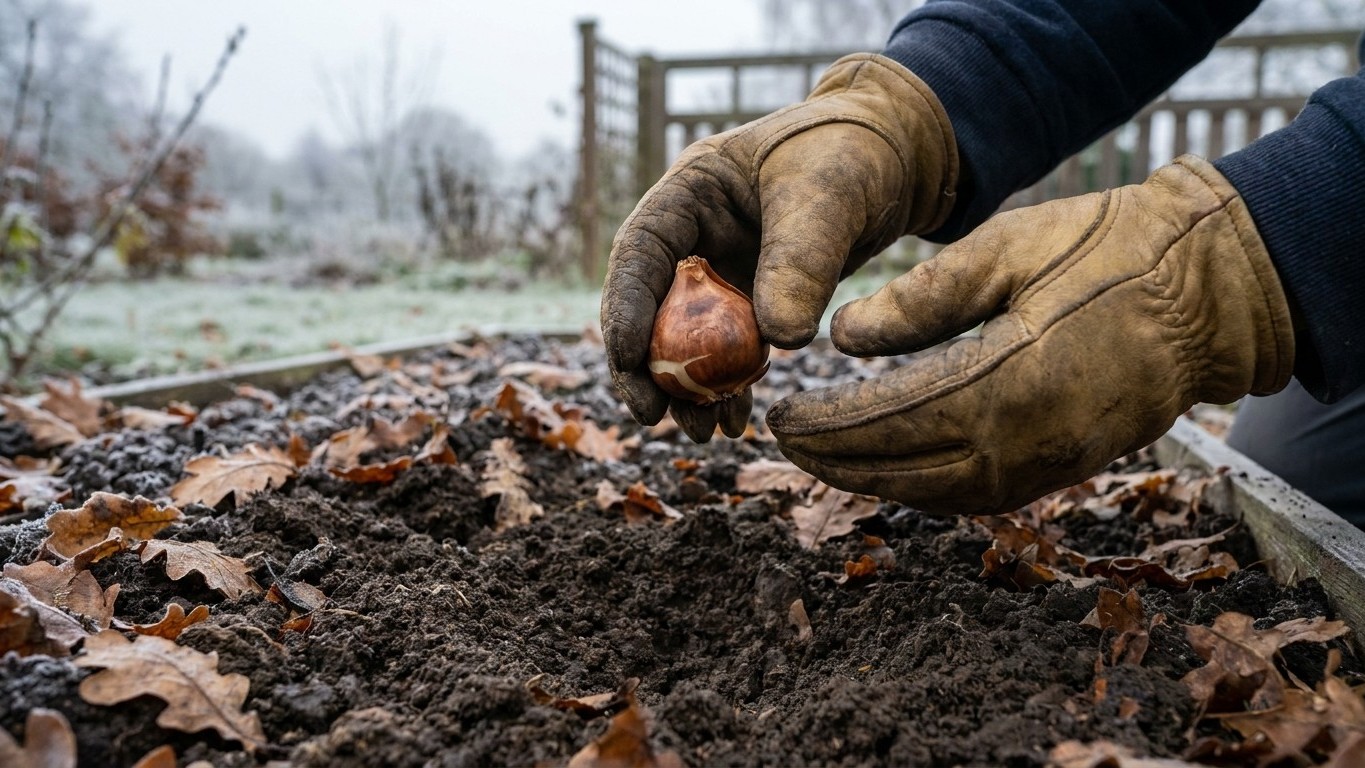

Iowa’s winters are cold enough to satisfy nearly every spring bulb sold at garden centers, but timing and rodent pressure still trip people up. The short answer: tulips, daffodils, crocus, and hyacinths all get the cold they need here without any extra work, whether planted directly in the ground or, as covered in this guide to Growing Spring Bulbs in Containers in Iowa, grown in pots on a porch or patio, while a handful of tender corms sold in the same bins simply cannot survive an Iowa winter and should never go in the ground unprotected.
When to plant bulbs in Iowa

The planting window opens around the first fall frost and closes roughly six weeks later, once the soil locks up hard. Across Iowa, that first frost lands somewhere between October 14 and October 25, based on 1991-2020 climate normals from the Des Moines airport station. Iowa State University Extension’s county-level records, built on a longer 1950-2021 dataset, tend to show that same fall freeze arriving about 10 days earlier than the airport figures. Treat the airport dates as the optimistic end of the range, not the rule for every county.
That gives a practical planting window running from roughly early-to-mid October through the last half of November for most of the state, with northern counties starting and ending earlier than that.
Both ends of the window punish the wrong choice. Plant too early, while the soil is still warm from summer, and the bulb pushes top growth before winter arrives. That green growth freezes back, and the bulb spends its stored energy recovering instead of building next spring’s flower. Plant too late, after the ground has already gone hard, and the bulb never gets the six to eight weeks of root growth it needs before freeze-up. A bulb that goes in without rooting either comes up weak and short the following spring or doesn’t come up at all.
An average is not a promise
The October 14-25 window is an average drawn from three decades of data, which means roughly half of all years fall on the early side of it and half fall late. A frost that arrives October 8 instead of October 20 catches a lot of gardeners who planned around the calendar instead of the thermometer. Watch the soil, not just the date: once daytime highs settle into the 40s and 50s for a stretch, the window is open.
Whether your winter is cold enough
Every spring bulb needs a long stretch of cold before it will flower. Most varieties require somewhere between twelve and fourteen weeks with soil temperatures below about 45F. Skip that requirement, and the bulb typically produces leaves with no flower at all, or a bloom stalk so short it never clears the foliage. This figure is the one number that matters more than any other when judging whether a bulb belongs in your yard, whether you garden in Iowa or anywhere else, and it’s the same chilling period gardeners have to replicate artificially when Forcing Spring Bulbs Indoors in Iowa for winter blooms.
Iowa doesn’t just meet that requirement, it clears it with room to spare. The coldest month at the Des Moines reference station has a mean daily minimum of 13.8F, which is a measure of how cold nights typically run in January, not a record low or a monthly average. Soil temperatures in central Iowa routinely sit below 45F from mid-November through March, a stretch closer to sixteen to eighteen weeks. That margin is what lets Iowa gardeners plant almost any spring bulb sold in a big-box bin without ever thinking about pre-chilling.
Gardeners in warmer states have to buy pre-chilled bulbs or refrigerate them themselves, twelve weeks minimum, kept away from ripening fruit because the ethylene gas fruit gives off kills the flower bud sitting inside the bulb. That entire step is unnecessary in Iowa. The state’s native cold does the work.
| Bulb | Weeks of chill required | What Iowa delivers | Verdict |
|---|---|---|---|
| Tulip | 12-16 weeks below 45F | ~16-18 weeks below 45F | Clears easily, no pre-chill needed |
| Daffodil / Narcissus | 12-14 weeks below 45F | ~16-18 weeks below 45F | Clears easily, no pre-chill needed |
| Hyacinth | 12-14 weeks below 45F | ~16-18 weeks below 45F | Clears easily, no pre-chill needed |
| Crocus | 8-15 weeks below 45F | ~16-18 weeks below 45F | Clears easily, no pre-chill needed |
| Allium | 8-10 weeks below 45F | ~16-18 weeks below 45F | Clears easily, no pre-chill needed |
The margin buys more than convenience. It means a gardener here can pick from the full commercial catalog of hardy spring bulbs without checking chill hours item by item. Where the story changes is hardiness range, not cold quantity, which is the subject of the next section.
Which bulbs suit Iowa
Iowa sits in USDA hardiness zones 4b through 6a, a range built entirely on the average annual extreme minimum temperature. Bulbs whose published hardiness range covers that band are the ones worth planting.
- Tulip — hardy zones 3-8
- Daffodil / Narcissus — hardy zones 3-8
- Crocus — hardy zones 3-8
- Hyacinth — hardy zones 4-8
- Grape hyacinth (Muscari) — hardy zones 3-8
- Snowdrop (Galanthus) — hardy zones 3-7
- Allium — hardy zones 3-9, depending on species
None of those ranges are a hard line. A tulip bed tucked against a south-facing foundation in zone 4b country often outperforms the same bulbs planted in an open, wind-scoured field a few miles away, because the building holds soil heat the open field never sees.
What disappoints here
Some bulbs sold in the same nursery aisle simply don’t belong in Iowa soil. Ranunculus is rated for zones 8-10 and rots in an Iowa winter rather than surviving it; treat it as a spring-planted, fall-lifted bulb instead. Freesia and Ixia, both zones 9-10, fail the same way. Anemone blanda, rated zones 5-8, sits right at the edge of Iowa’s range and is a coin flip in the colder northern counties without heavy mulch protection; a gardener who plants it unprotected in zone 4b territory often loses it by the second winter, even after a strong first-year show.
What digs them up here
Squirrels and voles don’t raid bulb beds at random. The bulbs they take and the ones they leave alone come down to chemistry, not luck. Daffodils, alliums, and anything else in the onion family contain compounds that make them bitter or mildly toxic, so rodents learn to avoid them fast. Tulips and crocus contain none of that chemical defense, which is exactly why they’re the bulbs most often found half-eaten or missing entirely by spring.
- Bulbs squirrels and voles take: tulips, crocus, true lilies
- Bulbs they leave alone: daffodils/narcissus, alliums, snowdrops, hyacinths, fritillaria
The one method that consistently works is physical, not chemical: lay a sheet of galvanized wire mesh directly over the planting bed and pin it down until the ground freezes hard. Rodents can’t dig through it, and once the ground locks up, the digging season is over anyway. Repellent sprays and granules get pitched as an easier fix, but they wash off with the first rain or heavy dew, and most need reapplying every week or two through the entire fall planting window, which makes them a lot more work than a $15 roll of mesh.
Where to check for your own county
Iowa runs across two full USDA hardiness zones, from 4b in the north to 6a along the southern border, and the frost dates and chill figures above describe the Des Moines airport station specifically. A planting window built around the state capital can run three weeks off in either direction once you’re up near the Minnesota line or down along the Missouri border.
Iowa State University Extension and Outreach maintains county-specific planting and frost data that accounts for that spread, and it’s worth a look before locking in a date. Find the service at extension.iastate.edu and search for the local county office, which will have horticulture staff who can confirm both the average frost date and any local wrinkles, like heavy clay soils that hold cold longer than the loam the state averages are built on.