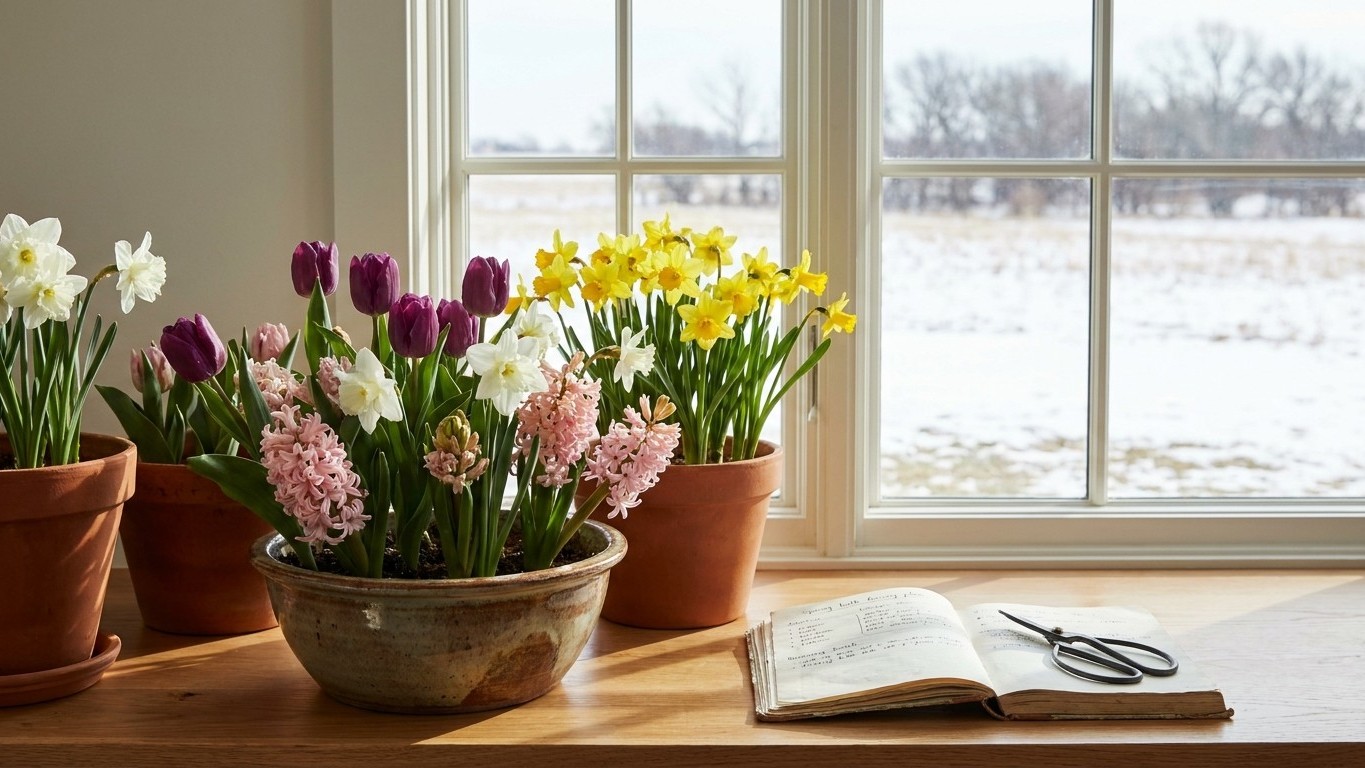

In Kansas, the ground already delivers all the cold a spring bulb needs to bloom on its own outdoors. Forcing indoors here is not about substituting for a winter that falls short, it is about pulling blooms into January and February on your own schedule, and about keeping a bulb alive in a pot when the ground itself would have protected it.
Why this matters in Kansas

The mean daily minimum of the coldest month at the Wichita reference station runs 22.5°F, according to NOAA NCEI Climate Normals for 1991-2020. That number matters because it settles a question before you even start: does this state need help supplying winter chill, or does it have the opposite problem? A tulip or hyacinth needs roughly twelve to fourteen weeks below 45°F to set a flower bud. At 22.5°F for a coldest-month average low, Kansas ground clears that bar with room to spare. Bulbs planted in a garden bed here get all the chilling they require from the soil itself, no refrigerator or garage required.
That reframes what forcing indoors is actually for in this state. It is not a workaround for a mild winter, the way it would be in the Gulf Coast or coastal California. It is a way to move bloom time earlier than the calendar would otherwise allow, and it is a defense against a different hazard: the container itself. Garden soil freezes from the top down, and even in a hard winter the frost line rarely reaches the depth where a planted bulb sits. A pot has no such buffer. Once air temperatures drop into the range Kansas sees routinely in January, a container above ground freezes clear through, roots, bulb, and all, because there is no surrounding earth to slow the cold.
The USDA Plant Hardiness Zone Map, using 1991-2020 normals, places Kansas across a 5b-7a range. That span is built on the average annual extreme minimum temperature, and it varies enough across the state that a bulb rated hardy for the coldest corner of Kansas can still die in a pot in a milder corner, simply because the pot offers no insulation. So the real fork in this state is not “does winter give enough cold.” It does. The fork is whether the bulb is going into the ground, where that cold arrives gradually and stays moderate, or into a container, where the same air temperature hits the bulb directly and without mercy.
How to do it here
Forcing indoors follows a fixed sequence, and every step should be something you can check yourself with a thermometer or your own eyes, not something you take on faith.
- Pot the bulbs in fall, using a container with drainage holes and fresh, well-draining potting mix. Set the bulbs close together, shoulders just below the soil surface, and water once to settle the mix.
- Move the pot to a cold location for twelve to fourteen weeks, keeping it consistently below 45°F but above freezing. An unheated garage works only if you have verified with a thermometer that it stays above 32°F through the coldest nights; in a Kansas winter, an attached garage usually holds that range better than a detached one. A refrigerator crisper drawer is the more reliable option, but keep it away from ripening fruit, since the ethylene gas fruit releases will damage the flower bud forming inside the bulb.
- Check the soil weekly and water lightly whenever it starts to dry. It should stay barely moist, never soggy, for the entire cold period.
- Watch for root and shoot growth. Most bulbs are ready to come out of the cold once you see roots pressing against the drainage holes and pale shoots an inch or two tall.
- Bring the pot into a cool, dim room, around 60°F, for about a week before moving it into full light. This step lets the stem green up gradually instead of bleaching or stalling.
- Move to bright light and normal room temperature once the shoots have greened. Bloom typically follows within two to three weeks.
If the plan is to leave a potted bulb outdoors through winter instead of chilling it indoors, the container needs to be rated at least two USDA zones hardier than the bulb itself, since the pot offers none of the insulation garden soil does. Short of that, the safer move is to sink the pot into a mulched trench or move it into an unheated but frost-buffered space once temperatures start running consistently in the 20s.
Which bulbs are worth it
Not every bulb rewards the extra handling, and the difference usually comes down to how long a cold period the plant demands and how tall it grows once forced. A bulb with a short chilling requirement finishes faster and fits a shorter indoor timeline. A bulb that throws up a tall, top-heavy stem is more likely to flop over in a lightweight pot than the same plant would in open ground, where surrounding soil and other stems hold it upright.
Bulbs bought specifically for forcing are also usually a one-season purchase anyway, spent by the forcing process and unlikely to rebloom well if planted outdoors afterward. That makes the cost-benefit simple: if the bulb was never going somewhere in the yard, forcing it loses nothing.
- Paperwhite narcissus (needs no cold period at all, blooms in three to four weeks from potting)
- Hyacinth (short chilling window, sturdy stem, strong scent)
- Crocus (short stem, rarely topples, quick to finish once chilled)
- Grape hyacinth, or muscari (compact and reliable in a shallow pot)
- Trumpet daffodils (long chilling requirement, tall stems that lean toward the window)
- Late-season tall tulip varieties (top-heavy once in bloom, prone to toppling in lightweight pots)
- Alliums (long stems, inconsistent bloom after forcing)
What goes wrong, and when you can still fix it
Leaves but no flower
This means the cold period ran short of what the bulb needed, so the flower bud inside never fully formed even though the leaf tissue did. There is no fix for this season’s bulb. Planting it outdoors in the garden afterward can let it rebuild strength over a year or two of natural seasons, but it will not produce a flower indoors after the fact.
Short stem, flower hidden in the foliage
This happens when the pot was moved into full light and warmth too fast, skipping the gradual greening step, or when it sat in a room too warm during that transition. The stem stops elongating before the flower clears the leaves. This bloom cannot be recovered once it has opened. The fix applies to the next batch: hold the pot in a cooler, dimmer room for the full week before moving it to bright light.
Rot in the pot
Soft, discolored bulbs during or after the cold period almost always trace back to drainage. A pot without holes, or one sitting in a saucer that held standing water through the chilling weeks, keeps the bulb wet enough for fungal rot to take hold. A rotted bulb will not recover this season or any other. Prevention is the only real fix: drainage holes, a mix that drains freely, and a saucer emptied after every watering.