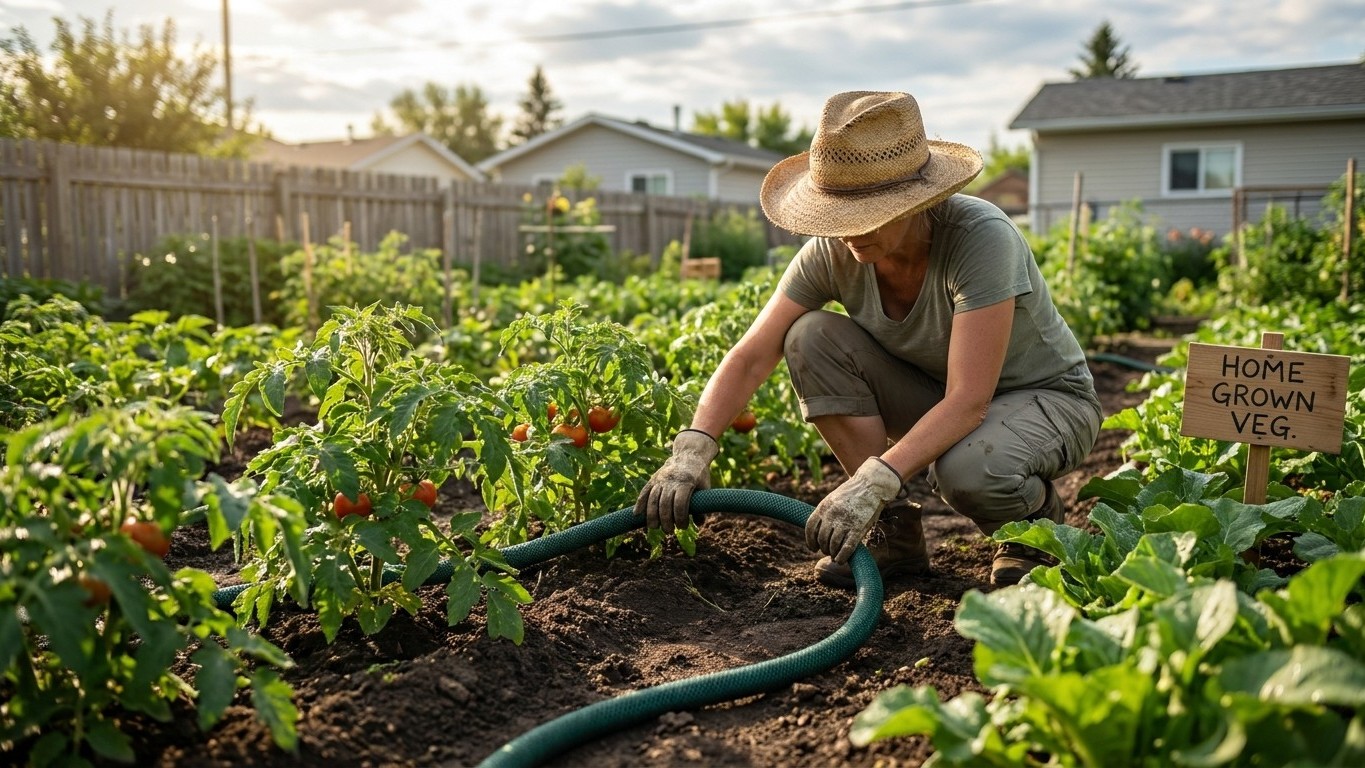

Manitoba’s driest summer month, August, still delivers 3.03 inches of rain on average, and the reference station records 0.0 days a year reaching 90 degrees F. That combination means a garden here rarely fights heat stress, but it still needs a hand from the hose to close the gap between what falls and what a bed actually wants.
What changes here

Start with the two numbers that matter most for a Manitoba gardener: 3.03 inches of rain in August, the driest of the three summer months, and 0.0 days a year at or above 90 degrees F at the Winnipeg reference station. Read together, they say something a gardener can act on right away: rain is fairly steady even in the leanest month, and the punishing evaporation that comes with repeated 90-degree days simply isn’t part of the local pattern.
A vegetable bed or a perennial border generally wants about an inch of water a week. Spread August’s 3.03 inches evenly across the month’s roughly 4.4 weeks, and the sky supplies about 0.68 inch a week on its own. That leaves close to 0.32 inch a week for the gardener to carry by hand, soaker hose, or sprinkler to reach that one-inch benchmark.
| Month | Average rainfall |
|---|---|
| June | 3.54 inches |
| July | 3.13 inches |
| August | 3.03 inches |
Notice that even June and July, both wetter than August, still leave a shortfall against the one-inch weekly target once you divide the month into weeks. What keeps Manitoba gardens from struggling the way hotter states do is the second figure: with 0.0 days a year hitting 90 degrees F, whatever moisture is in the soil isn’t being pulled back out by relentless heat. A third of an inch a week is a modest gap to close, and it stays closed longer here than in a territory where afternoons routinely bake the topsoil.
These are normals from the 1981-2010 period at the Winnipeg Richardson International Airport station, not a forecast and not a reading of any particular yard. A slope, a windbreak, or a low spot on the property can shift things noticeably. A simple rain gauge on the actual bed is what turns these averages into a real watering decision.
How to water when it matters
The method that works on this ground is deep, infrequent watering, delivered at the base of the plant, done in the morning. Deep watering pushes moisture down where roots can follow it, rather than leaving a shallow wet layer that roots never bother to grow past. Infrequent watering forces those roots to stretch downward looking for moisture, which builds a plant that tolerates the next dry stretch better. Watering at the base keeps leaves dry, and morning watering gives the day’s mild warmth a chance to dry any splashed foliage before evening, when damp leaves overnight invite fungal trouble.
Checking the soil at root depth matters more than checking the surface. The top half-inch can look bone dry an hour after a storm while the zone where roots actually feed stays damp, or the reverse: a crusted, sun-baked surface can hide moisture just below. A finger pushed two inches down, or a trowel pulled up for a quick look, settles the question in seconds.
Here’s a sequence to start from, adjusted against your own soil as you go:
- Push a finger or trowel two inches into the bed before watering; if it’s dry at that depth, proceed.
- Water deeply enough to add roughly 0.32 inch, the average weekly gap left after August’s typical rainfall, which works out to about two gallons for every ten square feet of bed.
- Apply that water at the base of each plant with a soaker hose, drip line, or watering can, avoiding the leaves.
- Do this in the morning, so any incidental moisture on stems or nearby leaves dries out during the day.
- On sandy soil, split that same amount into shorter, more frequent soakings, since sand drains fast and holds little; on heavy clay, one deeper soaking can often carry the bed for most of the week, since clay holds water far longer.
That 0.32-inch figure is a starting point built from the regional average, not a rule for every yard. A raised bed with sandy fill and a clay-heavy garden three miles away will behave differently even under the same August sky, so the finger test each time is what actually decides whether to water.
What goes wrong
A daily sprinkle
Running the hose for a few minutes every evening feels responsible, but it wets only the top inch or so of soil. Roots follow the moisture, which means they stay shallow and close to the surface. On the rare Manitoba day that does climb into real heat, those shallow roots have nowhere to go and the plant wilts fast, even though deeper soil nearby is perfectly moist.
Watering the leaves at night
An evening pass with a sprinkler leaves foliage wet for hours with no sun to dry it. Even without frequent 90-degree heat, Manitoba’s summer humidity from steady monthly rainfall is enough to support powdery mildew and other fungal problems once leaves stay damp overnight.
Trusting the last rain shower
A summer thunderstorm can drop a good share of August’s 3.03-inch monthly total in under an hour, and most of that water runs off a dry, crusted surface rather than soaking in. The rain gauge might read half an inch while the soil two inches down is still dust. The only way to know is the finger test, not the memory of a storm passing through.
Skipping the mulch
With almost no days above 90 degrees F, it’s tempting to think mulch is optional here. But the weekly margin a gardener is working with, roughly a third of an inch, is thin enough that bare soil left in open sun and wind gives that moisture back within a day or two. A two- to three-inch layer of mulch protects exactly the margin the climate normals show is already tight.
Drowning a bed that never dried
Because Manitoba’s summer rain is fairly reliable, the opposite mistake shows up too: watering on schedule regardless of what the soil is doing. On clay ground that holds a week’s worth of moisture, adding more before the trowel test shows it’s dried out saturates the root zone and starves roots of oxygen. In a wetter-than-average summer, skipping a scheduled watering after checking the soil is often the right call.
Local help
Manitoba Agriculture is the province’s extension service and a good source for local growing guidance. Watering restrictions vary by municipality and water district, and they change with conditions, so check with the local water utility or town office for current rules before setting an outdoor watering schedule.
Common questions
How often should I water a Manitoba garden in August?
Check the soil two inches down before watering rather than following a fixed calendar. As a starting point, one deep soaking adding about a third of an inch every few days covers the typical shortfall left after August’s average 3.03 inches of rain, adjusted for how fast your particular soil drains.
Do Manitoba gardens really face heat stress?
The reference station shows 0.0 days a year reaching 90 degrees F, so extreme evaporation from heat isn’t the main driver of watering needs here the way it is in hotter states. Watering decisions rest more on the modest rainfall gap than on heat stress.
Is morning or evening better for watering?
Morning. It gives the day’s warmth time to dry any moisture on leaves and stems, cutting the risk of fungal disease that comes with damp foliage sitting overnight.
Can I skip watering after a rainstorm?
Only if the soil two inches down is actually moist. A hard summer storm can run off a dry surface without soaking in, so check with a finger or trowel rather than assuming the rain gauge total tells the whole story.