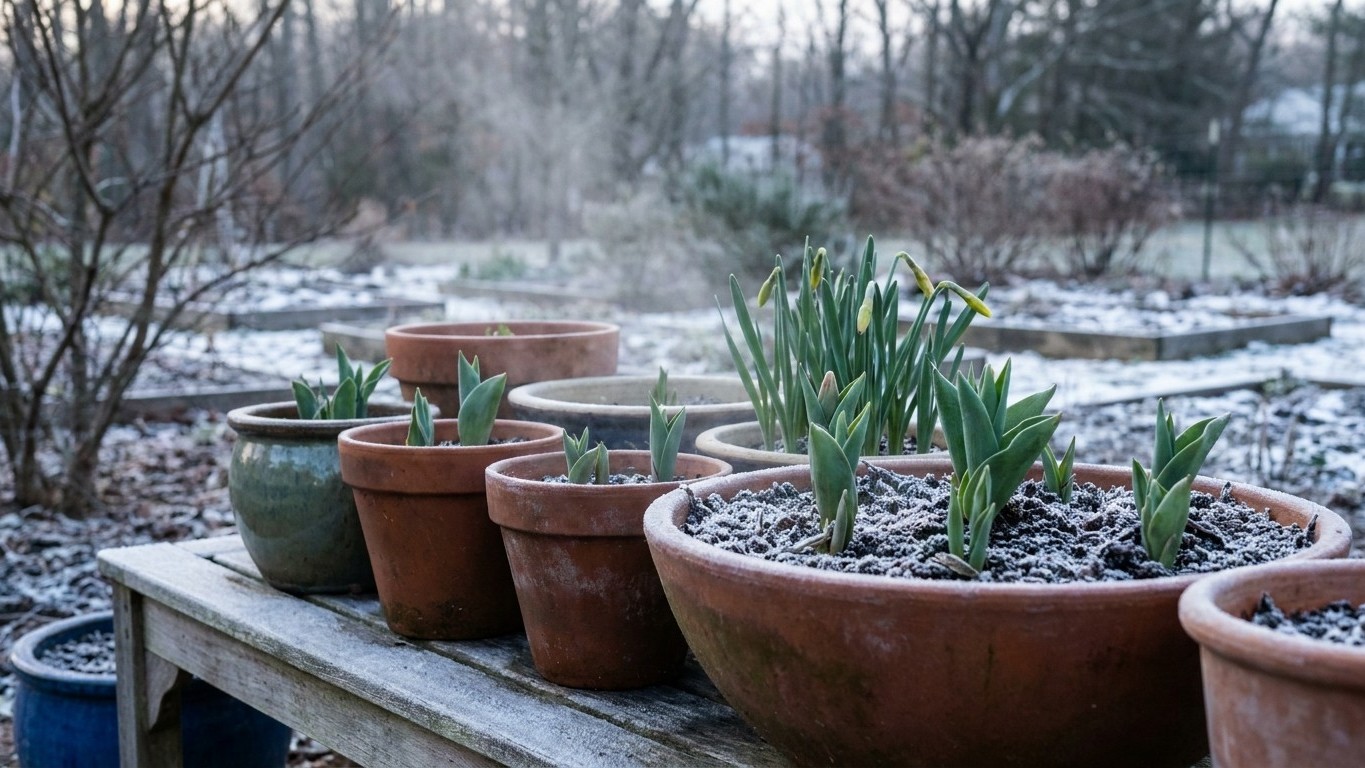

Maryland’s winter already delivers more cold than any spring bulb needs to bloom on schedule in the ground, so the real project here is not tricking dormant bulbs into flowering early. It’s keeping bulbs in pots alive through a freeze that reaches every inch of soil in the container, roots included.
Why this matters in Maryland

Baltimore’s coldest month averages a daily minimum of 25.4°F, according to NOAA NCEI Climate Normals for 1991-2020. That number matters because a spring bulb needs roughly twelve to fourteen weeks below 45°F to break dormancy and flower properly. At 25.4°F for the coldest month alone, Maryland soil sits far under that ceiling for most of the winter. The chilling a tulip or daffodil needs, it gets for free, outdoors, in the ground.
That changes the whole calculation. Forcing, the practice of chilling bulbs artificially in a refrigerator or garage to bloom them ahead of the outdoor season, is not a rescue operation in this state. Nobody in Maryland needs to force a daffodil bulb just to get it to flower at all. Forcing here is a scheduling trick, a way to have blooms on a windowsill in late winter while the garden is still bare, not a workaround for a winter that fails to deliver cold.
Containers are a separate problem, and a bigger one for anyone planning to leave pots outdoors all winter. Garden soil freezes from the top down, and a few inches under the surface the ground stays buffered, often well above the air temperature on a given night. A container has no such buffer. Once the pot’s walls chill through, the whole root ball is exposed to something close to air temperature, on every side. A bulb rated hardy for a Maryland garden bed can die in a pot in that same yard, because the pot never got the insulation the ground provided.
The USDA Plant Hardiness Zone Map (2023 edition, built on 1991-2020 normals) puts Maryland across a wide band, from zone 5b to zone 8a. That’s an unusually broad range for one state, reflecting everything from the cooler western counties to the milder Chesapeake shoreline. A hardiness rating that works for a bulb bed in one part of the state can be several zones off for a container in another part, which is exactly why the pot, not the ZIP code, has to be the starting point for any decision about leaving bulbs outside all winter.
So the situation Maryland gardeners are actually in is the second one: container hardiness math, not a shortage of natural cold. Forcing is worth doing if the goal is an early indoor bloom. Protecting a potted bulb through winter is worth doing if the goal is a container that survives to flower on its own schedule outside.
How to do it here
Whether the goal is an indoor bloom ahead of schedule or a container left outdoors, the steps are checkable and don’t require guessing at temperatures the gardener can’t verify.
- Confirm the cold requirement first. Most spring bulbs need twelve to fourteen weeks below 45°F before they’ll flower. That’s the number to plan a chilling period, or an outdoor exposure period, around.
- Pick a cold space that stays above freezing. An unheated garage that doesn’t drop below 32°F works for chilling potted bulbs indoors. A refrigerator crisper drawer works too, but it has to be kept away from ripening apples, pears, or other fruit: the ethylene gas they give off will kill the flower bud forming inside the bulb, even though the bulb looks fine from the outside.
- Pot the bulbs before chilling begins, using a container with a drainage hole, so the twelve-to-fourteen-week clock and the rooting process run together instead of one after the other.
- Decide the container’s fate for winter. If it’s staying outdoors, the pot needs to be rated at least two hardiness zones colder than the bulb’s own rating, since the pot offers none of the insulation garden soil does.
- If the pot isn’t rated that cold, move it or insulate it. Push the container against a foundation wall on the sheltered side of the house, group several pots together so they buffer each other, or bury the pot to its rim in a vacant garden bed and mulch over the top with several inches of straw or shredded leaves.
- Check moisture through the cold months. A dormant bulb still needs slightly damp, never soggy, soil. A pot that dries out completely in an unheated garage will shrivel the bulb before it ever gets to bloom.
- Bring forced bulbs into warmth gradually. A move straight from a 35°F garage to a heated living room rushes the stem and produces a short, floppy bloom instead of a full-height one.
Which bulbs are worth it
Not every spring bulb rewards the extra handling a container demands. Some finish their chilling fast and stay short and sturdy in a pot; others need a long cold period, grow tall, and tip over the moment a container gets top-heavy. A short cold requirement means a faster path to bloom and less time managing a pot in a garage. A short, compact growth habit means the flower actually stays upright once it’s indoors, away from the wind that would hold a tall stem up outdoors.
It also helps to know which bulbs were never going to come back for a second season anyway. Paperwhite narcissus and most forced hyacinths are typically spent after one indoor bloom cycle, whether they were forced or not, so using them for forcing costs nothing in the long run.
- Paperwhite narcissus (no cold period required at all, blooms in as little as four to six weeks from potting)
- Crocus
- Grape hyacinth (muscari)
- Hyacinth
- Dwarf iris (Iris reticulata)
- Miniature daffodil varieties bred for short stems
Sulkers, on the other hand, tend to need either an unusually long chilling period, or a stem tall enough that a container can’t support it without staking:
- Full-size trumpet daffodils (tall stems, prone to toppling in a lightweight pot)
- Standard tulip varieties bred for garden borders rather than pots
- Fritillaria (long, uneven chilling requirement, inconsistent results)
- Large ornamental alliums (top-heavy once the flower head opens)
What goes wrong, and when you can still fix it
Leaves but no flower
The plant grew, put out foliage, and stopped there. This almost always means the cold period ran short of the twelve to fourteen weeks a spring bulb needs before the flower bud finishes forming. There’s no fix this season. The bulb has already spent its stored energy on leaves instead of a bloom, and the only remedy is a full, uninterrupted chilling period the following winter.
A flower low in the foliage, on a stem too short to see
The bud opened, but sits buried among the leaves instead of rising above them. That’s usually a sign the pot was warmed too fast after chilling, so the stem never got the gradual temperature rise it needed to elongate. The bloom itself is fine and will open normally; there’s just no way to add height to it after the fact. Moving future pots into warmth more gradually, over several days rather than in one move, prevents the same result next time.
Soft, rotted bulbs in a waterlogged pot
A bulb that feels mushy instead of firm has drowned, usually because the container had no drainage hole or sat in a saucer that never dried out during the cold months. Once a bulb has gone soft, it’s finished for this season and shouldn’t go back in the ground. Going forward, a pot with a drainage hole, and soil that’s checked rather than watered on a fixed schedule, prevents the same failure.