
Missouri gardeners don’t fight a genuine drought most summers, but they do fight timing. August brings only 4.24 inches of rain on average, and the region logs 32.7 days a year at 90F or hotter. That combination means the water a garden needs and the water it actually gets often arrive on different schedules, so the gardener has to fill the gap rather than trust the calendar.
What changes here

Start with the two numbers that matter most for a Missouri garden bed: August, the driest summer month, delivers 4.24 inches of rain, and the region averages 32.7 days a year at 90F or above. Together they say something simple: the rain is there on paper, but the heat that arrives alongside it pulls a lot of that moisture right back out of the soil before roots can use it.
Run the arithmetic on that August figure. Spread 4.24 inches over 31 days and you get about 0.137 inch a day, or roughly 0.96 inch across an average week. A vegetable bed or a new perennial planting generally wants close to an inch of water a week, so on paper, the sky in August comes within a hair of covering that whole requirement.
The catch is distribution, not total. Missouri’s summer rain rarely falls as a gentle half-inch every few days. It tends to arrive as a thunderstorm that dumps an inch in twenty minutes, then nothing for a week and a half. A lot of that intense rain runs off a hard or sloped surface before it soaks in, and with 32.7 days a year pushing past 90F, whatever does soak in evaporates faster than it would in a milder climate. So the 0.96-inch weekly average is real, but it’s not reliably usable water. The gardener ends up carrying the hose on the weeks the storms skip.
Soil texture decides how far that carried water goes. A sandy bed lets an applied inch of water drain through the root zone within a day, which means it needs shorter, more frequent watering to keep up. A heavy clay bed holds that same inch for the better part of a week, but water it again too soon and roots sit in saturated soil instead of drying out between drinks. Knowing which kind of ground is under a bed changes the watering schedule more than the rainfall total does.
How to water when it matters
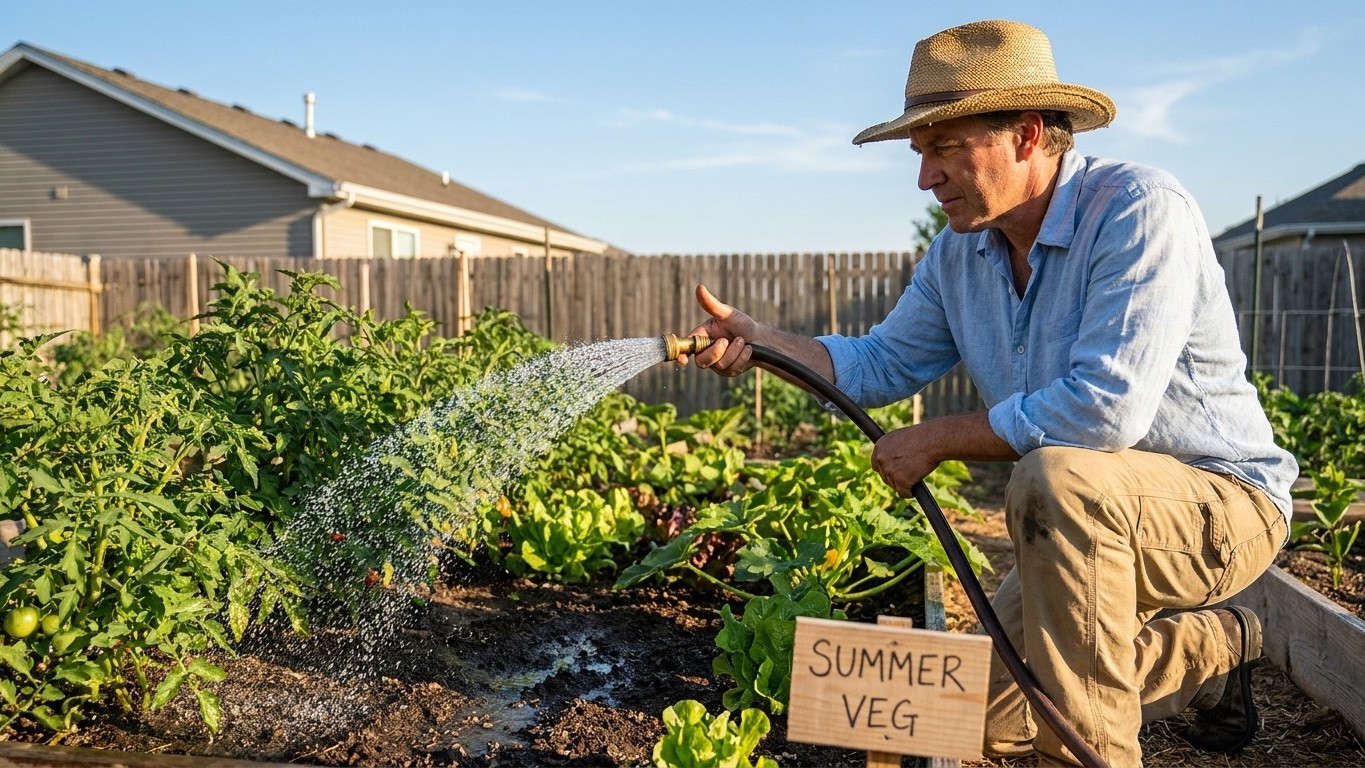
Deep, infrequent watering at the base of the plant, done in the morning, beats a quick daily sprinkle almost every time in Missouri’s heat. Deep watering pushes moisture down where roots actually grow, which trains them to follow the water downward instead of clustering at the surface where the first hot afternoon can dry them out. Watering at the base, rather than overhead, keeps water off the foliage, and morning watering gives any leaves that do get wet time to dry before evening, when damp leaves sitting overnight invite fungal disease.
Before turning on the hose, check the soil rather than the calendar. Push a finger two inches into the bed, or use a trowel to open a small slice near the root zone. If it’s dry at that depth, it’s time to water regardless of what the surface looks like; if it’s still damp two inches down, wait, especially on clay.
A simple sequence works as a starting point, to be adjusted once the reader has watched their own soil for a season:
- Check soil moisture two inches down with a finger or trowel before watering, not after a light rain.
- On sandy soil, water in shorter sessions every two to three days during the hottest stretch, since sand won’t hold much of a single deep soak.
- On clay soil, water deeply once a week and let it dry between soakings; watering again too soon drowns roots that clay is already holding onto.
- Apply roughly an inch of water per session as a baseline figure, using a rain gauge or a straight-sided can under the sprinkler to measure it.
- Water at the base of the plant in the early morning, before the day’s heat and before any of the 32.7 annual days that reach 90F start pulling moisture back out.
That inch-a-week baseline is only a starting point. A raised bed, a container, or a spot near a downspout behaves nothing like open clay ground, so the finger test stays the real judge, week to week.
What goes wrong
“I water a little every day”
A light daily sprinkle wets only the top inch or so of soil. Roots follow the moisture, so they stay shallow, right where the day’s heat bakes the ground hardest. When a stretch of 90-degree days hits, those shallow roots have nowhere to draw from, and the plant wilts faster than one trained to reach deeper.
“I water in the evening to be safe”
Evening watering feels considerate, since it avoids the midday sun, but it leaves foliage wet through the night. Combined with warm, humid Missouri nights, that damp leaf surface is exactly what fungal diseases like powdery mildew need to take hold. Morning watering lets the sun dry leaves within hours instead of within a full night.
“It rained, so I skipped watering”
A summer thunderstorm can look like a soaking rain and still leave the top half-inch of soil damp while the root zone below stays dry, especially on clay where surface water runs off before it penetrates. The finger test settles it: two inches down, dry means water regardless of what fell an hour ago.
“I didn’t bother with mulch”
Bare soil left exposed to 32.7 days a year of 90-degree heat loses water to evaporation almost as fast as it’s applied. A two- to three-inch layer of mulch slows that loss, keeping the soil cooler and the water the gardener just carried from evaporating back out within the day.
Local help
The University of Missouri Extension publishes guidance suited to local soils and conditions across the state. Watering restrictions, when they apply, are set by individual water providers and municipalities and can change during a dry stretch, so check with the local water utility or district for current rules before setting an outdoor watering schedule.
Common questions
How much rain does Missouri get in a typical summer?
About 14.1 inches fall across June, July and August combined, with June the wettest at 5.25 inches and August the driest at 4.24 inches.
How many days a year does Missouri hit 90F or hotter?
The region averages 32.7 days a year at 90F or above, which is the main driver of how fast garden soil dries out.
Is an inch of water a week enough during a Missouri summer?
It’s a reasonable starting point, but heat and uneven rainfall mean the actual amount needed varies by soil type and week; checking soil moisture two inches down is more reliable than a fixed rule.
Does sandy or clay soil need more water in Missouri?
Sandy soil needs more frequent, shorter watering because it drains fast; clay soil holds water longer but needs time to dry between waterings to avoid drowning roots.