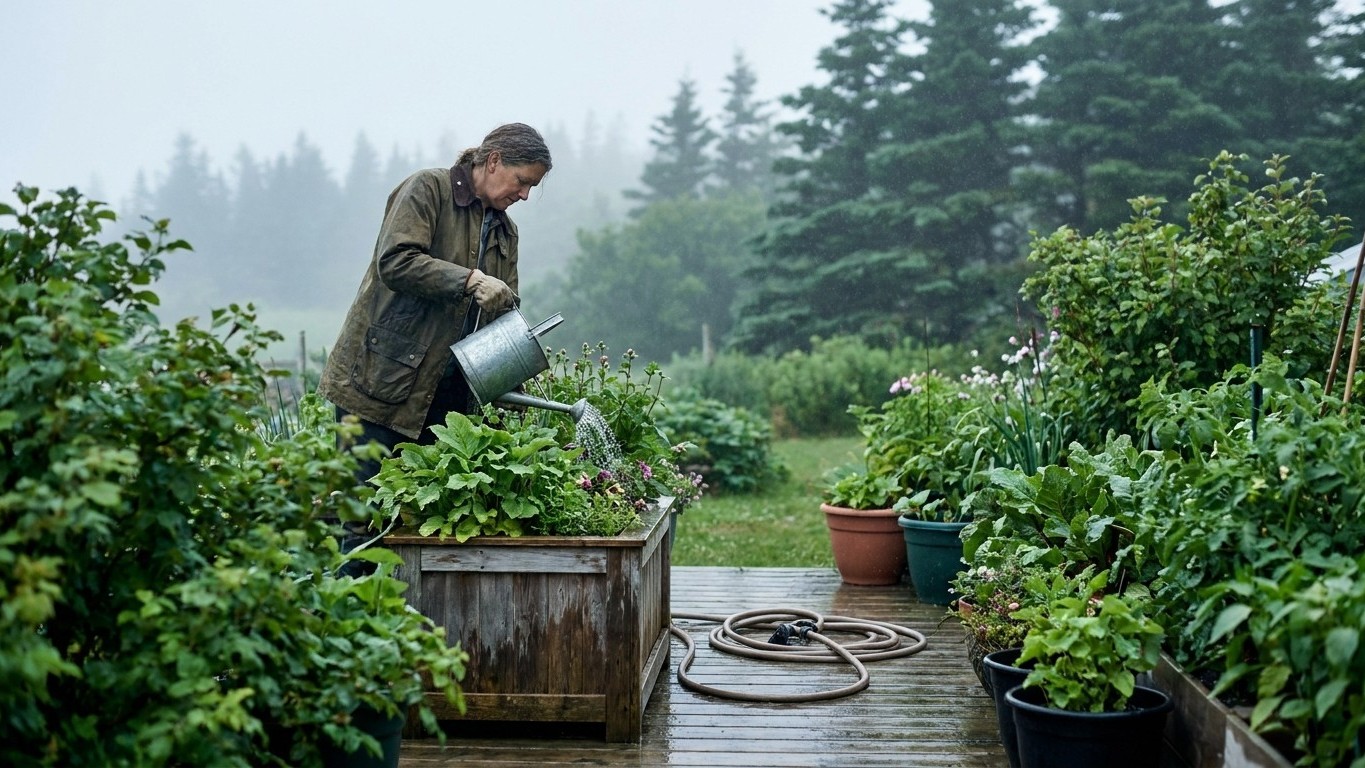

In St. John’s and across Newfoundland and Labrador, gardens rarely need daily attention. July delivers 3.61 inches of rain on average, and the region sees essentially zero days a year above 90F. That combination means the sky does most of the work, but not all of it, and knowing the gap is what keeps a bed healthy through the growing season.
What changes here

Two numbers set the terms for watering in this territory: 3.61 inches of rain in July, the driest summer month, and 0.0 days a year that reach 90F. Together they describe a garden that gets steady moisture from above and almost no heat-driven evaporation pulling it back out. That’s a rare pairing in a garden climate context, and it means the watering can here is a backup tool, not a lifeline.
Run the arithmetic and the picture gets specific. A vegetable bed or a young perennial wants roughly an inch of water a week to keep growing without stress. July has about 4.43 weeks in it, so 3.61 inches spread evenly works out to roughly 0.82 inch of rain arriving in an average week. That leaves a gap of about 0.18 inch a week that has to come from a hose or a can if the goal is a full inch. It’s a small gap, smaller than almost anywhere else on this site’s state-by-state comparisons, but it’s not zero.
The absence of 90F days matters just as much as the rainfall figure. Heat is what drives evaporation and pulls moisture out of soil and leaf tissue fast; without it, the water that does fall or get carried in tends to stay put longer. A gardener in a territory with frequent 90-degree afternoons might see that same 0.82 inch of natural rain gone from the topsoil within a day or two. Here, it has a better chance of reaching root depth before the air pulls it back out.
None of this is a guarantee for any single yard. These are averages from a reference station, and a garden on a windy coastal bluff, a sheltered inland pocket, or a slope that sheds water fast will see something different. A rain gauge on the actual plot, checked weekly through July, is the only way to know if that 0.18-inch gap is real or already closed by a wetter-than-average week.
How to water when it matters
The method that works with this climate, rather than against it, comes down to depth, timing, and restraint. Deep, infrequent watering trains roots to grow downward, chasing moisture instead of clustering near the surface where the next dry spell can reach them fast. Watering at the base rather than overhead keeps leaves dry, which matters more here than the heat numbers suggest, because a cool, humid maritime climate is exactly the kind of place fungal disease spreads fastest. Morning watering gives any splashed foliage hours to dry before evening, when cooler temperatures and lingering moisture invite mildew and blight.
The soil itself decides the rhythm more than any calendar. Sandy, fast-draining ground holds water for a short window and needs shorter, more frequent soakings to keep pace. Heavy clay soil, common in many Newfoundland yards built on rocky, poorly drained subsoil, can hold a week’s worth of water and then some, which means watering it again before it has actually dried invites root rot rather than growth. The only reliable way to tell which situation applies is to check the ground itself, not the calendar and not the forecast.
A simple sequence works for most home gardens in this territory:
- Push a finger or a small trowel two inches into the soil near the plant’s base; if it comes out dry at that depth, it’s time to water, regardless of how the surface looks.
- Water slowly and deeply at the base of the plant, aiming for roughly one inch of total water delivered that week, counting whatever rain has already fallen.
- Do it in the early morning, before the day’s heat and wind pick up, so water has time to soak in rather than evaporate off the top.
- Skip the next scheduled watering if that same two-inch check still shows damp soil, especially after a heavier July rain.
- Add a two- to three-inch layer of mulch around the base to slow evaporation between waterings, particularly useful on sandier plots.
Treat the one-inch-a-week figure as a starting point, not a fixed rule. A raised bed of loose, amended soil will dry faster than the surrounding lawn; a container will dry faster still. The finger test, repeated through the season, is what actually calibrates the number to a specific yard.
What goes wrong
I water a little every day
A light daily sprinkle wets only the top inch or so of soil, and roots respond by staying shallow to chase that moisture. Those shallow roots are the first to suffer the moment a watering gets skipped or a dry stretch runs a few days longer than expected. Deep, less frequent watering is the fix, even though it feels counterintuitive to gardeners used to checking on their plants daily.
I water the leaves at night
Evening watering that wets the foliage leaves leaves damp for eight or more hours in cooler night air, which is close to ideal conditions for fungal spores to take hold. In a climate already prone to humidity and cool nights, this mistake shows up as blight or powdery mildew days later, often blamed on the weather rather than the watering habit that set it up.
I trust the last rain shower
A summer shower can look like it soaked the garden while only wetting the top half-inch of soil, especially if it fell fast or the ground was already dry and hydrophobic. The only way to know is the same two-inch check described above; a garden that looks freshly rained on can still be bone dry at root depth.
I let a rainy summer do all the work
This is the mistake that costs the most in a territory like this one. With decent July rainfall and virtually no extreme heat, it’s tempting to assume the sky has it covered all season. But clay-heavy plots that hold water for a week can go from adequately moist to waterlogged with one more storm added on top, and roots sitting in saturated soil suffocate and rot just as surely as a dry bed wilts. Checking soil moisture before adding water matters here as much as remembering to water at all.
Local help
Watering restrictions in Newfoundland and Labrador are set at the municipal or district level and change with local water supply conditions, so check with the local water provider before assuming any particular schedule applies. For general growing guidance suited to the province’s soils and climate, the Newfoundland and Labrador Department of Fisheries, Forestry and Agriculture is the relevant provincial resource.
Common questions
Does Newfoundland and Labrador get enough summer rain to skip watering entirely?
Not quite. July averages 3.61 inches, which covers most but not all of the roughly one-inch-a-week target most garden beds need; a small gap of around 0.18 inch a week typically still needs to be filled by hand, more on sandy soil, less on clay.
Why does the lack of 90F days matter for watering?
Heat is the main driver of evaporation from soil and plant leaves. With 0.0 days a year reaching that threshold, water applied or fallen here tends to stay available to roots longer than in hotter regions, reducing how often supplemental watering is needed.
How do I know if my soil is sandy or clay-heavy?
Squeeze a handful of moist soil: sandy soil falls apart immediately, while clay soil holds its shape and feels sticky. This matters because clay holds water far longer than sand, changing how often the same garden needs watering.
Is morning or evening better for watering in this climate?
Morning is better. It gives any water that lands on foliage time to dry during the day, cutting down the risk of fungal disease that thrives in the cool, damp nights common to this maritime climate.