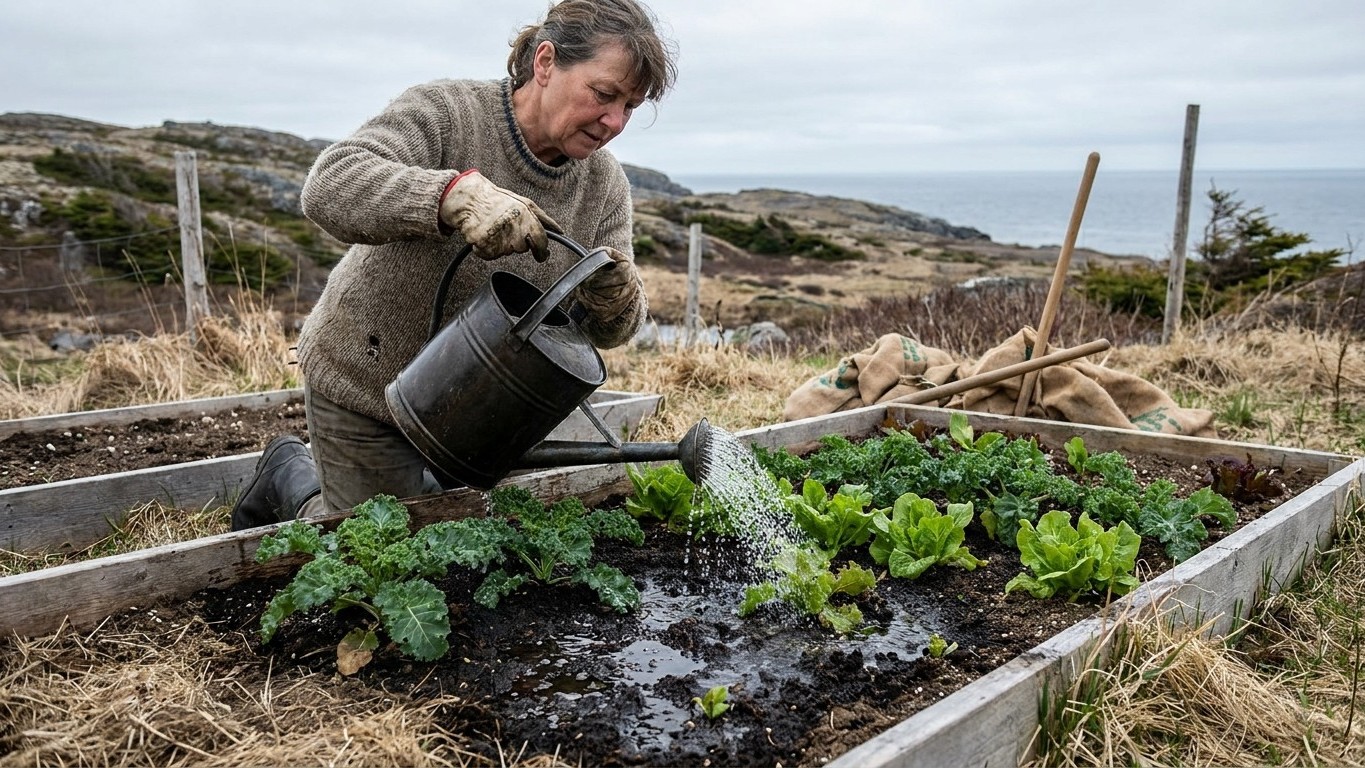

Newfoundland and Labrador gets a decent amount of summer rain on paper, but it rarely gets hot enough to force a garden into crisis. That combination means the real skill here isn’t fighting drought, it’s reading the gap between what falls from the sky and what actually reaches root depth.
What changes here

Two numbers set the terms for this territory: 3.61 inches of rain in July, the driest summer month, and 0.0 days a year that reach 90°F. Put together, they say something specific: heat stress is almost never the problem, but a full month of gentle rain can still leave root zones short if that rain lands unevenly or runs off a slope before it soaks in.
Do the arithmetic and the gap gets smaller than gardeners often assume. A vegetable bed or a young perennial wants roughly an inch of water a week. July averages 3.61 inches across the month, and a month holds about 4.4 weeks, so the sky delivers something like 0.82 inch in an average week that month. That leaves a shortfall of about 0.18 inch, less than a quarter inch, for the gardener to make up with a hose or a can, assuming the rain arrives evenly across the weeks. It rarely does. A single heavy shower can drop half a week’s total in an hour, run off the surface, and leave the days on either side of it dry at root depth even though the monthly average looks generous.
Soil texture decides how far that inch actually travels. On sandy ground, water drains through within a day and needs to be replaced sooner and in smaller amounts. On heavy clay, the same inch sits in the top few inches for a week or more, which sounds convenient until it drowns roots that never got a chance to dry out. Since no two yards in this province sit on identical ground, the number to trust is the one measured on your own bed, not the provincial average.
Zero days above 90°F also means evaporation demand stays low almost all season. That’s a real advantage over hotter provinces, but it cuts both ways: soil that stays damp for days doesn’t announce itself as a problem the way scorched, cracked dirt does. The failure mode here tends to be quiet rather than dramatic.
How to water when it matters
The method that works on this ground is deep and infrequent, delivered at the base of the plant, in the morning. Deep watering pushes moisture down past the top couple of inches, which trains roots to grow downward and follow it, rather than clustering near the surface where they dry out fast. Watering at the base instead of overhead means the water goes where roots can use it instead of evaporating off leaves or running off nearby turf. Morning watering gives the plant several hours to take up moisture before the heat of the day, and it lets any water that does land on foliage dry out before evening, when damp leaves overnight become an invitation for fungal disease.
Checking the soil beats checking the sky, especially in a province where rain arrives unevenly. Push a finger two inches into the bed, or use a trowel to lift a small scoop near the base of a plant. If it’s dry at that depth, water. If it’s still damp, wait, even if the surface looks parched. Surface dryness is normal in cool climates and tells you almost nothing about what roots are actually experiencing a few inches down.
Soil texture should set the rhythm, not just the amount. Sandy soil holds little moisture and asks for shorter, more frequent soakings, often every two to three days in dry stretches. Heavy clay can hold a week’s worth of water, but watering it again before it’s had that week to drain risks suffocating roots in waterlogged ground. Use the numbers below as a starting point to test against your own soil, not a fixed rule:
- Check soil moisture two inches down with a finger or trowel before every watering, regardless of how recently it rained.
- If July’s rain falls short of an inch for the week, add roughly 0.2 inch by hose or can to close the gap.
- On sandy beds, split that amount into two shorter waterings a few days apart rather than one large soak.
- On clay beds, water once, deeply, and wait until the two-inch check reads dry again, even if that takes a full week.
- Water at the base of the plant, in the morning, so foliage dries before evening.
What goes wrong
A little water every day
Daily light sprinkling wets only the top inch of soil, which trains roots to stay shallow and close to the surface. Those roots then bake the moment a warm stretch hits, even a mild one by this province’s standards, because they never developed the depth to reach moisture lower down.
Watering the leaves at night
Evening watering that lands on foliage leaves it damp for hours in cooler night air, which is exactly the condition fungal diseases like powdery mildew and blight need to take hold. Morning watering at the base avoids this almost entirely.
Trusting a passing shower
A brief summer shower can look convincing on a driveway or a car windshield while wetting only the top half inch of a garden bed. The finger test settles the question a glance at wet pavement can’t.
Skipping mulch, or overwatering because heat never shows up
Bare soil gives back moisture to the air faster than mulched soil, so skipping a two to three inch layer wastes water gardeners already worked to apply. But the costlier mistake in this territory runs the other way: because days above 90°F sit at 0.0, there’s rarely a hot stretch to punish overwatering with visible wilt, so damp, waterlogged beds go unnoticed until roots have already started to rot in soil that never got the chance to dry.
Local help
For soil testing, planting guidance, and season-specific advice suited to this province, the Newfoundland and Labrador Department of Fisheries, Forestry and Agriculture is the go-to resource. Watering restrictions are set locally and change by district and by year, so check with your own municipal water provider before setting a summer schedule.
Common questions
Does Newfoundland and Labrador really need supplemental watering if it rains this much?
Often yes, in short stretches. Even with 3.61 inches falling in July, that rain can arrive unevenly, in one or two storms rather than spread across the month, leaving several dry days at root depth in between.
How often should I water during a dry week in summer?
Start by checking the soil two inches down before watering at all. On sandy ground, expect every two to three days in a dry stretch; on clay, once a week is often enough since it holds moisture longer.
Is heat stress a major risk for gardens here?
Not by the numbers. With 0.0 days a year reaching 90°F, extreme heat stress is close to a non-issue, which makes overwatering and poor drainage the more common threats to plant health.
What’s the fastest way to tell if a bed needs water?
Skip the visual check on the surface. Push a finger or trowel two inches into the soil near the plant’s base; if it’s dry at that depth, water, regardless of how the top layer looks.