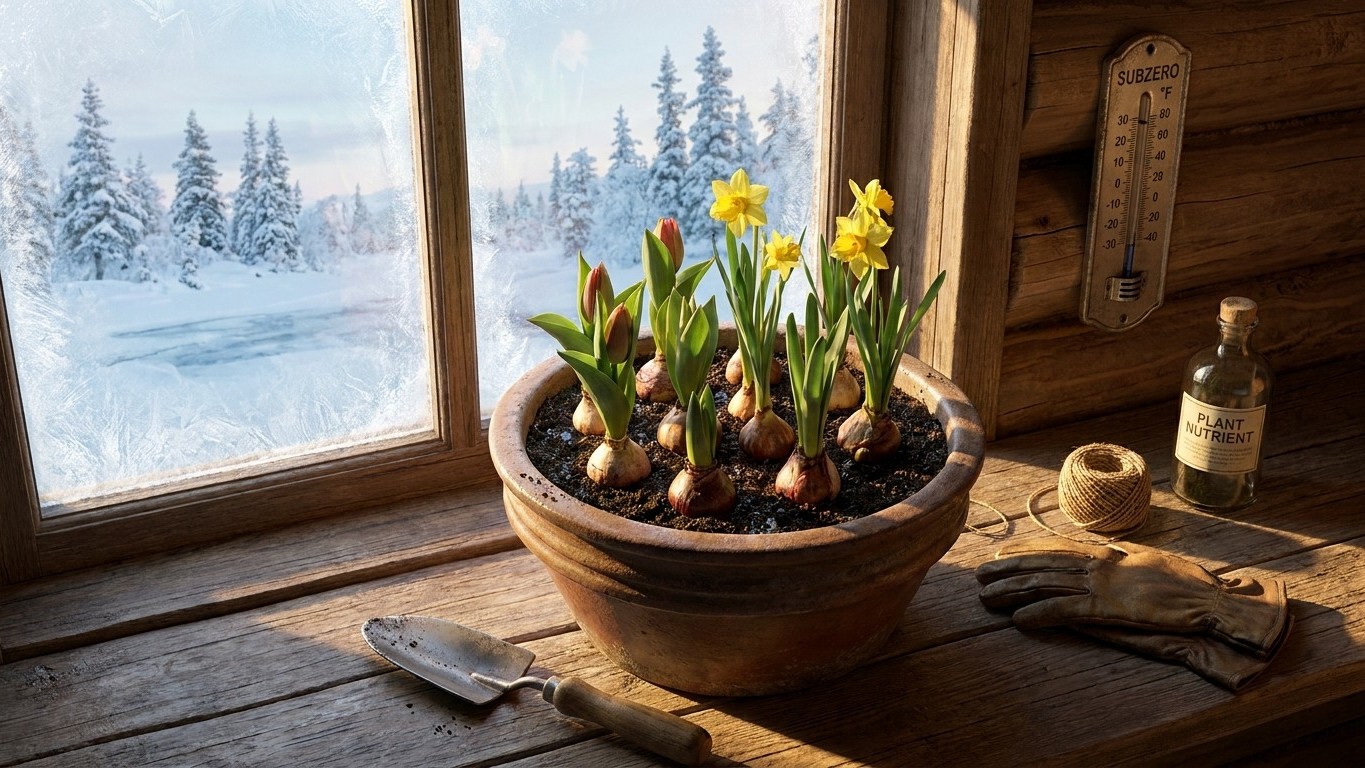

Forcing Spring Bulbs Indoors works in Northwest Territories, but the method has to match the climate here, not the general instructions written for milder provinces. With a coldest-month average low of -21.1F and a hardiness zone of 1b (Canadian system), the ground offers more cold than any bulb needs, the trouble is that a pot left outdoors in that cold freezes solid, roots and all, which is a different failure than a simple cold deficit.
Why this matters in Northwest Territories

Start with the number: -21.1F is the mean daily minimum for the coldest month at the Yellowknife reference station, per Environment and Climate Change Canada’s 1981-2010 Climate Normals. That is not a record low, it is the average low night in the coldest month, meaning most nights that month sit close to that mark or colder. Combined with a Canadian hardiness zone of 1b, this places the territory among the harshest growing climates tracked by Natural Resources Canada.
That figure rules out one of the two classic forcing problems immediately. In places where winter is short or mild, spring bulbs never get their full twelve to fourteen weeks below 45F, so the gardener has to manufacture that cold artificially in a refrigerator. Northwest Territories has the opposite issue. There is no shortage of cold here, there is a surplus of it, delivered fast and hard. The ground itself provides more chilling than a tulip or daffodil bulb will ever use.
The real hazard is the second problem: containers. A bulb planted directly in garden soil is insulated by the mass of earth around it; even in a zone this cold, the soil several inches down rarely swings as violently as the air above it, and snow cover adds another layer of insulation. A bulb sitting in a plastic or terra cotta pot has none of that protection. The pot’s thin walls let cold move straight through, so a container left outside, or even in an unheated space that dips below freezing, chills the bulb far faster and far deeper than the same bulb would experience in a bed. At -21.1F ambient air temperatures, an unprotected pot can freeze through in hours, not weeks, and a frozen root system does not recover.
This is why the classic mild-climate trick, plunging potted bulbs into a garden trench and letting the ground do the chilling, does not translate here. The trench method assumes soil that stays a workable, protective few degrees below freezing. In Northwest Territories the soil itself can drop well past the point that would kill the bulb outright, and by the time a gardener notices, the pot is a block of ice. Forcing here means creating a controlled middle ground: cold enough to satisfy the bulb’s dormancy requirement, not cold enough to freeze the container solid.
How to do it here
The chilling period spring bulbs need before they will flower indoors runs twelve to fourteen weeks, and every bulb in that window has to stay in a space that hovers just above freezing, never plunges into the deep negatives this territory sees outdoors in midwinter, and never overlaps with ripening fruit, since fruit gives off ethylene gas that can kill the flower bud forming inside the bulb. Given how extreme outdoor temperatures get, most gardeners here rely on an indoor cold space rather than anything left outside unprotected.
- Pot the bulbs in a container with drainage holes, using ordinary potting mix, and water them once so the soil is moist but not soaked.
- Choose the cold space before you commit: an unheated garage that reliably stays above freezing through the coldest stretch works, or a dedicated refrigerator crisper drawer kept away from any apples, pears, or other ripening fruit.
- Check that whichever space you use does not swing below freezing overnight. If your garage is attached to an unheated structure that can still drop into the negatives during a cold snap, the fridge is the safer bet in this territory.
- Leave the potted bulbs in that space for twelve to fourteen weeks, checking every couple of weeks that the soil hasn’t dried out completely.
- If you are using containers rather than a controlled indoor space, know that the pot needs to be rated at least two hardiness zones hardier than the bulb itself to survive outdoors here at all, and at zone 1b, that bar is high enough that most gardeners simply skip outdoor container overwintering and move everything to a protected, mulched spot or indoors instead.
- Once the chilling period is up, bring the pot into a cool room, around 50-60F, out of direct sun, for one to two weeks to let shoots green up gradually.
- Move the pot to a warmer, brighter spot only after shoots are a few inches tall and showing color at the tip. Moving it too soon is the single most common reason the flower stem ends up short.
Every one of these steps is something you can check yourself with a thermometer and a calendar. Nothing here depends on guessing the outdoor weather, which is the point: at this latitude and this cold, the outdoors is not part of the plan.
Which bulbs are worth it
Not every spring bulb rewards the effort of forcing, and the difference usually comes down to how long the bulb needs to chill and how tall its flower stem grows. A bulb with a short cold requirement forces faster and with less risk of trouble along the way. A bulb that throws up a tall, heavy stem is more likely to flop over once it’s indoors in a pot, away from the wind and structure that would normally hold it upright outside.
- Crocus, short cold requirement, low stem, rarely topples
- Daffodils and narcissus, reliable bloomers, sturdy enough for indoor pots
- Hyacinths, strong scent, dependable, one of the most commonly forced bulbs
- Grape hyacinth (muscari), compact, forces easily, good for small containers
- Tulips, reliable if given the full chilling period, though shorter varieties hold up better indoors than tall ones
- Alliums, tall, heavy flower heads that topple easily once indoors
- Fritillaria, finicky cold and moisture needs, inconsistent results indoors
- Large trumpet daffodil varieties, can grow leggy and weak-stemmed under indoor light
Worth noting: most bulbs bought specifically for forcing are treated as single-season purchases anyway, since a forced bulb rarely has enough stored energy left to bloom again the following year, and in a zone this cold it has almost no chance of surviving to try in the garden regardless. That makes the choice simpler than it sounds. If the bulb was never going to be a long-term investment, forcing it costs nothing extra in the long run beyond the bulb itself.
What goes wrong, and when you can still fix it
Leaves come up but no flower forms
This means the chilling period was cut short, whether by a few days or a few weeks. The bulb had enough stored energy to push leaves, but not enough cold exposure to trigger the flower bud inside it. There is no fix once the leaves are already up this season; the bulb needs a full, uninterrupted chilling cycle to try again, which means waiting until next year and tracking the weeks more carefully.
The flower opens on a stem too short to see well
This is almost always the result of moving the pot into warmth too quickly, before the shoots had a chance to green up and stretch during that one-to-two-week transition period. The flower itself is fine, just compressed. Nothing recovers the stem length this season, but it’s a useful signal to slow the transition down next time.
The bulb rots in the pot
Rot points to standing water, almost always a container without adequate drainage holes or soil that stayed soaked through the chilling weeks. Once rot has set into the bulb tissue itself, the bulb is done for this season and cannot be saved. The fix is entirely preventive: drainage holes, and water that moistens the soil without pooling at the bottom of the pot.
Related guides
- Growing Spring Bulbs in Containers in Northwest Territories
- Forcing Spring Bulbs Indoors in Nova Scotia