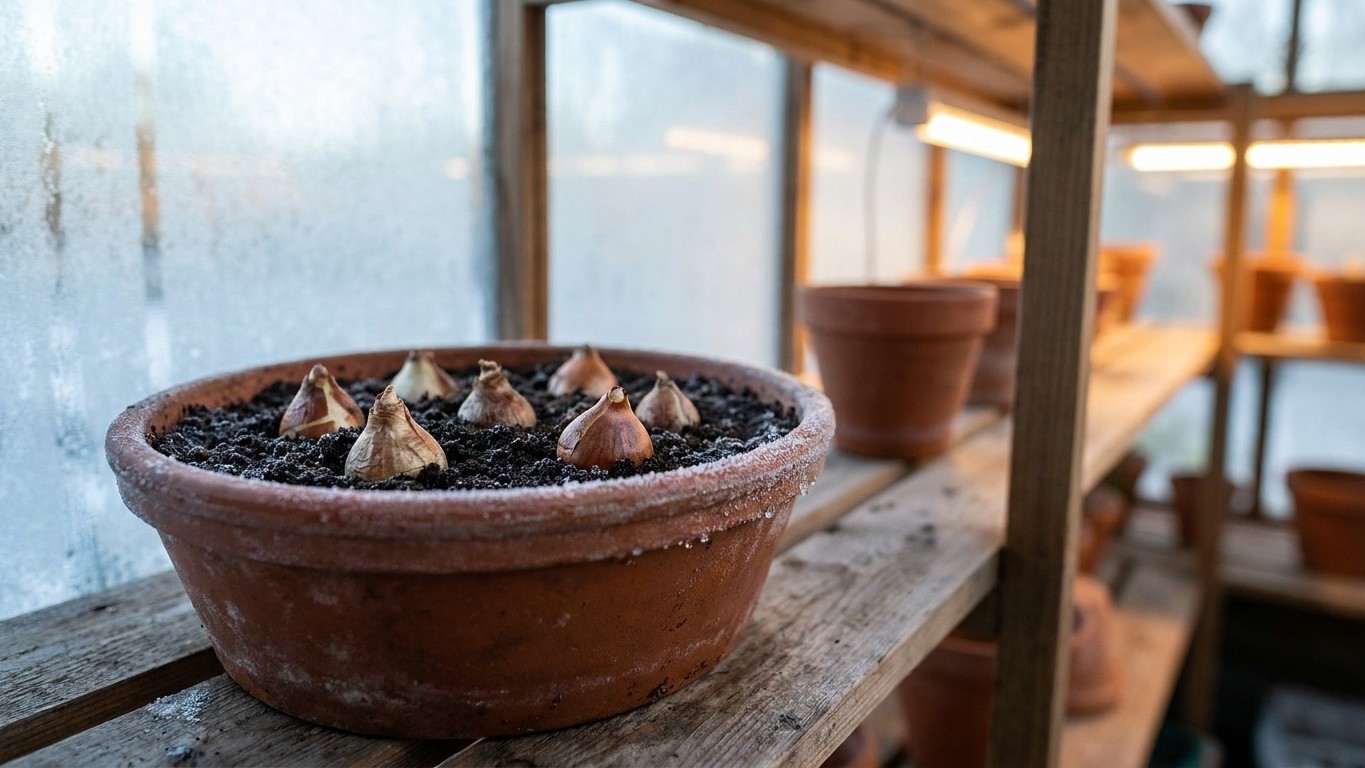

Spring bulbs in Containers work in Nunavut only as an indoor forcing project. Outdoor pots left through winter freeze solid, roots and all, at temperatures no bulb survives. The practical path is planting bulbs in a pot, chilling them in a controlled space for the cold period they need, then bringing the container into light to bloom indoors, never leaving it outside once the ground starts to freeze.
Why this matters in Nunavut

Rankin Inlet, the reference station for this territory’s climate normals, averages a daily minimum of -29.8°F in its coldest month. That single figure settles which of two problems a Nunavut gardener is actually facing. A spring bulb such as a tulip or crocus needs somewhere between twelve and fourteen weeks of temperatures below 45°F to finish building the flower inside itself before it can bloom. Nunavut has that cold in vast excess, for months longer than any bulb requires. This is not a territory short on winter chill, so forcing bulbs here is not a rescue for missing cold the way it would be somewhere winter barely dips below freezing.
A container problem, not a forcing-shortage problem
The trouble in Nunavut is what that same cold does to a pot. A garden bed freezes from the surface down, and below a certain depth the soil holds enough residual warmth and insulation that a hardy bulb’s roots stay above lethal cold even in a brutal winter. A container has no such buffer. Its whole volume of soil and roots tracks the surrounding air almost directly, with no depth of earth around it to slow the heat loss. At a coldest-month average minimum near -29.8°F, a potted bulb left outdoors faces cold a buried bulb of the same species would never feel.
Natural Resources Canada places the reference city for this territory in Canadian hardiness zone 0a, using its own seven-variable system, on the 1991-2020 normals. That number cannot be read against a USDA zone; the two systems are built differently, and Natural Resources Canada itself notes that a single Canadian zone can span nine different USDA zones. What zone 0a tells a container gardener here is that even bulbs rated hardy well above 0a in the ground have no ground to rely on inside a pot. The practical answer in Nunavut is not picking a hardier bulb, but treating every containerized bulb as an indoor project from the day it is potted.
How to do it here
Forcing a container of spring bulbs in Nunavut follows the same botany as anywhere else, but every step has to be checked against a climate colder than almost any indoor space a bulb would tolerate. The sequence below assumes bulbs bought and potted in fall, aimed at an indoor bloom weeks later.
Setting up the chill period
- Choose a pot with drainage holes, sized so the bulbs sit close together without touching the sides, and fill it with fresh, well-draining potting soil.
- Plant the bulbs at the depth recommended for that species, water once to settle the soil, and label the pot with the date, since the chill period is timed from this point.
- Move the pot to a space that holds steadily between 32°F and 45°F for twelve to fourteen weeks. An unheated garage only works if it stays above freezing all winter; check it with a min-max thermometer rather than assume, because an unheated outbuilding here can easily track the outdoor coldest-month minimum of -29.8°F, which would kill the bulbs outright.
- If no space in the home holds that range reliably, use a spare refrigerator drawer instead. Keep the pot away from any ripening fruit stored in the same fridge: fruit gives off ethylene gas, and ethylene destroys the flower bud forming inside the bulb before it ever gets the chance to open.
- Once the full chill period has passed and pale shoots appear, move the pot to a cool room around 55°F to 60°F, out of direct sun, for a week or two so the shoots green up and lengthen gradually.
- Move the pot into a bright, warmer room to finish flowering, and keep the soil evenly moist. Do not set the container outdoors at any point: outdoor cold here freezes a pot’s entire root mass, which a monitored garage or fridge drawer does not.
The rule sometimes used elsewhere, planting a bulb one or two hardiness zones hardier than rated so its pot survives outdoors, does not give Nunavut gardeners a workable shortcut. With a coldest-month minimum near -29.8°F, moving the pot into a monitored indoor space is the dependable route, not mulching it and leaving it against an outside wall.
Which bulbs are worth it
Some bulbs reward the trouble of forcing in a container; others produce a spindly, disappointing show for the same weeks of care. The difference usually comes down to two things: how long a bulb needs to sit in the cold before it is ready to bloom, and how tall and top-heavy the flower stem gets once it does.
Bulbs that force reliably here
- Crocus, short and sturdy, with a shorter cold requirement than most spring bulbs, so it often finishes first and rarely flops in a pot.
- Hyacinth, a compact, heavy flower spike on a short stem that seldom needs staking indoors.
- Paperwhite narcissus, which needs no cold period at all and blooms a few weeks after potting; since it is not reliably hardy outdoors here anyway, it is bought fresh each year regardless.
- Amaryllis, also needing no cold, treated like paperwhites as a one-season purchase, so forcing costs nothing in the long run since it was never going into the ground.
Bulbs that sulk in a Nunavut container
- Tall daffodil varieties, whose long stem looks fine in a garden bed but topples in a pot without staking.
- Large-flowered tulip varieties, whose top-heavy blooms on tall stems lean or fall once fully open indoors.
- Large ornamental alliums, whose long cold requirement and tall flower stalks make them a poor match for a container’s limited space and stability.
- Fritillaria, known for uneven, unreliable forcing results even under controlled conditions, with buds that often fail to open fully.
Where the bulb was always a single-season purchase, paperwhites and amaryllis being the two most common examples, forcing it in a container carries almost no downside: it was never going to survive Nunavut’s zone 0a ground regardless of how carefully it was grown.
What goes wrong, and when you can still fix it
Three problems show up often enough in forced containers to be worth naming by their symptom, along with what caused each one.
Leaves but no bloom
The pot pushes up healthy green leaves, but no flower stalk ever appears, or a bud forms and shrivels before opening. This usually means the chill period was cut short, whether the pot spent ten weeks in the cold instead of the full twelve to fourteen, or the storage space warmed above 45°F partway through without anyone noticing. The flower was never fully formed inside the bulb before it was asked to grow, so there is no fix this season. Most bulbs are spent after one forcing attempt anyway; if it is a bulb the gardener wants to try again, the earliest another attempt makes sense is next fall, with a full, monitored chill period.
Flower on a stem too short to see
The bloom opens, but low and almost buried in the leaves, hard to see over the rim of the pot. This is the signature of a bulb moved from cold storage into full warmth too quickly, skipping the cool, dim stage that lets the stem lengthen before the flower opens. There is no way to stretch that stem after the fact this season. Next time, give the pot its week or two in a 55°F to 60°F dim room before moving it into full light and heat.
Bulb rot in the pot
Soft, mushy bulbs, sometimes with a sour smell, usually trace back to a pot without adequate drainage, or soil kept wet rather than evenly moist during the chill period. Once a bulb has gone soft, it will not recover this season or any other; the tissue that would have produced roots and a flower stalk has already broken down. The fix is entirely preventive: drainage holes, a well-draining potting mix, and watering only enough to keep the soil from drying out completely during the weeks in cold storage.