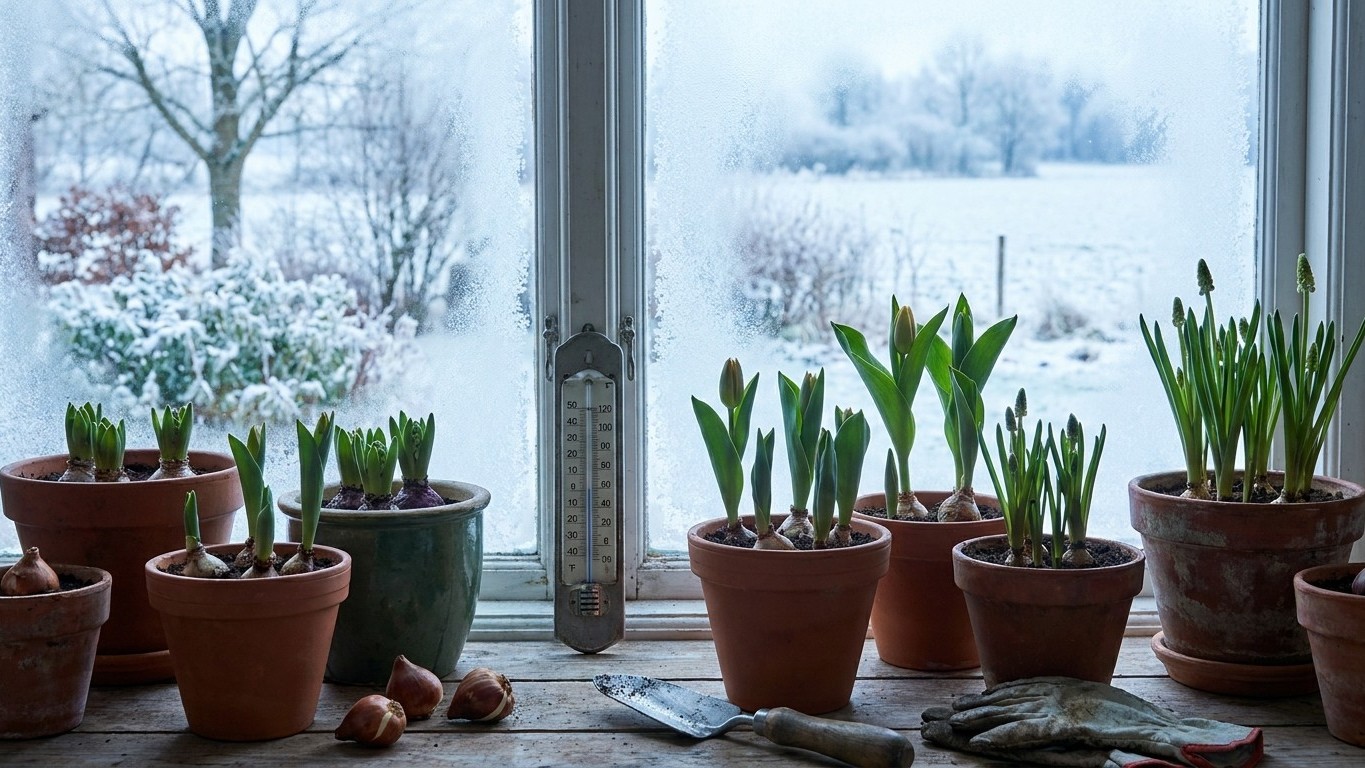

Yes, spring bulbs grow well in Containers in Ohio, but a pot behaves nothing like garden soil once the mercury drops. Two separate techniques solve two separate problems here: forcing brings bulbs into bloom indoors on your own schedule, while container overwintering asks whether a potted bulb can survive an Ohio winter outdoors at all. The answer to each depends on numbers most gardeners never check before they start.
Why this matters in Ohio

Columbus averages a daily minimum of 22.0°F during the coldest month of the year, according to NOAA NCEI’s 1991-2020 Climate Normals. That single figure settles a question a lot of container advice skips over: whether Ohio’s winter already supplies the cold spring bulbs need, or whether the gardener has to manufacture it.
A tulip or hyacinth bulb wants somewhere between 12 and 14 weeks below 45°F before it will bloom. Compare that threshold to 22.0°F and the math isn’t close. Ohio’s winter, even measured by an average rather than an extreme, sits more than 20 degrees colder than the ceiling a bulb needs, and it holds that cold for months, not weeks. Forcing, the practice of chilling bulbs artificially in a refrigerator or unheated garage, exists for gardeners in places where winter never gets cold enough for long enough, think coastal California or the Gulf Coast. Ohio isn’t that place. Anyone here who forces bulbs is choosing the technique for the timing, blooms in February instead of April, not because the outdoors failed to deliver.
Containers flip the logic entirely. USDA’s Plant Hardiness Zone Map, built on the same 1991-2020 normals, places Columbus at zone 6a, inside the state’s broader 5b-6b range; other parts of Ohio, especially the higher ground toward the northeast, run a half zone or more colder. That zone rating describes what happens in the ground, where several feet of surrounding earth act as a thermal buffer and keep root-zone temperatures well above the air temperature overhead. A container has no such buffer. Roots, soil, and bulb sit inches from four exposed sides, and a pot left outside on a porch or patio can freeze solid to its core during exactly the kind of cold snap the ground shrugs off. The practical result: a bulb rated hardy to zone 6 in a garden bed can die in a pot in the same yard, because the pot experiences something closer to zone 4 conditions.
Ohio sits squarely in the second situation, not the first. Winter cold is abundant here. What’s scarce, for a potted bulb, is insulation.
How to do it here
Two different jobs call for two different paths, chilling a bulb on purpose to force early indoor bloom, or keeping a planted container alive outdoors through an Ohio winter. Both start with the same bulb and the same pot, and both hinge on temperatures you can check rather than guess at.
- Buy or dig bulbs in early fall and inspect them for firmness; soft or moldy bulbs won’t force or overwinter well.
- Pot them in a container with drainage holes, using a loose, well-draining potting mix, with bulb tips resting just at the soil surface.
- Decide the bulb’s path now: forcing for an indoor bloom on your schedule, or overwintering in place outdoors.
- For forcing, move the potted bulb somewhere that holds a steady temperature below 45°F for 12 to 14 weeks, an unheated garage that still stays above freezing, or a refrigerator’s crisper drawer, kept away from any ripening fruit, since the ethylene gas fruit gives off will damage the flower bud growing inside the bulb.
- Check the pot every couple of weeks while it chills; the soil should stay barely moist, never soggy and never bone-dry.
- For overwintering outdoors instead, check the bulb’s own hardiness rating against Columbus’s zone 6a, or your local reading within the state’s 5b-6b range, and subtract two zones; if the bulb doesn’t clear that lower rating, don’t leave the pot exposed on a deck or porch.
- Move the pot to an unheated garage, shed, or against a foundation wall, then bury it to the rim in mulch, straw, or fallen leaves so the container’s sides are no longer in direct contact with the air.
- Once the 12- to 14-week cold period ends, whichever path you took, bring the pot into indirect light at a cool room temperature for a week or two before moving it into brighter, warmer light to finish blooming.
Which bulbs are worth it
Not every spring bulb is worth the extra handling a pot demands. The plants that force fastest tend to be the same ones that behave best in a container outdoors too, because a short cold requirement and a short stem both work in the bulb’s favor.
Bulbs that force reliably here
- Crocus: needs only about 8 to 10 weeks of cold, among the shortest of any spring bulb, and its short stem never topples in a lightweight pot.
- Hyacinth: forces predictably in roughly 10 to 12 weeks, and the thick, single stem stands upright without staking.
- Muscari (grape hyacinth): short cold requirement, short stem, and it multiplies in a container without complaint.
- Daffodil (Narcissus), dwarf cultivars: reliable forcer at 12 to 14 weeks, and the dwarf types stay proportional to a small pot.
- Paperwhite narcissus: not winter-hardy in Ohio ground at all, so it’s grown strictly as a forced, one-season container bulb with no cold requirement whatsoever.
Bulbs that sulk in a pot
- Tall tulip cultivars: the standard-height varieties put up a stem long enough to catch wind and topple a lightweight container; the shorter species tulips fare better.
- Large ornamental alliums: their cold requirement runs long and their flower stalks grow tall enough to make a pot top-heavy.
- Fritillaria: an uneven, finicky forcer that often skips flowering entirely if the cold period isn’t timed precisely.
- Amaryllis: not a hardy spring bulb at all, and confusing it with the crocus-and-hyacinth group leads to disappointment; it belongs to a different indoor-bloom category entirely.
Where a bulb like a paperwhite was never going to survive an Ohio winter or come back next year regardless, forcing costs nothing in the long run. The bulb was already a one-season purchase before the pot ever left the store.
What goes wrong, and when you can still fix it
Leaves come up, no flower
The bulb didn’t get its full cold period. Below 45°F for less than 12 weeks, the flower bud tucked inside the bulb never finishes developing, even though the leaf tissue, which needs far less cold signal, grows anyway. This isn’t fixable this season; the bulb has already spent its stored energy on leaves. Next time, track the chilling period on a calendar rather than by eye.
The flower opens buried in the leaves, on a stem too short to see
This one comes from warming the pot too fast. Moving a chilled bulb straight from cold storage into bright, warm light skips the stem’s chance to elongate during a cool transition period, so the flower opens at almost ground level. This season’s bloom is what it is; there’s no stretching a stem after the fact. Next round, give the pot a week or two in cool, indirect light before moving it into full brightness and warmth.
The bulb turns soft and rots in the pot
Rot traces back to drainage, either a container without enough holes or a potting mix packed too dense to shed water. Sitting in constant moisture breaks down the bulb’s tissue before it ever gets the chance to sprout. This bulb isn’t recoverable this season. The pot and the leftover mix can still be reused, but only after adding real drainage and a coarser blend before the next planting.