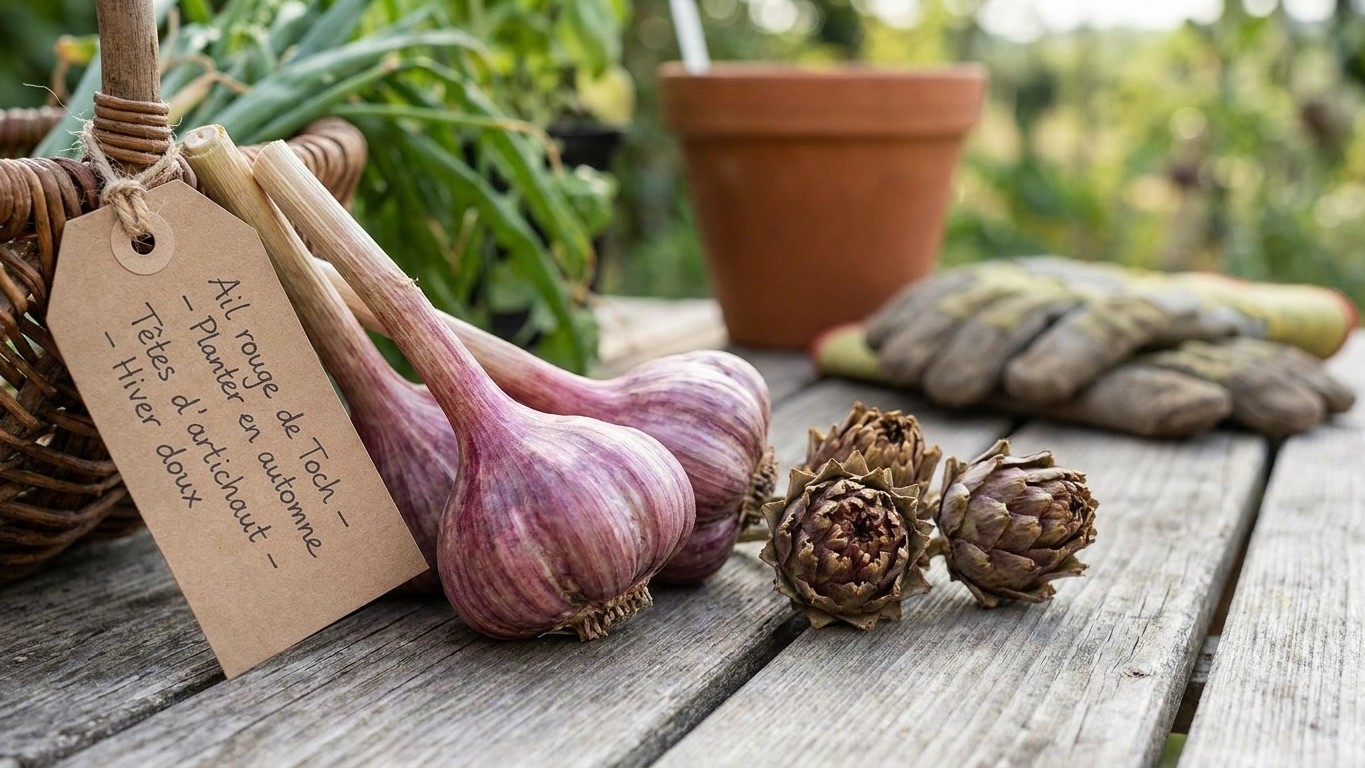

Red Toch is a softneck Artichoke type garlic grown for a flavor catalogs describe as sharp and spicy raw, mellowing to a rich sweetness once cooked. Like all garlic, it needs a real run of cold weather after planting to split a single clove into a full head, and this variety sits toward the higher end of that requirement for a softneck. Before you order it, find a weather station near you and check whether your winter actually clears that bar.
What Red Toch actually is

Red Toch belongs to the Artichoke group, one of the recognized botanical types of garlic, and like the rest of that group it grows as a softneck: the stem stays pliable right through harvest instead of stiffening into the woody, scape-bearing stalk you see on hardneck types. Seed catalogs that carry it describe the raw flavor as hot and pungent, settling into a milder, almost buttery sweetness once roasted or cooked through.
Storage is where Red Toch parts ways with its Artichoke cousins. Several specialty growers note it keeps for a shorter stretch than a typical Artichoke type, closer to a few months than the six-plus months expected from bulbs like California Early White. That shorter shelf life should shape how much you plant, since a bulb you intend to eat through spring doesn’t need the storage insurance a longer-keeping softneck would give you.
What Red Toch tastes like, and what to do with it
Garlic flavor is built on volatile sulfur compounds that are strongest right when a clove is cut or crushed raw, and that lessen with every minute of heat applied afterward. That’s why a “hot” garlic can taste sharp minced into a raw salsa and mellow considerably by the time it’s sautéed for two minutes, and why roasting, which breaks the clove down slowly over high heat, turns nearly any garlic sweet. Where a variety lands on that scale in its raw state, and how far it travels once cooked, is what actually separates one from another at the table.
Red Toch’s raw flavor is mild yet complex, smooth and aromatic rather than sharp, which sets it apart from the sharper, more aggressive bite the Artichoke group is generally known for raw. Roast it and that mild
Will it get the cold it needs where you are
Garlic sizes its head by splitting one clove into several during a stretch of cold weather after planting. Skip that cold and the plant grows a single round bulb with no seam to pull apart, nothing worth calling a head in the kitchen. Red Toch, like most garlic, needs on the order of six weeks with temperatures below 40°F to trigger that split.
Where the chill falls short
Weather station records make the shortfall obvious in the mildest parts of the country. Los Angeles, the reference station for California, logs essentially zero weeks below 40°F in an average winter against the six weeks Red Toch needs. New Orleans, standing in for Louisiana, and Houston, the station for Texas, come up just as short, and Jacksonville shows the same pattern for Florida. Honolulu and Phoenix, the reference points for Hawaii and Arizona, are no better off. In all six, the verdict comes back risky: plant Red Toch straight from the bag in these climates and you’re likely to lift one round bulb instead of a head of cloves.
Growers in those states get around the shortfall by giving the cloves the chill artificially. Refrigerate the seed cloves for around six weeks before planting, holding them between 35°F and 40°F and away from apples or other fruit that give off ethylene, which can damage the germ inside the clove. The other option is to skip Red Toch in these climates and plant a type bred to divide on less cold. A Silverskin such as Silver Rose Garlic asks for less chill to split, which is exactly why it suits a mild winter that Red Toch does not.
Where cold is never the problem
At the other extreme, cold isn’t the limiting factor at all, heat is. In Prince Edward Island, Charlottetown’s records put the season at roughly 1,569 accumulated degree-days, a marginal total for finishing a full-sized head even though the cold requirement is met with room to spare. Growers there lean on an early-maturing strain and a plastic mulch to warm the soil and stretch what heat the season gives them. Farther north the numbers get more extreme: Anchorage, standing in for Alaska, totals only about 917 degree-days across the year no matter how long the ground stays frozen, and Whitehorse, the station for Yukon, manages around 600. Growers that far north bring garlic under a high tunnel or greenhouse to bank enough cumulative warmth to size a bulb at all, since the cold requirement there is met many times over and heat, not chill, is what’s missing.
When to put the cloves in
Garlic goes into the ground in fall and comes out the following summer, and the whole window is set by the first fall frost rather than a fixed calendar date. The cloves need enough time to root before the ground freezes solid, but not so much time that they push a lot of top growth, which can get burned back by winter cold and wastes energy the bulb needed for spring. Sources disagree on exactly how far ahead of frost to plant, and that disagreement is real, not something to smooth over: a Gulf Coast grower and a subarctic grower are working with entirely different problems.
What the timing looks like in practice
The set-out windows below come from the same weather stations used above and show how differently the calendar reads depending on climate.
| Region | Set out window | First ripe |
|---|---|---|
| Louisiana (New Orleans) | late November to mid December | late August |
| Texas (Houston) | early November to late November | early August |
| Florida (Jacksonville) | early November to late November | early August |
| Prince Edward Island (Charlottetown) | late September | early June |
| Alaska (Anchorage) | early September | mid May |
| Yukon (Whitehorse) | early August | mid April |
Notice the direction of the pattern: warm Gulf states plant late in the year, close to and even into early winter, because the goal is to avoid sprouting before the little cold that does arrive shows up. Cold northern territories plant much earlier, sometimes in high summer, because the ground itself will be frozen solid within weeks and the cloves need that head start to root at all. Your own window sits somewhere between these extremes, and the only way to pin it down is to check your local frost date against your state extension service or a nearby weather station, the same way the table above was built.
Hardneck or softneck: what this one asks of you
Red Toch is softneck, which settles a few practical questions before you even plant it. There’s no scape to watch for and cut, the flower stalk that hardneck types send up and that growers snap off so the plant puts its energy into the bulb instead. Softneck bulbs also carry more cloves than hardnecks, smaller and arranged in overlapping rings rather than a single neat circle, and that clove count is exactly what lets softnecks be braided, since the pliable stem this group is named for bends without cracking.
The usual trade-off with softnecks is a longer storage life in exchange for cloves that are harder to peel than a hardneck’s. Red Toch complicates that trade slightly, since it’s a softneck that still keeps for a shorter stretch than most of its group, as covered above. For a grower deciding between habits before ordering seed stock, the Garlic Varieties guide lays out how all ten botanical types compare on scape, clove count and storage life side by side. A hardneck Porcelain type such as German White Garlic sits at the opposite end: it needs a real winter, sends up a scape you must cut, and gives fewer, larger cloves that peel easily but don’t keep nearly as long as a softneck does.
Growing and curing it without losing the crop
Plant cloves pointed end up, a couple of inches deep, spaced roughly four to six inches apart in rows about a foot apart, standard spacing for garlic regardless of type. Mulch matters more here than it does for a spring-planted crop, since this clove is sitting in the ground through an entire winter of freeze and thaw. A heavy layer of straw insulates the roots against heaving, keeps weeds down through a long occupancy, and holds moisture without waterlogging the bed.
Reading the harvest and curing it right
Stop watering a few weeks before you expect to lift the crop, since wet soil at harvest stains the wrapper skins and shortens storage life. Garlic is ready when the lower leaves have browned back but several leaves up top are still green, since each green leaf corresponds to a wrapper layer protecting the bulb.
- Lower third to half of leaves brown and dry
- Upper leaves still mostly green
- Necks starting to soften near the base
The classic mistake with any overwintered garlic, Red Toch included, is lifting too late or curing badly, and either one costs the whole crop in storage rather than in the field. A bulb left in the ground past its point splits its wrapper open and invites rot before it’s even out of the soil. After lifting, cure the bulbs whole, roots and tops still attached, in a shaded spot with good airflow for a few weeks until the necks are dry and papery. Curing in direct sun or anywhere damp is the fastest way to lose a crop that survived the whole winter fine, since mold sets in on wrapper skins long before the bulb itself looks affected.
Common questions
Does Red Toch throw a scape I need to cut?
No, not reliably. As a softneck Artichoke type it may push a loose, curled false stem in some seasons, but it doesn’t need cutting the way a hardneck’s stiff, coiling scape does.
Why did my Red Toch come up as one round clove with no head?
That’s the classic sign of insufficient chilling, covered above: the crop didn’t get enough weeks below 40°F after planting to divide. Refrigerating next year’s seed cloves before planting, or switching to a lower-chill type, fixes it.
Can I grow Red Toch in a raised bed or container over winter?
You can, but a container’s soil tracks air temperature much more closely than ground soil does, so both the cold snaps and the deep freezes hit the cloves harder. If you’re in a cold-winter region, bank mulch or leaves around the container sides, or move it against a wall, so the soil doesn’t freeze solid all the way through.
How long does Red Toch actually keep once it’s cured?
Catalog listings describe it as keeping for a shorter stretch than most softnecks, closer to a few months than the six or more you’d expect from a longer-keeping type. Plan to eat through it earlier in the year rather than counting on it to last until the next planting season.