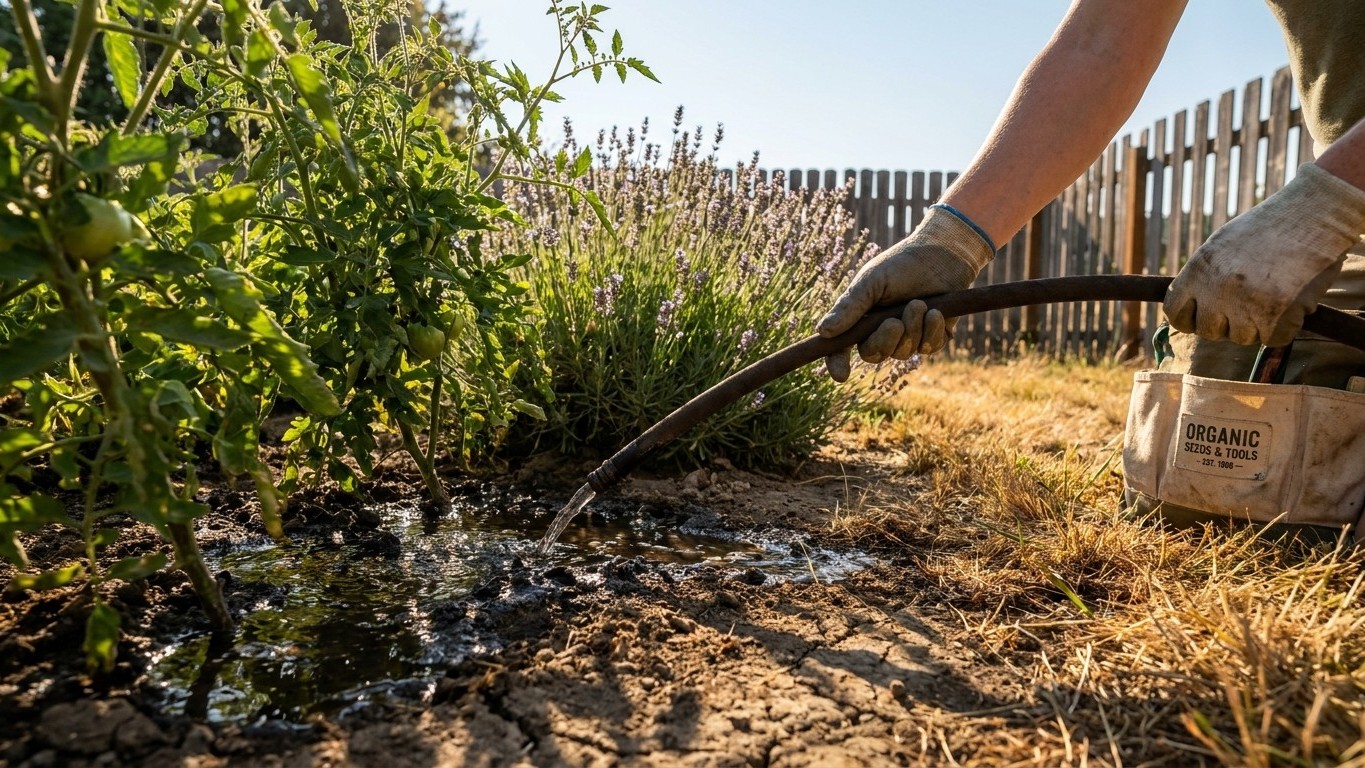

Water Oregon gardens the way the summer climate actually behaves: deep soakings at the base, in the morning, spaced to match what the soil holds rather than a daily habit. The state’s driest month delivers almost no rain while heat pulls it back out fast, so the gardener carries nearly the whole load until fall rains return.
What changes here

Two numbers ground everything that follows: July, the driest month at the reference station, averages just 0.51 inches of rain, and the region logs 11.9 days a year at or above 90F, based on the same 1991-2020 normals. Read together, they say the same thing a different way: the month when a garden needs the most water is the month the sky provides the least of it.
Run the arithmetic and the gap gets concrete. A vegetable bed or a perennial border wants roughly an inch of water a week to keep growing without stress. Spread July’s 0.51 inches evenly across that month’s four-plus weeks, and the sky is only delivering about 0.12 inch of that weekly inch, something close to an eighth of what the bed actually needs. The gardener has to supply the remaining 0.88 inch, every week, for as long as the dry spell holds. June runs wetter at 1.63 inches for the month and August sits close to July at 0.54 inches, so the gap doesn’t close until later rains arrive; across the three summer months the region averages about 2.7 inches total, against 36.9 inches for the full year.
How that 0.88 inch behaves once it’s on the ground depends on what’s underneath it. On sandy, fast-draining soil, water moves through quickly and roots can be dry again within a day or two of a soaking. On heavy clay, the same water sits near the surface for the better part of a week, which sounds convenient until a second watering arrives before the first has drained and roots start sitting in water instead of drawing from it. Neither of these normals is a forecast for one particular yard. A slope, a rain shadow, or a patch of pavement nearby can push the real number up or down, so a rain gauge on the actual property is what settles the question a climate average can’t.
How to water when it matters
The method that works here isn’t a gardening rule imported from somewhere wetter. It’s a response to a specific gap: almost no rain in July, real heat pulling moisture out of the top few inches of soil, and a root system that will only grow as deep as the water gives it a reason to. Watering deeply and infrequently, at the base of the plant, in the morning, addresses each part of that gap directly rather than by habit.
- Check soil at root depth before watering, not just the surface: push a finger or a trowel about two inches down. If it’s dry there, water now, no matter how the top half-inch looks.
- Water at the base rather than overhead, keeping the crown and leaves dry, since wet foliage held into the evening gives fungal disease the moisture and darkness it needs overnight.
- Water in the morning, ideally before 9 a.m., so roots take up the moisture before the day’s heat arrives and so any splashed leaves dry out well before evening.
- Soak until moisture reaches 6 to 8 inches down, then let the top few inches dry out before watering again. This pushes roots downward instead of keeping them shallow and dependent on frequent light watering.
- Adjust the rhythm to the soil underneath: on sandy ground, split the week’s inch into two shorter soakings every three to four days, because sand holds little and lets the rest through. On clay, apply the water more slowly in one session and wait, because clay holds a week’s supply and a second watering before it’s drained will drown roots rather than feed them.
- Start from about one inch of water a week across the bed, which works out to roughly 0.6 gallon per square foot, then watch how the plant and the soil respond and adjust from there rather than treating that figure as fixed.
That starting number is exactly that: a starting point to check against a particular patch of ground, not a rule that holds for every soil and every plant in the same yard.
What goes wrong
A daily sprinkle that never reaches the roots
Given 11.9 days a year at 90F or above, this is the mistake that costs the most here. Light, frequent watering wets only the top inch or two of soil, which trains roots to stay shallow because that’s where the moisture keeps showing up. Those shallow roots then sit in the hottest, driest layer of soil right when the heat is worst, and the plant stresses on exactly the days it can least afford to.
Watering the leaves in the evening
Overhead watering after work feels efficient, but wet foliage left through a cool overnight period is close to an invitation for fungal disease. Powdery mildew and similar problems spread fastest on leaves that stay damp for hours in the dark. Watering the base of the plant in the morning avoids the problem entirely.
Trusting a passing shower
A summer thunderstorm can look generous while wetting only the top half-inch of soil, with the rest running off before it soaks in. The sky isn’t a reliable report on what the roots actually received. A finger pushed two inches down after the rain settles the question a downpour’s noise can’t.
Skipping the mulch
Bare soil under a July sun gives back a large share of whatever water was just applied through straight evaporation. A few inches of mulch over the root zone slows that loss and stretches the time between waterings, which matters most in exactly the month, July, when the region’s own rainfall does the least.
Local help
The Oregon State University Extension Service publishes region-specific guidance on irrigation, soil, and plant selection for gardeners across the state. Watering restrictions during dry stretches vary by local water provider and can change through the season, so check current rules directly with the water district serving the property rather than relying on a general guideline.
Common questions
How much should I water an Oregon garden during a dry summer?
Start from about one inch of water a week, roughly 0.6 gallon per square foot, then adjust based on how quickly your particular soil dries out between waterings.
What’s the driest month for Oregon gardens?
July, averaging 0.51 inches of rain at the reference station, well below June’s 1.63 inches and close to August’s 0.54 inches.
Should I water clay soil the same way as sandy soil?
No. Sandy soil drains fast and needs shorter, more frequent soakings, while clay holds moisture for close to a week and can drown roots if watered again before it dries.
Is a summer rain shower enough to skip watering?
Not usually. A storm can wet only the top half-inch while the rest runs off. Check with a finger or trowel two inches down before deciding to skip a scheduled watering.