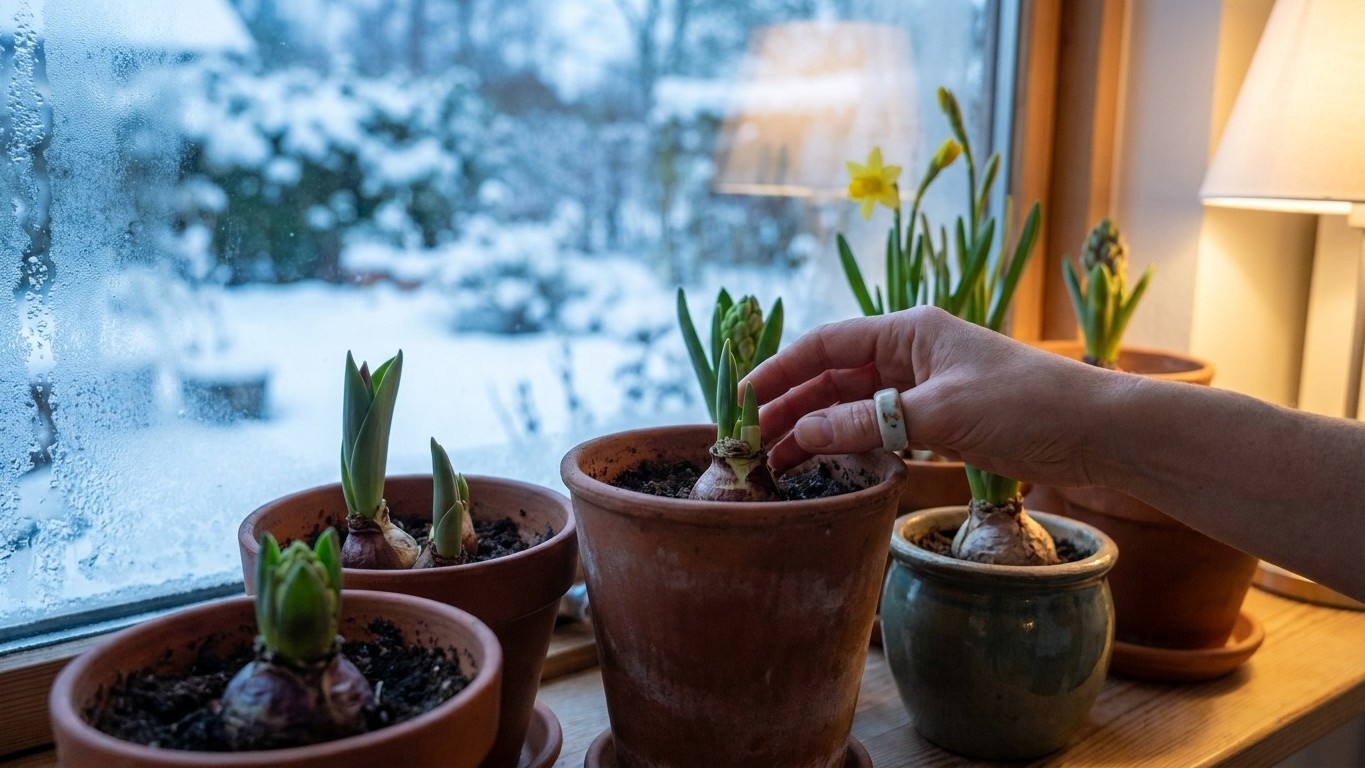

Forcing Spring Bulbs Indoors works in Pennsylvania by giving bulbs the cold period they need artificially, then bringing them into warmth and light on a schedule the gardener controls, not the calendar. It’s a technique for timing indoor bloom during winter, not a rescue for missing cold, since the state’s winters already deliver more chill than a bulb needs. The real risk here is a container freezing solid outdoors, which the ground itself never does.
Why this matters in Pennsylvania

Start with the number that settles the question: the mean daily minimum for the coldest month at the Philadelphia reference station is 26.0F, according to NOAA NCEI Climate Normals for 1991-2020. That’s a full 19 degrees below the 45F threshold a spring bulb needs to break dormancy. Over a normal winter, that gap holds for weeks at a stretch, not days. A tulip or daffodil planted in the ground in eastern Pennsylvania gets its twelve to fourteen weeks of chill without anyone doing anything for it.
That fact changes what “forcing” means here. In a place where winters never dip below 45F, forcing indoors is the only way to get a spring bulb to flower at all, since the garden can’t supply the cold on its own. Pennsylvania isn’t that place. Forcing here is a choice, useful for pulling a hyacinth into bloom on a windowsill in the middle of winter, or for timing daffodils to open for a specific week, not a workaround for a climate that falls short.
The hazard that does apply is the container itself. The USDA Plant Hardiness Zone Map, built on the 1991-2020 average annual extreme minimum, places Pennsylvania across a wide band, from zone 5a to zone 7b. That range matters because a bulb rated hardy for a given zone in the open ground is not automatically safe in a pot in that same zone. Ground insulates itself: the surface freezes and thaws while a few inches down, roots stay buffered. A pot has no such buffer. Cold reaches it from every side, and in a stretch of Pennsylvania winter weather, a small terracotta or plastic container left on a porch or a step can freeze straight through, soil and roots together, in a way open garden soil rarely does.
So the situation this territory sits in is the container-freeze problem, not the insufficient-cold problem. A gardener in Erie, in the Allegheny Plateau’s colder pockets near zone 5a, faces a sharper version of that risk than one in Philadelphia’s milder zone 7b, but the mechanism is the same everywhere in the state: it’s the pot, not the ground, that needs the gardener’s attention.
How to do it here
The steps below assume the gardener is potting bulbs specifically to force them into bloom indoors, using either an unheated garage or a refrigerator to supply the cold artificially, rather than leaving them in the ground where Pennsylvania winters already do the job.
- Pick bulbs suited to forcing (the next section names which ones reward the effort) and pot them shallowly in a container with drainage holes, noses just breaking the surface of the soil.
- Water the pot thoroughly right after planting, then let it drain fully before moving it anywhere. A soggy pot sitting in cold storage is the single most common cause of rot.
- Move the pot to a cold-but-not-freezing location for twelve to fourteen weeks. An unheated, attached garage that stays above freezing through winter works in most of Pennsylvania, but the reader should check it with a simple thermometer rather than assume: if it drops well below freezing on the coldest nights, the pot needs extra insulation or a different spot.
- If a refrigerator is the chilling site instead, use a crisper drawer and keep it away from any ripening fruit. Apples, pears, and other ripening produce release ethylene gas, and ethylene can kill the flower bud inside a bulb before it ever gets the chance to open.
- If the pot stays outdoors instead of in a garage or fridge, it needs to be rated at least two hardiness zones colder than the bulb’s own rating, since a pot has none of the ground’s natural insulation. Where that’s not practical, move the pot against a house wall and bank mulch or leaves around its sides.
- After the full cold period, check for a few inches of white root growth showing at the drainage holes and pale shoots pushing up through the soil. That’s the signal the bulb has taken up enough chill to move indoors.
- Bring the pot into a cool, dim spot for a few days first, then into bright, warm light. Skipping this transition and putting a just-chilled bulb straight into a sunny, warm window is the most common way to shorten or ruin the bloom.
Which bulbs are worth it
Not every spring bulb earns its space in a forcing pot. The ones that force well tend to share two traits: a cold requirement on the shorter side of that twelve-to-fourteen-week window, and a stem short enough to stand upright in a small container without staking. The ones that sulk usually fail on one of those two counts, needing more chill than most gardeners give them, or growing tall and top-heavy in a pot with no garden soil to anchor the roots.
It also matters that forced bulbs are almost always a one-season purchase. A tulip or hyacinth pushed to bloom indoors in winter rarely has the strength left to rebloom well if planted outside afterward, so treating it as disposable costs nothing extra. The bulb was already headed for the compost pile either way.
Force reliably
- Hyacinths, prized for forcing because of their shorter chill requirement and sturdy, compact stem
- Crocus, small enough to never topple and quick to respond once the cold period ends
- Paperwhite narcissus, which need no cold period at all and can go straight into a bowl of water and pebbles
- Miniature daffodils, such as the smaller narcissus types bred for pots rather than beds
- Short tulip varieties, chosen specifically for compact height
Sulk in a pot
- Tall trumpet daffodils, which grow leggy indoors and topple without garden soil to brace the roots
- Large-cup or tall tulip varieties, top-heavy once the flower opens
- Alliums, which demand a longer chill period than most gardeners are willing to give a houseplant
- Camassia and other late-blooming bulbs, whose long dormancy needs don’t suit an indoor timeline
What goes wrong, and when you can still fix it
Leaves come up, but no flower ever forms
This means the cold period ran short. The bulb had enough energy to push leaves but not enough stored cold to trigger a flower bud. There’s no fix this season: the leaves will fade, and the bulb should either go into the garden bed to recover on its own timeline or be discarded if it was a one-season variety like a forced tulip. Next attempt, add more weeks to the chilling period rather than less.
A flower opens, but on a stem too short to notice
This is a warming problem, not a cold problem. The bulb was moved from cold storage into full warmth and bright light too fast, and the stem never got the chance to elongate before the flower forced itself open. This season’s bloom is what it is, there’s no way to stretch a stem after the fact. Next time, hold the pot a few extra days in a cool, dim spot before moving it into full sun and heat.
Rot in the pot
Soft, mushy bulbs and a sour smell point to a drainage failure, either no holes in the container, or soil that stayed soaked through the chilling period. A rotted bulb can’t be revived this season, and there’s no partial save. The pot itself needs new drainage holes or a coarser, faster-draining mix before it goes back into use for the next batch.