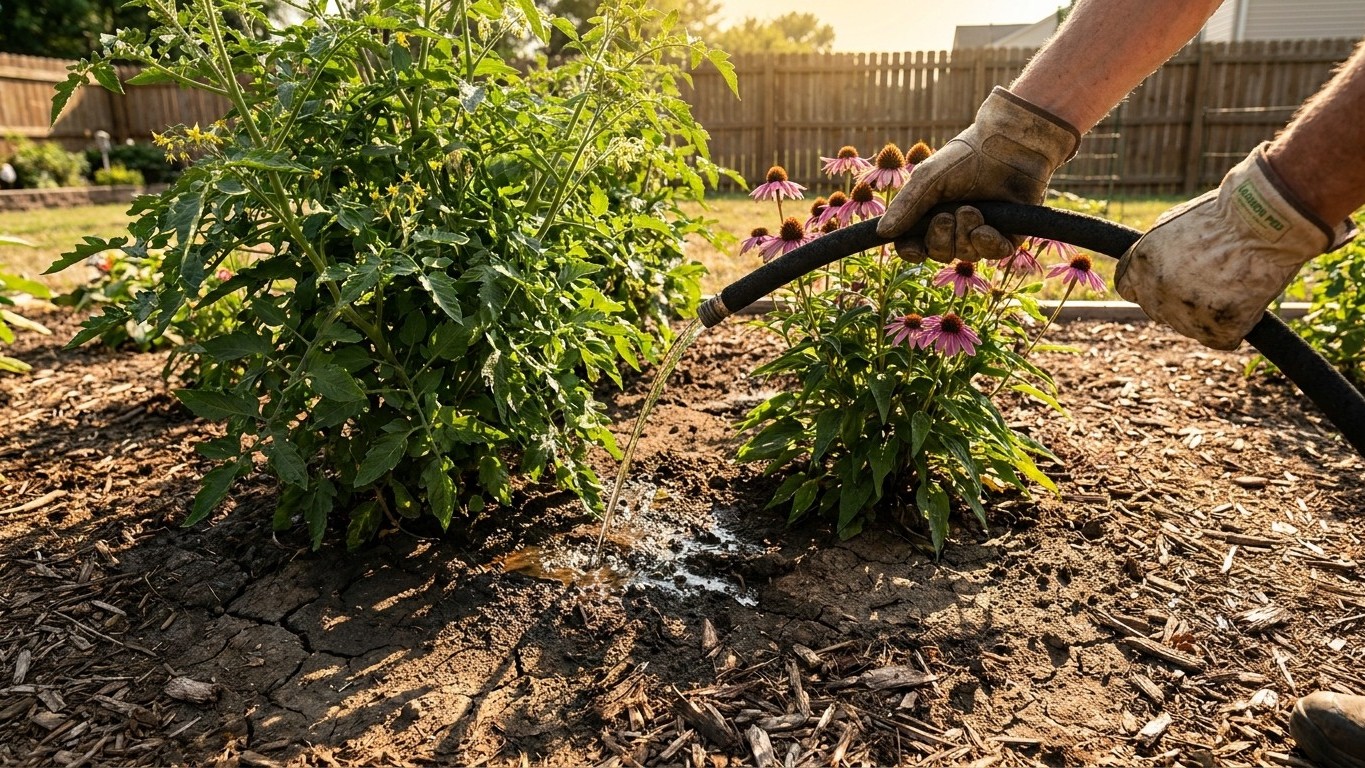

June is Pennsylvania’s driest summer month, averaging 4.04 inches of rain, while the state sees 24.0 days a year at or above 90F. Put together, that means the driest stretch of summer often lines up with the hottest days, so a garden bed can dry out faster than the rain gauge suggests. The fix is deep, infrequent watering at the base of plants, checked against your own soil rather than the calendar.
What changes here

Start with the two numbers that actually run the show: 4.04 inches of rain in June, the driest of the three summer months, and 24.0 days a year when the thermometer hits 90F or higher. Together they mean this: the month when a Pennsylvania garden gets the least rain is also sitting inside the window when heat load drives the most evaporation from soil and leaves. A bed that looks fine in May can start struggling by the second week of June for that exact reason.
Do the arithmetic and the gap gets specific. A vegetable or flower bed generally wants about an inch of water a week. June has roughly 4.3 weeks in it (30 days divided by 7), so 4.04 inches spread evenly works out to about 0.94 inch a week from the sky. That’s close to the target on paper, leaving a gardener to carry something like a tenth of an inch a week to hit that full inch. Sounds like nothing to worry about.
But rain in June rarely falls evenly. It tends to arrive as a couple of thunderstorms rather than a steady drizzle, which means long dry stretches broken by downpours that run off a compacted bed faster than they soak in. July and August actually get slightly more rain than June, at 4.38 and 4.29 inches, which is part of why June is the month gardeners get caught off guard: it’s the leanest month for rainfall, right as those 90-degree days start stacking up. Across the full year Pennsylvania averages 44.1 inches, so the state isn’t short on water overall. It’s the timing and the delivery, not the total, that catches a garden bed short in early summer.
Texture matters here too, even without a specific number to plug in. Sandy soil lets that 0.94 inch pass through within a day, leaving little in reserve for a hot stretch. Heavy clay holds onto the same inch for a week or more, but drowns roots if a gardener adds more before it’s had time to drain. Knowing which one you’re standing on changes everything about the schedule below.
How to water when it matters
The method that works in Pennsylvania’s climate isn’t complicated, but it runs against instinct for a lot of gardeners. Deep and infrequent beats frequent and shallow because roots grow toward where the water is. A quick daily splash keeps moisture in the top inch of soil, so roots stay shallow and vulnerable the moment a 90-degree day shows up. A deep soak pushes water down six inches or more, and roots follow it down, out of reach of the surface heat that dries things out fastest.
Morning watering matters for a related reason: it gives the plant hours to take up water before the heat of the afternoon starts pulling it back out through the leaves. Water applied at the base, rather than oversprayed across the foliage, avoids leaving leaves wet overnight, which is exactly the condition fungal disease needs to take hold.
Checking the soil rather than guessing is the part most gardeners skip. A finger pushed two inches down, or a trowel pulled up for a quick look, tells you whether the root zone is dry. If it’s dry at that depth, water. If it’s still damp, wait, even if the surface looks dusty.
- Push a finger or trowel two inches into the soil near the base of the plant to check moisture at root depth, not just on the surface.
- If dry at that depth, water slowly and deeply at the base until the top six inches of soil are moist, roughly one inch of water delivered in one or two sessions per week as a starting point.
- On sandy soil, shorten the interval and water more often in smaller amounts, since sand won’t hold a full week’s inch.
- On heavy clay, lengthen the interval and let the soil dry out between waterings, since clay holds moisture long enough that a second soak too soon will drown roots.
- Water in the early morning so plants take up moisture before the heat of the day and leaves dry off before evening.
- Recheck the finger test after each 90-degree stretch, since heat load pulls moisture out faster than a normal week and can shift the schedule by a day or two.
That one-inch, twice-a-week starting point is exactly that, a starting point. The only way to know if it’s right for your yard is to check the soil itself against it.
What goes wrong
A little water every day
Watering lightly every evening feels responsible, but it trains roots to stay near the surface where the next 90-degree day bakes them. The plant never has a reason to grow deeper, so it becomes more fragile with every week of shallow watering, not less.
Watering the leaves at night
Pennsylvania summers carry enough humidity that wet foliage left standing overnight is an invitation for fungal disease. Watering at the base in the morning avoids that window entirely. This is probably the mistake that costs a Pennsylvania garden the most, since the state’s combination of decent rainfall and warm, humid nights gives fungus exactly the conditions it needs if leaves stay damp until dawn.
Trusting a passing shower
A quick thunderstorm can look like it solved the watering problem for the week, but many summer storms drop their inch fast enough that most of it runs off a bed rather than soaking into the root zone. The only way to know is the same finger test: two inches down, dry means the storm didn’t do the job it looked like it did.
Skipping the mulch
Bare soil under a 90-degree sun gives back moisture almost as fast as it’s watered in. A two-to-three-inch layer of mulch slows that evaporation and keeps the soil from swinging between soaked and bone-dry within the same week.
Local help
Penn State Extension offers county-level guidance on soil testing and watering practices suited to local conditions across the state. Watering restrictions during dry spells vary by municipality and water provider, and they change from year to year, so check with your local water utility for current rules before setting up a regular watering schedule.
Common questions
How much should I water my garden per week in Pennsylvania?
About one inch a week is a reasonable starting point, adjusted for your soil type and checked with a finger test two inches down rather than followed as a fixed rule.
Is June really the driest month for watering in Pennsylvania?
Yes, among the summer months. June averages 4.04 inches of rain, slightly less than July’s 4.38 and August’s 4.29, which is why early summer beds often need the most attention even though total summer rainfall isn’t low.
Does Pennsylvania’s heat make watering more urgent than the rainfall numbers suggest?
It can. With 24.0 days a year at or above 90F, evaporation spikes during those stretches, pulling moisture out of soil faster than an average week’s rainfall replaces it, even in a month like June that comes close to the one-inch target on paper.
Should I water differently on clay soil versus sandy soil?
Yes. Sandy soil drains fast and needs shorter, more frequent watering, while clay holds water for a week or more and can drown roots if watered again before it has dried out.