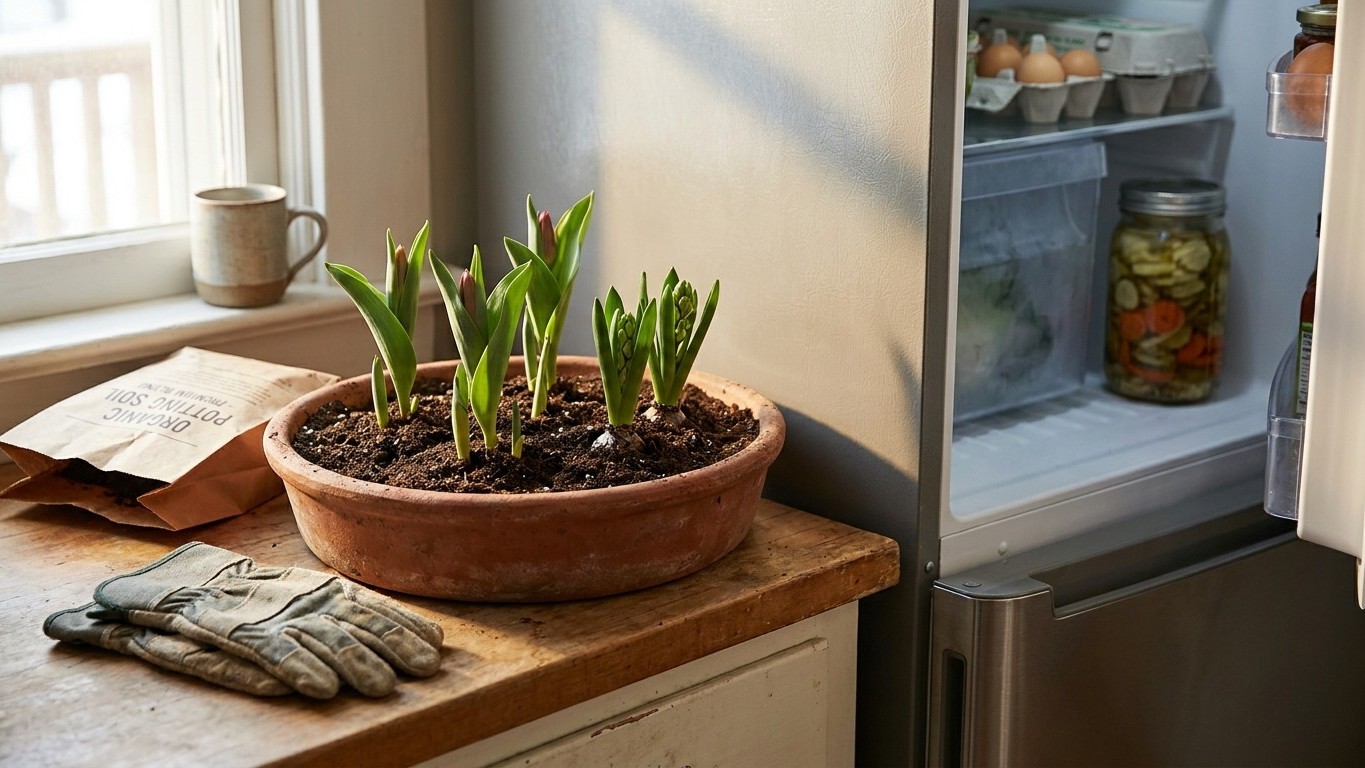

Spring bulbs in containers work in South Carolina, but not the way they do farther north. The state’s mild winter rarely hands bulbs the sustained chill they need, so growers here end up doing the refrigerator’s job themselves. Containers change the math again, since a pot loses heat faster than garden soil ever does.
Why this matters in South Carolina

The coldest month at the Charleston reference station averages a daily minimum of 38.9°F, according to NOAA NCEI Climate Normals for 1991 to 2020. That number sits below 45°F, which sounds like enough cold for a tulip or hyacinth. But a mean minimum isn’t the same as twelve to fourteen consecutive weeks of cold. It’s an average pulled from a season that also includes warm spells, sometimes stretching well above 50°F for days at a time along the coast. Those warm breaks interrupt the chill clock a bulb’s flower bud is running inside it, and an interrupted clock doesn’t add up the way a steady one does.
This is the situation that decides everything else on this page: South Carolina is a state where winter, left alone, often doesn’t deliver enough uninterrupted cold for many spring bulbs to bloom well. That’s why forcing, storing bulbs artificially at the right temperature for the right number of weeks, matters more here than in a Zone 5 garden where winter does the work for free.
The container question runs on a separate track. USDA hardiness zones across South Carolina span 7a to 9a on the 2023 Plant Hardiness Zone Map, built from 1991 to 2020 normals. That’s a wide range for one state, and it matters because a pot doesn’t insulate the way ground soil does. A raised container can freeze through, roots and all, at temperatures the surrounding earth never reaches. In the colder end of the state’s range, up toward 7a, that gap between pot and ground is worth planning around. Along the milder coastal stretch near 9a, deep pot freezes are less common, but they’re not impossible during a hard cold snap. Either way, a bulb rated hardy in a garden bed isn’t automatically hardy in a container left outside all winter in the same yard.
How to do it here
Forcing a spring bulb in a container is a sequence, and skipping a step usually shows up later as foliage with no flower or a flower that never clears the pot rim. Here’s the order that holds up in South Carolina conditions:
- Pick bulbs with a shorter chill requirement. Hyacinths and crocus generally need less cold than large daffodils, which makes them easier to satisfy fully in a state where winter chill is inconsistent.
- Find a spot that holds steadily below 45°F. An unheated garage often works if it stays above freezing but under that 45°F line, but South Carolina garages swing with outdoor temperatures more than northern ones do, so check with a thermometer over a few days before trusting it.
- Or use the refrigerator, away from fruit. The crisper drawer works well, but keep bulbs away from apples, pears, or any ripening fruit. Ripening fruit releases ethylene gas, and ethylene damages the flower bud forming inside the bulb before it ever gets planted.
- Log the weeks, not the calendar month. Twelve to fourteen weeks is the general window most spring bulbs need. Track it from the day chilling starts, since a garage that dips above 45°F on a warm spell doesn’t count those days the same way a refrigerator does.
- Match the pot to the bulb, or move it. If the container will sit outside through winter, it should be rated at least two hardiness zones tougher than the bulb inside it. If it isn’t, move the pot into an unheated garage or shed and mulch heavily around it during the coldest stretch.
- Pot up after chilling, then root in cool light before warmth. Plant in a well-draining mix, water, and keep the pot somewhere cool and bright, roughly 55 to 65°F, until roots establish. Only then move it toward warmer, brighter conditions for bloom.
Which bulbs are worth it
Not every spring bulb pays back the effort of forcing in a container, and the difference usually comes down to how long the chill requirement runs and how tall the finished stem gets. A bulb with a short chill window forces faster and more predictably. A bulb that grows a tall, top-heavy stem is fighting the pot the whole time it’s blooming.
Worth the trouble here:
- Paperwhite narcissus, which need no chill period at all
- Hyacinths, with a comparatively short chill requirement
- Crocus, small enough that pot instability is rarely an issue
- Short and species tulips, which stay low and sturdy
Likely to disappoint:
- Large trumpet daffodils, which need a longer chill period that’s harder to guarantee fully
- Tall standard tulip varieties, which tend to topple once the flower opens in a lightweight pot
- Bearded iris, which doesn’t respond well to forced chilling in a container at all
There’s a practical upside for the bulbs on the first list. In much of South Carolina’s warmer zones, tulips rarely rebloom well the following year even when planted directly in garden soil, since the ground doesn’t chill long enough naturally either. That means forcing a tulip in a pot costs nothing in the long run. The bulb was already a one-season purchase before it ever went into the container.
What goes wrong, and when you can still fix it
Leaves, but no flower
This usually means the chill period ran short. The bulb had enough stored energy to push up foliage but not enough completed cold to finish forming the flower bud inside it. There’s no fix this season. The bulb needs a full, uninterrupted chill cycle next winter, tracked in weeks rather than guessed at by the calendar.
A flower on a stem too short to see
This points to warmth arriving too early. The bulb was moved into bright, warm conditions before the roots had time to establish, so the plant rushed the bloom without the stem elongation that normally happens during that cooler rooting phase. Once the stem has already set, there’s little left to do this season beyond enjoying a shorter-than-expected flower.
Rot in the pot
Rot almost always traces back to drainage, either a pot without enough drainage holes or a potting mix that held water too long around the bulb. A rotted bulb can’t be saved this season. Discard it, and for the next planting, use a mix that drains freely and a container with real drainage holes, not just a decorative liner.