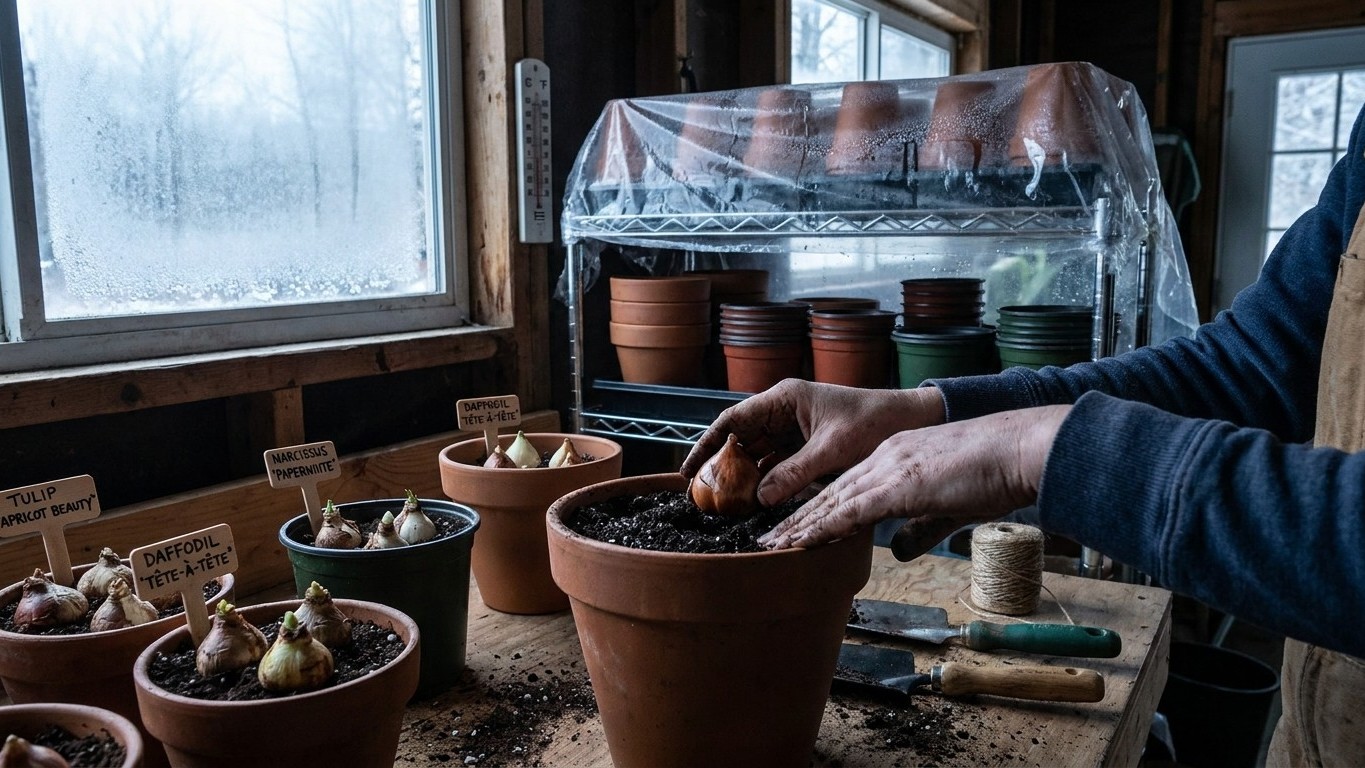

Forcing spring bulbs indoors works in South Dakota, but the reason isn’t a shortage of cold, the state has that in abundance. The real issue is timing bloom for the dead of winter and protecting a potted bulb from a freeze that goes clean through the container. The method needs 12 to 14 weeks below 45F, supplied in a refrigerator drawer or an unheated garage, before the bulb ever sees a warm room.
Why this matters in South Dakota

The average daily minimum for the coldest month at the Sioux Falls reference station sits at 8.5F, according to NOAA NCEI Climate Normals for 1991-2020. Spring bulbs need roughly 12 to 14 weeks under 45F to break dormancy and set a flower bud. At 8.5F, South Dakota clears that threshold with room to spare, often before Thanksgiving. This isn’t a state where a gardener has to hunt for enough chill hours. Forcing here is a scheduling tool, not a rescue.
The USDA Plant Hardiness Zone Map, 2023 edition, built on the 1991-2020 normals, places the state across zones 3b to 5b, a wide range that says a lot about how differently a bulb bed behaves depending on which corner of the state it sits in. That range describes bulbs planted in the ground, where soil mass insulates roots even as the surface freezes solid. A container has no such mass. A pot left outside doesn’t just get cold at the top, it freezes clear through, roots and all, because there’s no deep earth underneath holding a buffer of warmth.
That gap matters more than the zone number itself. A tulip rated hardy to zone 4 in a garden bed can die in a pot at the same address, because the container strips away roughly two zones’ worth of protection. Effectively, a potted bulb left outside in South Dakota is living through conditions closer to zone 1b or 2b. That’s the situation this state falls into: not a lack of cold, but a container problem, and it’s the reason forcing bulbs indoors, using a controlled cold source rather than the porch or the patio, is worth the extra step here even though outdoor winter chill is never in short supply.
How to do it here
The sequence stays the same regardless of which bulb goes in the pot, and every step can be checked with a thermometer or a look at the shoot.
- Pot the bulbs in a well-draining mix, in a container with drainage holes, in early to mid fall, setting each bulb at the depth given on its packaging.
- Water once, then move the pot into 12 to 14 weeks of cold below 45F, not into a freeze. An unheated garage that stays a few degrees above freezing works, as does the crisper drawer of a refrigerator, kept away from apples, pears, or any ripening fruit, since the ethylene gas fruit releases will kill the flower bud inside the bulb before it ever opens.
- Check the pot monthly and keep the soil barely moist. A bulb sitting in cold, wet soil for three straight months rots before the chill ever finishes its job.
- Watch for 1 to 2 inches of pale shoot growth. That’s the sign the chilling period has done its work, usually right around the 12 to 14 week mark.
- Bring the pot into a cool, dim room, around 60F to 65F, for about a week so the shoot can green up gradually. Moving a pot straight from a cold garage into a sunny, heated window shocks the plant into a stunted stem.
- Move the pot to bright light and normal indoor temperature. Bloom follows in 2 to 4 weeks, depending on the species.
- For any pot a gardener wants to leave outdoors instead of cycling through a fridge or garage, remember the container needs to rate at least two zones hardier than the bulb itself, which given this state’s 3b-5b range means looking for stock hardy to roughly zone 1b to 3b, stock that’s hard to find. The more realistic option is to move the pot into an unheated structure and bury it in mulch for the winter.
Which bulbs are worth it
Not every bulb pays back the effort of a chilling schedule and a windowsill wait. The ones that force well tend to share two traits: a short cold requirement and a stem short enough to stand up in a pot without staking.
- Paperwhite narcissus, no cold period needed at all, blooms in 3 to 4 weeks from potting, and since it isn’t hardy to overwinter outdoors in this state anyway, forcing it costs nothing in the long run.
- Hyacinths, a shorter chill requirement than tulips and a sturdy, upright stem that holds its own weight.
- Crocus, a short chill period and a stem low enough that toppling is never an issue.
- Miniature daffodils such as the ‘Tete-a-Tete’ type, short stems that don’t flop the way full-size trumpet daffodils do.
- Amaryllis, not a hardy spring bulb at all, needs no chill period, and delivers a large bloom that makes it a popular one-season purchase.
Others sulk more often than they perform.
- Tall, single late tulips, a long chill requirement paired with a tall, top-heavy stem that leans or falls in a pot.
- Giant alliums, tall stems and long chilling needs that make the timing hard to hit indoors.
- Fritillaria, notoriously uneven results when forced, with bloom quality varying pot to pot.
- Large trumpet daffodils like the King Alfred type, tall stems that flop without staking once they’re indoors and warm.
What goes wrong, and when you can still fix it
Leaves but no flower
This means the cold period ran short. The bulb produced foliage because it had enough energy stored to grow leaves, but it never got the signal to set a flower bud. There’s no fix this season, the bloom simply isn’t coming. If the bulb is a hardy type suited to this state’s zones, it can go into a garden bed to rebuild its reserves for next year. A one-season type like a paperwhite is done and gets composted.
A flower on a stem too short to see
This happens when the pot moved from cold storage into heat and light too fast, skipping the gradual, cool greening-up week. The stem has already formed short and can’t be coaxed longer once it’s growing. This season’s bloom is what it is. Next time, add that intermediate cool, dim week before moving the pot to a bright, warm spot.
Rot in the pot
Soft, mushy bulbs after weeks in cold storage almost always trace back to drainage. A container without enough holes, or soil kept too wet through the whole chilling period, keeps the bulb sitting in cold water it was never built to tolerate. This is not fixable this season, the bulb is lost. Next time, use a container with real drainage and let the soil dry to barely moist rather than damp before setting it into the cold.
Related guides
- Growing Spring Bulbs in Containers in South Dakota
- Forcing Spring Bulbs Indoors in Tennessee