
Garlic grows well in British Columbia, but the province is not one climate, and the answer changes with elevation. Environment and Climate Change Canada’s 1981-2010 climate normals put the average first fall frost at Vancouver International Airport on November 10, and that single figure anchors both When to Plant Garlic in British Columbia, the guide gardeners rely on, and the choice between hardneck and softneck types. Coastal growers near sea level should lean softneck and plant with an eye on soil cooling rather than a hard freeze, while anyone gardening in the interior or at higher elevation should check their own frost history before assuming Vancouver’s date applies.
Will garlic get the cold it needs in British Columbia

Garlic clove division is not automatic. A clove planted without enough cold sits in the ground, roots, and comes up in summer as a single round bulb with no internal cloves at all, essentially a giant single-clove garlic. University of Georgia Extension bulletin C854 sets the requirement at six to eight weeks of soil temperatures below 40°F before the plant will commit to splitting into cloves. That number was worked out for the Southeast, but the biology behind it is universal: garlic needs sustained cold, not just a frost or two, to trigger division.
The six-to-eight-week test
British Columbia does not answer this question with one climate. Coastal areas near Vancouver sit under Pacific air that keeps winters mild and wet, and while the region’s growing-season temperature data (drawn from the disease pressure figures used later in this guide) show the cold months running well below 50°F, that is a long way from confirming a sustained run below 40°F for six to eight straight weeks. Some winters on the coast will clear that bar comfortably. Others, especially in a mild year, will fall short, and a grower who assumes otherwise ends up with a bed of round, undivided bulbs. Move inland or upslope, into the Fraser Valley uplands, the Interior Plateau, or the Kootenays, and the cold season deepens and lengthens, making the six-to-eight-week threshold far easier to clear without any help from the gardener.
Two ways around a mild winter
A coastal grower who is not confident their garden gets enough sustained cold has two real options, and neither one is “don’t bother.” The first is to refrigerate the seed cloves before planting, holding whole heads (not broken into cloves until just before planting) at refrigerator temperature for four to eight weeks ahead of the planting date. This substitutes a controlled cold spell for one the winter might not deliver. The second is to sidestep the problem by choosing softneck types from this guide to Garlic Varieties That Suit British Columbia Winters, since softneck types divide reliably even where winter cold is inconsistent and are the type most often grown in mild-winter regions worldwide. Neither workaround is a downgrade. A softneck bulb from a mild coastal garden stores longer in the pantry than most hardneck types manage anywhere.
When to put the cloves in
Garlic is planted in autumn and harvested the following summer, and the planting window is set by working backward from the ground freezing, not forward from a calendar month. The goal is a clove that has time to grow roots before the soil locks up cold, but not so much time that it pushes tall green top growth that then gets knocked back hard by winter. Using Environment and Climate Change Canada’s Vancouver normal of November 10 as the reference point, planting roughly three to five weeks ahead of that date gives the clove enough autumn soil warmth to root without leaving enough growing season for much leaf growth. That points to a window running from late September through mid-October for gardens near the coast, which lines up with the mid-October planting figure that applies across all fourteen garlic cultivars grown in this region’s catalog data.
Reading the frost date correctly
Treat November 10 as a midpoint, never as a safe date to plan around. Environment and Climate Change Canada’s normals are averages of 30 years of data, which means that in roughly half of those years, the first fall frost at Vancouver’s station arrived later than November 10, and in the other half it arrived earlier. A grower who waits until early November to plant, banking on the average holding, is gambling on the half of years that go their way. Planting inside the three-to-five-week window ahead of the mean date, rather than right up against it, absorbs that uncertainty.
What shifts the window
The Vancouver airport figure describes one station on a low-lying coastal plain. Move even a short distance and the picture changes. Higher elevation cools faster in autumn and pushes the effective planting window earlier. A large body of water, including the Strait of Georgia itself, moderates the air around it and can delay the first frost compared to inland sites at the same latitude. Low-lying frost pockets, the kind that collect cold air on still nights, will frost well ahead of the regional average even within the same valley. Anyone gardening outside the immediate Lower Mainland should treat the Vancouver figure as a reference point to adjust from, not a number to copy directly.
Which types Suit British Columbia
Hardneck and softneck garlic split on winter, not on taste. Hardneck types send up a rigid central flower stalk (the scape, which is cut off and never allowed to flower or set seed) and generally need a real winter cold season to perform and divide well. Softneck types have no scape, tolerate a milder winter without complaint, and cure down into the tight, long-storing braids most grocery-store garlic comes from.
Given the coastal Lower Mainland’s mild, wet winters, softneck cultivars are the more forgiving choice for gardeners near Vancouver and along the south coast generally. Early Red Italian, Inchelium Red, Italian Late, and Lorz Italian are all softneck varieties suited to a mid-October planting in this territory, with first bulbs ready to lift in late June the following summer according to catalog figures for the type. These varieties also store considerably longer in a pantry or root cellar than hardneck garlic typically manages, which matters more in a region where garlic is grown for the kitchen year-round rather than for a farmers’ market scape crop.
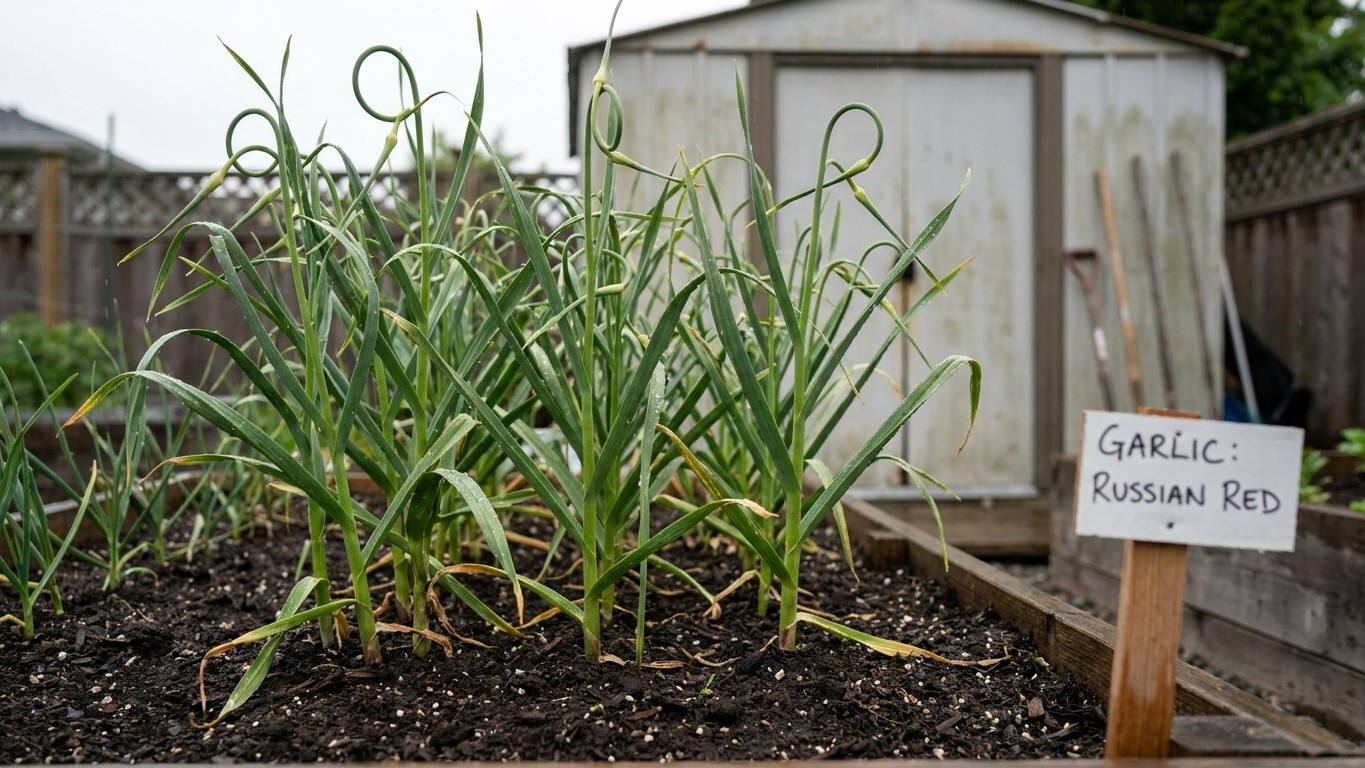
Gardeners in the BC Interior, the Kootenays, or at meaningful elevation, where winter cold is deeper and more dependable, can grow hardneck types with more confidence that the cold requirement will be met without help. German White, Duganski, Chesnok Red, and Georgian Fire are hardneck cultivars set out on the same mid-October schedule, first ripe in late June. Hardneck garlic tends to carry the stronger, more complex flavor that serious cooks look for, and it also produces the scape, an edible bonus harvest cut off in early summer that softneck garlic does not offer. The tradeoff is a shorter shelf life after curing, typically a few months rather than most of a year.
This is close to the reverse of California‘s problem, where mild winters over most of the state push growers toward softneck almost by default, as covered in our guide to growing garlic in California. New York sits at the other extreme, with winters cold enough that hardneck is the standard recommendation across most of the state, discussed in our guide to growing garlic in New York. British Columbia’s coast and interior split the difference, and matching the type to your specific microclimate matters more here than in either of those states.
Soil and bed preparation
Garlic spends eight or nine months in the ground here, through the wettest part of the British Columbia year on the coast, and drainage decides more outcomes than any other single factor. A clove sitting in saturated soil through a rainy Pacific winter will rot before any disease organism gets the chance. Raised beds or ridged rows are worth the extra effort on any site with heavy clay or a high water table, and they cost nothing once built.
Work compost or well-rotted manure into the bed several weeks before planting, not at planting time. Garlic is a heavy feeder over its long season, but fresh, undecomposed organic matter right at the clove can encourage rot in wet ground rather than feeding the plant. A soil test ahead of planting will tell you where your pH and nutrient levels actually stand rather than guessing, and it is worth doing once per bed rather than assuming last year’s numbers still hold.
Break up compaction to a full spade’s depth so roots can run down rather than being forced sideways, and rake the bed to a fine, even tilth before setting cloves. Remove perennial weed roots now. A weed that gets established alongside garlic in October has all winter to build a root system before you can do anything about it, and by spring it is competing directly with a crop that has no ability to outgrow it quickly.
What the climate here favours, and what it does not
UC IPM’s Pest Management Guidelines for onion and garlic (UC ANR Publication 3453) publish the temperature ranges in which four major garlic diseases become active, and those ranges can be checked against typical monthly air temperatures for this region. Two cautions matter before reading the numbers. First, the published thresholds are soil temperatures, while the figures used here are air temperatures, so a month falling inside a disease’s range is a tendency toward risk, not a diagnosis. Second, a monthly average hides real day-to-day swings, so a month that averages inside a range still contains days well outside it.
White rot and Fusarium basal rot
White rot, caused by the fungus Sclerotium cepivorum, has a published range of 50-75°F, and this region’s growing-season air temperatures fall inside that range in five months: September, October, May, June, and July, with two of those months landing at the pathogen’s published optimum. That is the widest window of any disease covered here, and it is the one to watch most closely, particularly since white rot survives in soil for years once introduced and has no effective in-season cure. Fusarium basal rot, caused by Fusarium oxysporum f. sp. cepae, has a narrower published range of 59-90°F, matched here in two months, June and July.
Southern blight and pink root
Southern blight (Sclerotium rolfsii) and pink root (Setophoma terrestris) both need real heat, with published optimum ranges of 86-95°F and 75-85°F respectively. No month in this region’s growing season reaches either optimum on average. That does not mean either disease is impossible here. Infected planting stock or introduced soil can bring a pathogen into a garden regardless of climate, and being outside a published optimum only means the disease runs less aggressively, not that it cannot establish at all.
| Disease | Pathogen | Months in published range | Risk category |
|---|---|---|---|
| White rot | Sclerotium cepivorum | 5: Sept, Oct, May, June, July (2 at optimum) | Critical |
| Fusarium basal rot | Fusarium oxysporum f. sp. cepae | 2: June, July | Critical |
| Southern blight | Sclerotium rolfsii | 0 at optimum (86-95°F) | High |
| Pink root | Setophoma terrestris | 0 at optimum (75-85°F) | High |
Buying certified disease-free seed garlic and rotating away from the allium family for several years on any bed that has grown onions or garlic before are the two practical steps this table points to, regardless of which part of the province you garden in.
Getting it through the winter
Mulch is the main tool for carrying garlic through a British Columbia winter, and how you use it depends on which side of the province you are on. On the mild coast, mulch is mostly about moderating wet-cold cycles and suppressing winter weeds rather than insulating against deep freeze. In colder interior gardens, mulch does real insulating work and matters more.
Lay three to four inches of straw or shredded leaf mulch over the bed once the ground has cooled but before a hard freeze sets in, never right after planting while the soil is still warm, since trapping that warmth under mulch can encourage the clove to push top growth too early. Straw is preferred over hay because hay carries weed seed that will germinate right alongside the garlic in spring.
Watch for frost heaving on any bed where cloves went in shallow. Repeated freeze-thaw cycles, more common on the coast where winter temperatures hover near the freezing point than in a steadily cold interior, can lever a shallow clove partway out of the ground, exposing it to cold and drying air. Planting cloves at a proper depth, with the tip roughly two inches under the soil surface, resists heaving far better than a shallow-set clove under a thick mulch layer.
Pull mulch back gradually in spring once new green shoots are visible and the hardest frosts have passed, rather than stripping it all at once. Leaving a thin layer down even after growth resumes continues to suppress weeds through the plant’s long summer growing period without smothering the emerging leaves.
Harvest and curing here
Lift garlic by reading the plant, not a date on the calendar. The reliable signal is the leaves: once the lower third to half of the leaves have browned and died back while the upper leaves are still green, the bulb is mature. Pulling too early leaves cloves undersized and papery skins underdeveloped. Waiting too long past this point lets the bulb wrappers split and the individual cloves separate in the ground, which ruins storage life even though the garlic itself is still edible.
Curing is where a lot of otherwise well-grown garlic gets lost, and the coastal climate makes it harder than in a hot, dry inland summer. Garlic needs two to three weeks of warm, dry, well-ventilated air to cure properly, with the outer wrapper drying down tight around the bulb and the neck constricting fully. On the humid coast, that airflow has to be provided rather than assumed. Hang bulbs in loose bunches or lay them on mesh racks in a covered, open-sided space, such as a carport or a screened porch, with a fan running if the air feels at all still or damp. Do not cure garlic in direct sun or in a closed space with poor air movement. Mold and soft rot spreading through a curing batch is almost always a ventilation failure, not a sign the bulbs were unhealthy going in.
Local help
County-level frost dates, soil testing, and disease diagnosis are all things a provincial reference station three counties away cannot answer precisely. British Columbia’s Ministry of Agriculture and Food is the place to check for local growing conditions, soil test services, and current disease advisories before committing a whole bed to garlic, particularly if you garden well outside the Lower Mainland where the Vancouver figures used throughout this guide apply least directly.
Common questions
Can I Plant Garlic in spring in British Columbia instead of fall?
You can, but expect a smaller bulb. Garlic planted in spring skips most or all of the cold period that triggers clove division, and even where it does divide, the shortened season before summer heat sets in usually produces undersized heads compared to fall-planted garlic.
Why did my garlic come up as one big round clove instead of a full head?
That is a classic sign of insufficient cold before or during early growth, the same issue covered in the section on winter cold above. It is also sometimes caused by planting too late in spring rather than fall. Either way, the round bulb is edible, just not what you were growing for.
Is it too wet on the BC coast to grow garlic well?
Rainfall itself is not the problem, drainage is. A raised bed or ridged row that sheds water through the winter will grow garlic fine in a wet coastal climate. Flat, heavy clay ground that holds standing water is where coastal growers lose cloves to rot before spring.
Do I need to remove the scape on hardneck garlic?
Yes, cut it once it curls, typically in early summer before harvest. Removing the scape redirects the plant’s energy into bulb size rather than the flower stalk, and the scape itself is edible, often used like a mild garlic-flavored green in cooking.
Can I use grocery store garlic as seed stock?
You can, but it carries real risk. Grocery garlic is often treated to suppress sprouting, may not be a cultivar suited to your climate at all, and can introduce soil-borne diseases like white rot into a garden that has never had a garlic problem before. Certified seed garlic from a known source avoids all three issues.