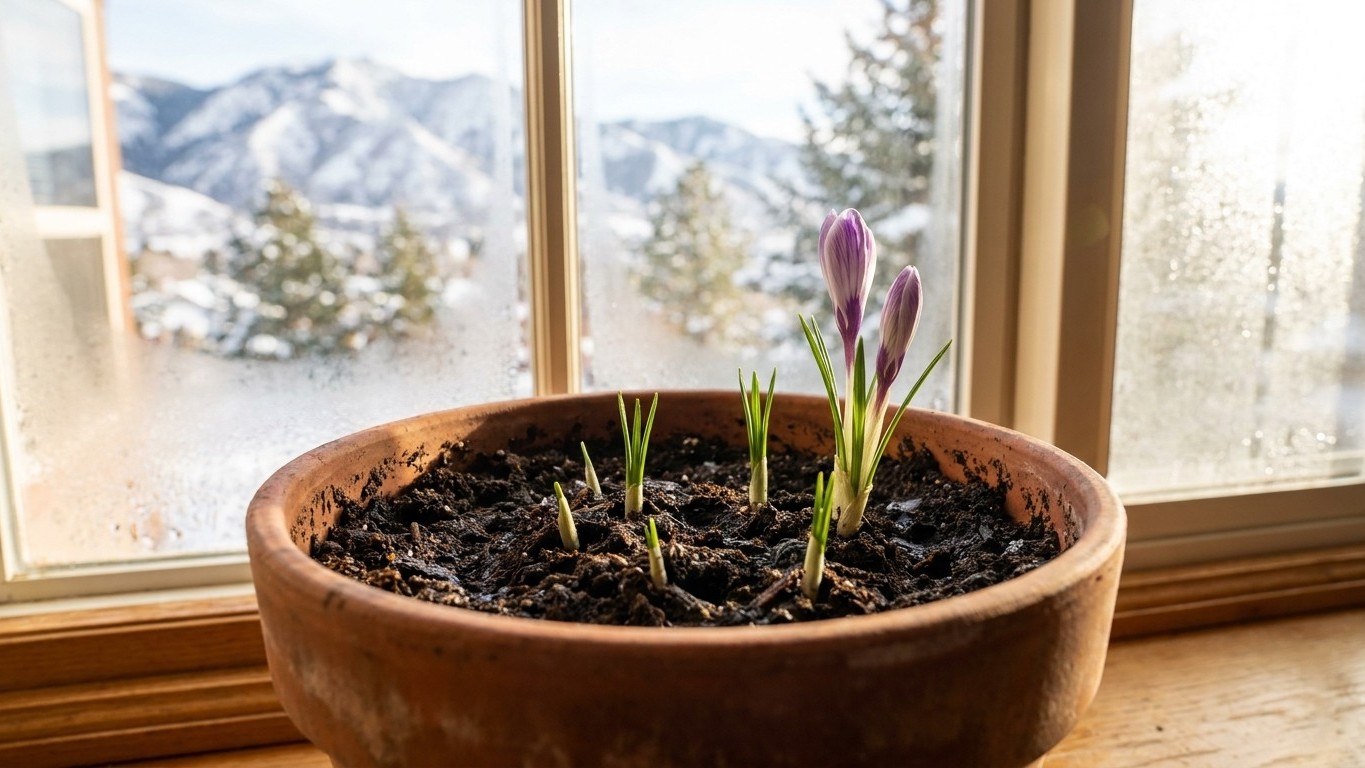

Forcing spring bulbs indoors works in Utah, but the reason to bother isn’t a shortage of winter cold. Salt Lake City’s ground gets plenty of chill on its own. What forcing actually solves here is timing (blooms in January instead of April) and the container problem: a pot left outside freezes clean through in a way garden soil never does.
Why this matters in Utah

Salt Lake City’s coldest month, historically January, has a mean daily minimum of 24.2 degrees Fahrenheit, according to NOAA’s 1991-2020 Climate Normals for the reference station there. That’s the number that actually decides winter hardiness for a bulb sitting in the ground, not the record cold snap neighbors swap stories about at the mailbox. A spring bulb typically needs somewhere in the range of twelve to fourteen weeks with soil temperatures below 45 degrees to complete the chill process that lets it bloom on schedule. With a coldest-month average minimum sitting at 24.2 degrees, ground-planted bulbs in this territory pile up that chill naturally over the stretch from roughly November through February, no help required.
That puts Utah in a different bucket than states where forcing is a workaround for a winter that never gets cold enough. Here, a tulip or daffodil bulb planted in a garden bed doesn’t need a gardener to manufacture cold for it. The soil does the job.
The catch is containers, and it’s a real one. Utah spans a wide swing of USDA hardiness zones, from 4a up in the higher mountain terrain to 9a down around the state’s low desert, according to the USDA Plant Hardiness Zone Map (2023, built on 1991-2020 normals). That range is too broad to apply as a single number to any one yard, which is why the map is built around reference cities rather than a blanket statewide zone. What holds true regardless of where in that range a particular yard falls is this: a pot has no thermal mass around it the way garden soil does. Roots in a container are exposed to freezing air on every side, not just from above. A bulb rated hardy for the ground in a given zone can still die in a pot in that same zone, because the pot effectively behaves like a colder zone than the ground it’s sitting on.
That’s the situation this territory is actually in. Ground beds already get the cold they need. Containers don’t get a pass just because the yard around them does.
How to do it here
Forcing indoors is a controlled version of what the ground already does naturally, just moved into a spot the gardener can watch and time. The sequence matters more than any single step in isolation.
- Pot the bulbs shoulder to shoulder in a container with drainage holes, tips near the soil surface, and water once so the soil settles around the roots.
- Move the pot somewhere that holds a steady 35 to 45 degrees for the full twelve to fourteen weeks. An attached, unheated garage is the usual first choice, but check it with a thermometer rather than assuming. On the coldest nights here, when outdoor lows sit well below freezing (Salt Lake City’s January mean minimum is 24.2 degrees), a detached or poorly insulated garage can drop below freezing too, which damages the bulb rather than chilling it properly.
- If the garage runs too cold or too warm to hold steady, use a spare refrigerator or a produce drawer instead, kept well away from apples, pears, and other ripening fruit. Ripening fruit gives off ethylene gas, and ethylene can kill the flower bud forming inside the bulb before it ever has a chance to emerge.
- Check the pot every couple of weeks and water lightly if the soil has dried out. The cold period isn’t a storage period; the bulb is still alive and rooting.
- Once the chill weeks are complete and pale shoots have pushed up an inch or two, bring the pot into a cool room, around 60 to 65 degrees, with indirect light for about a week. This lets the shoot green up gradually instead of shocking it into weak, floppy growth.
- Move the pot to a brighter, warmer spot to finish flowering, and rotate it every few days so the stem doesn’t lean hard toward one light source.
Anyone who’d rather skip the garage-or-fridge routine and just chill a potted bulb outdoors needs to apply the container rule directly: an unmulched pot left outside needs a bulb rated at least two USDA zones hardier than the zone it’s actually sitting in, because the pot offers none of the insulation the surrounding ground provides. Short of finding a bulb that hardy, the alternative is moving the pot into an unheated garage and mulching it heavily once outdoor ground temperatures start dropping toward freezing.
Which bulbs are worth it
Not every bulb rewards the effort of forcing, and the difference usually comes down to two things: how much cold the bulb needs before it’ll bloom, and how well its stem holds itself up once it’s growing in a pot with no garden bed around it for support.
A short cold requirement means a faster path to bloom, which is most of the appeal of forcing in the first place. A short, sturdy stem means the flower doesn’t flop over the side of the pot once it opens. Bulbs that fail one or both of those tests usually aren’t worth the shelf space in the garage or fridge.
- Paperwhite narcissus — needs no cold period at all, blooms in a matter of weeks, and since it’s tender in Utah’s ground anyway, it was never going to be a repeat-bloomer here regardless of how it’s grown.
- Hyacinth — among the shorter cold requirements of the hardy bulbs, with a stem sturdy enough to stand up in a container.
- Crocus — low, compact growth that rarely topples.
- Muscari (grape hyacinth) — small and short-stemmed, forgiving for a first attempt.
- Dwarf daffodil varieties — the shorter cultivars force cleanly where taller ones don’t.
- Tulips — a longer cold requirement combined with a tall, top-heavy stem that tends to flop in a pot without staking.
- Large trumpet daffodils — the height that looks good in a border becomes a liability in a container.
- Fritillaria — an erratic bloomer indoors, with results that vary too much to count on.
- Alliums — tall growth habit that’s simply awkward to manage indoors.
Where a bulb was already a one-season purchase, like paperwhites, forcing doesn’t cost anything long-term. It was never going back in the ground to rebloom regardless of how it was grown.
What goes wrong, and when you can still fix it
Leaves, but no flower
This means the cold period ran short of the twelve to fourteen weeks the bulb needed. The flower bud inside never finished forming properly. There’s no fix for this season’s bulb; the leaves can be allowed to die back naturally, and the bulb can go into the garden bed where Utah’s own winter will supply a full, uninterrupted chill next time around.
A flower stuck low, tangled in the foliage
This is the sign of a bulb warmed up too fast after its cold period, without the gradual week in a cool, dim room first. The stem never got the chance to elongate before the flower opened. This season’s bloom is what it is; the fix is procedural, for the next batch, not something to reverse on this one.
Rot in the pot
Soft, mushy tissue at the base of the bulb almost always means water sat against it during the cold weeks, usually from a blocked drainage hole or a saucer that was never emptied. Once rot has set in, the bulb isn’t salvageable. The fix is for the next container: drainage holes checked before potting, and the pot raised slightly off any saucer so water has somewhere to go.