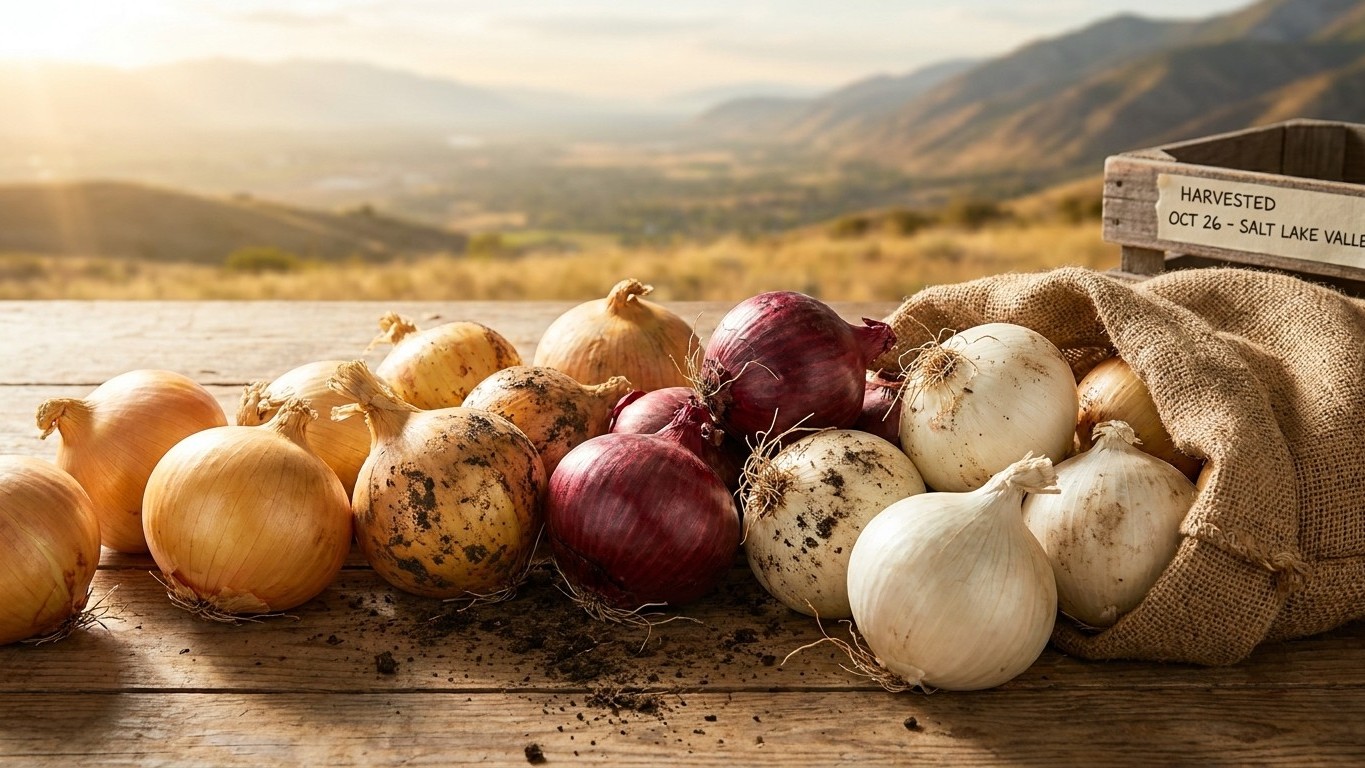

Utah sits at a latitude where both long-day and intermediate-day onions bulb reliably, while short-day types fail outright and a couple of far-northern long-day varieties fall just short of what the state’s daylight can trigger. The reference point is Salt Lake City, at 40.78 degrees north, where the longest day of the year delivers 14 hours and 56 minutes of daylight. That single number decides which onions belong in a Utah garden and which ones don’t.
The short answer for Utah

At 40.78 degrees north, Salt Lake City’s longest day tops out at 14 hours and 56 minutes of daylight. Long-day onions need 14 to 16 hours of daylight before they’ll stop building leaves and start building a bulb, and intermediate-day types trigger somewhere between 12 and 14 hours. Both groups fit comfortably inside what Utah’s summer sky delivers. That’s the whole answer, and it’s why gardeners across the Wasatch Front and down through most of the state have two full groups of onions to choose from instead of one.
On the long-day side, nineteen varieties in this territory’s documented range cover 40.78N. Ten of them are long-day types: Ailsa Craig, Barolo, Blush, Bridger, Frontier, New York Early, Patterson, Red Carpet, Rossa di Milano, and Walla Walla Sweet. These are the classic storage-leaning and slicing onions gardeners in the Mountain West have grown for generations, and Salt Lake City’s daylight hits their trigger point with room to spare.
Intermediate-day varieties that also work
Nine intermediate-day varieties are documented for this latitude as well: Cabernet, Calibra, Elsye, Expression, Monastrell, Red Long of Florence, Red Long of Tropea, Scout, and Sierra Blanca. Intermediate-day onions trigger a bit earlier in the season than long-day types, which means they can be a good fit for a shorter growing window, or for a gardener who wants an earlier harvest alongside a later long-day crop planted in the same bed.
Nothing about warmth enters this calculation. A hot July in Provo or a cool one in Logan doesn’t change when an onion bulbs, because the trigger is the clock, not the thermometer. Day length is the only variable that matters here, and at Utah’s latitude, that clock lines up with two of the three onion groups.
What will not work here
Short-day onions are built for latitudes well south of Utah, and planting them here isn’t a case of “might struggle.” It’s a guaranteed failure. A short-day variety starts bulbing once daylight hits roughly 12 hours, which in Utah happens in early spring, long before the plant has grown enough leaf mass to build a proper bulb. The result is a small, often unusable onion, because the plant gets the signal to stop growing leaves and start bulbing while it’s still practically a seedling.
- Gabriella — short-day, published for 20-35N, far south of Utah’s trigger window
- Madalyn — short-day, published for 20-35N, bulbs too early to size up
- Red Rock — short-day, published for 30-36N, wrong latitude group entirely
- Red Sensation — short-day, published for 25-35N, same failure pattern
- Texas Grano 1015Y — short-day, published for 25-35N, a Gulf Coast onion, not a Mountain West one
- Vidora — short-day, published for 25-35N, triggers before the plant is ready
- White Castle — short-day, published for 30-38N, still south of what Utah’s daylight demands
At the other end of the spectrum, two long-day varieties need more daylight than even Salt Lake City’s longest day provides. Powell (published for 43-47N) and Redwing (published for 43-65N) are built for latitudes north of Utah, places where summer days stretch past what the Wasatch Front ever sees. Plant either one here and the day never gets long enough to flip the bulbing switch. The plant keeps making leaves all season, then rots in the ground come fall. That’s not a small onion. That’s no onion at all, and it’s a variety mistake, not a feeding or watering mistake.
What changes across Utah
Utah isn’t one latitude, it’s a state that runs roughly five degrees from its southern tip near St. George up to its northern border near the Idaho line. The 40.78-degree figure and the 14-hour-56-minute daylight number both belong to Salt Lake City specifically, sitting close to the middle of that range. A gardener near St. George, several degrees south, sees a shorter longest day than Salt Lake City does. A gardener near the northern border sees a longer one.
| Approximate location | Relative latitude | Day length on longest day | What it changes |
|---|---|---|---|
| Southern Utah (near St. George) | Several degrees south of 40.78N | Somewhat shorter than 14h56 | Blurred-zone varieties like Candy may bulb better here than farther north |
| Salt Lake City (reference point) | 40.78N | 14h56 | Full range of 19 documented long-day and intermediate-day varieties applies |
| Northern Utah (near Idaho border) | Several degrees north of 40.78N | Somewhat longer than 14h56 | Safrane and Talon move closer to a safe bet; Powell and Redwing may edge into range |
This matters most for the three varieties sitting in the blurred zone: Candy (intermediate-day, 33-40N), which is at its northern edge in Salt Lake City and may do better in Utah’s southern counties, and Safrane and Talon (both long-day, 42-50N), which sit just above the reference city’s latitude and stand a better chance in Utah’s northernmost gardens. None of these three are a flat yes or no here. They’re an edge case, and where a reader gardens within the state changes which side of that edge they’re on.
Sweet now, or onions that last
Utah’s mix of long-day and intermediate-day onions hands gardeners a real trade-off, and it comes down to chemistry rather than luck. The compounds that give an onion its sharp bite are volatile sulfur compounds, and those same compounds are what protect the bulb during months in storage. According to University of Missouri Extension, sweet onion varieties do not store as well as more pungent ones, precisely because they carry fewer of those protective compounds.
Among the varieties suited to Utah, Walla Walla Sweet sits firmly on the sweet, short-keeping end. It’s excellent sliced fresh off the plant, but it won’t carry a pantry through winter. Varieties like Bridger, Patterson, or Red Carpet lean the other direction: sharper on the cutting board, but built to last in storage for months.
A Utah gardener who plants only sweet types is signing up for onions that need to be eaten within weeks of harvest. A gardener who mixes in a few pungent, long-keeping varieties is setting up a pantry that still has onions in it come March. Growing both, in separate rows, is the practical way to get a few weeks of sweet eating now and a supply that lasts through the cold months.
Checking this against your own garden
The 40.78-degree latitude and the 14-hour-56-minute daylight figure both belong to Salt Lake City. A backyard in St. George or a farm near the Idaho border sits at a meaningfully different point on that scale, and the closer a garden is to either edge of the state, the more it’s worth double-checking these numbers rather than assuming they apply exactly.
- Look up your own latitude if you garden more than an hour’s drive from Salt Lake City, since a few degrees can shift which onion group suits you best
- Check your local frost dates before setting a planting schedule, since Utah’s elevation changes those dates block by block in mountain valleys
- Call your county extension office to confirm which onion varieties are performing well in your specific area this season
- Watch for early bolting or unusually small bulbs in your first season with a new variety, both signs the variety’s daylight requirement doesn’t match your location