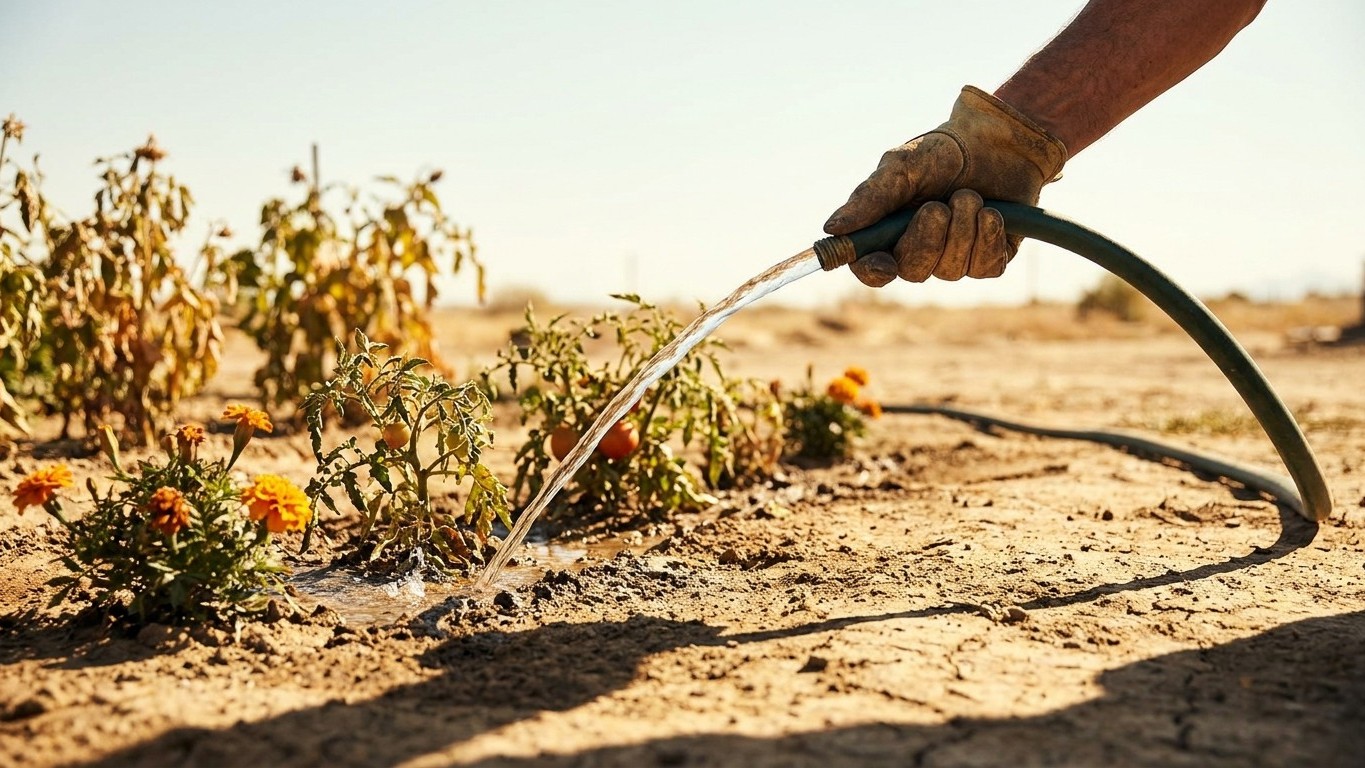

Wyoming’s driest summer month, August, brings just 1.52 inches of rain on average, while the region logs 10.4 days a year at 90F or hotter. That combination means most gardens here need supplemental water for roughly two out of every three weeks in high summer, and knowing exactly how much to add, and when, is what keeps a bed alive through August rather than scorched by it.
What changes here

Start with the two numbers that matter most: 1.52 inches of rain in August, the driest month of the growing season, and 10.4 days a year that reach 90F or above. Together they describe a stretch where the sky offers little and the air pulls hard at whatever moisture is already in the ground. For a gardener, that’s the difference between a bed that coasts through summer and one that needs a hose on a schedule.
The standard rule of thumb for most vegetable and flower beds is about an inch of water a week. Spread August’s 1.52 inches evenly across roughly 4.4 weeks in the month, and the sky is supplying something close to a third of an inch a week, on average. That leaves the gardener responsible for the other two-thirds of an inch, week after week, just to keep pace with what a normal bed wants. And that’s before accounting for the heat: on any of those 10.4 days that push past 90F, evaporation from soil and leaves climbs well beyond what a cooler week would demand, so the real shortfall on a hot week runs higher than the average suggests.
June and July aren’t much of a cushion either. June averages 2.16 inches and July 2.11, both better than August but still short of the roughly four inches a month a one-inch-a-week bed would need. That means the watering habit built in June, when there’s a bit more rain to lean on, has to tighten by August, when there’s less.
Soil texture decides how far that water goes once it lands. An inch of water on sandy ground drains past the root zone within a day, gone before most plants can use much of it. The same inch on heavy clay can sit in the top several inches of soil for a week or more, which sounds like an advantage until it turns into waterlogged roots on a bed that gets watered again too soon. Neither soil type changes the region’s rainfall numbers, but both change what a gardener should do with them, which is the next question.
How to water when it matters
The method that works in this climate is deep and infrequent, delivered at the base of the plant, done in the morning. Each part of that has a reason tied to what the plant is actually doing underground and in its leaves.
Deep watering pushes moisture down to where roots can follow it, training them to grow deeper instead of clustering near a surface that dries out within hours on a 90F day. Infrequent watering gives roots time to use that moisture and then stretch downward looking for more, rather than sitting in a permanently damp top layer. Watering at the base, instead of overhead, keeps foliage dry, which matters because wet leaves sitting overnight are an open invitation to fungal disease. Morning watering lets any splashed moisture evaporate during the day, before the cooler night air lets it linger.
Before turning on the hose, check the soil rather than guessing from how it looks. A finger pushed two inches down, or a trowel turned up, tells the real story; the surface can look bone dry while two inches down still holds moisture, or look fine while the root zone underneath is already parched.
Soil texture sets the rhythm from there. Sandy ground holds little water at a time, so it asks for shorter, more frequent soakings, often every two to three days in the hottest stretch. Heavy clay can hold a week’s worth of water, but watering it again before it’s had a chance to dry invites root rot, so the wait between soakings needs to be longer even if each one is generous.
A reasonable number to start from: about two-thirds of an inch of water delivered by hand or irrigation each week during August, on top of whatever rain falls, split across two sessions rather than one. That’s a starting point to test against a particular bed’s own soil and sun exposure, not a fixed rule.
- Check soil moisture two inches down with a finger or trowel before watering; if it’s dry at that depth, water; if it’s still damp, wait.
- Water early morning, before the day’s heat sets in, so moisture soaks in rather than evaporating off the surface.
- Apply water at the base of the plant, using a soaker hose, drip line, or watering can aimed at the soil, not the leaves.
- Deliver roughly two-thirds of an inch per week in August as a starting amount, adjusted up on stretches of 90F days.
- Space sessions two to three days apart on sandy soil, or once every five to seven days on heavy clay, letting the soil dry between waterings on clay.
What goes wrong
Watering a little every day
A quick daily sprinkle feels responsible, but it wets only the top inch or so of soil. Roots follow that moisture and stay shallow, which is exactly the wrong place to be on a day that hits 90F, since the top inch of soil bakes first and fastest. This is the mistake that costs the most in this climate, because it trains a plant to depend on a water source that disappears within hours of the sun coming up.
Watering the leaves in the evening
Evening watering feels convenient after a hot day, but wet foliage left overnight, without sun or breeze to dry it, gives fungal spores hours to take hold. Powdery mildew and other leaf diseases spread fastest on leaves that stay damp through the cool of the night.
Trusting a passing shower
A summer thunderstorm can look like it solved the watering problem, but a hard, brief downpour often runs off a dry surface rather than soaking in, leaving the top half-inch damp and everything below it still parched. A finger check after the storm settles the question a lot better than the sound of rain on the roof does.
Skipping the mulch
Bare soil gives back to the sun almost everything a watering session just put into the ground. A two- to three-inch layer of mulch slows that evaporation, which matters more here than in wetter climates, given how few inches of rain August actually provides to begin with.
Local help
The University of Wyoming Extension offers region-specific guidance on watering, soil, and garden planning at uwyo.edu/uwe. Watering restrictions vary by district and change from year to year, so check with the local water provider for current rules before setting an irrigation schedule.
Common questions
How often should I water a Wyoming garden in August?
Check soil moisture two inches down every two to three days on sandy soil, or every five to seven days on heavy clay, and water deeply whenever it’s dry at that depth rather than on a fixed daily schedule.
Is rainfall enough to skip watering in summer?
Rarely in August, since the driest month averages only 1.52 inches for the whole month, well short of the roughly four inches a one-inch-a-week bed would use.
Does the number of 90F days really affect how much I water?
Yes. At 10.4 days a year reaching 90F or higher, evaporation on those days runs well above an average summer day, so beds often need extra water right around those hot stretches, not just a flat weekly amount.
What’s the single biggest watering mistake to avoid here?
Shallow, frequent sprinkling. It keeps roots near a surface that dries out fastest on hot days, leaving plants stressed exactly when the region’s heat load is highest.