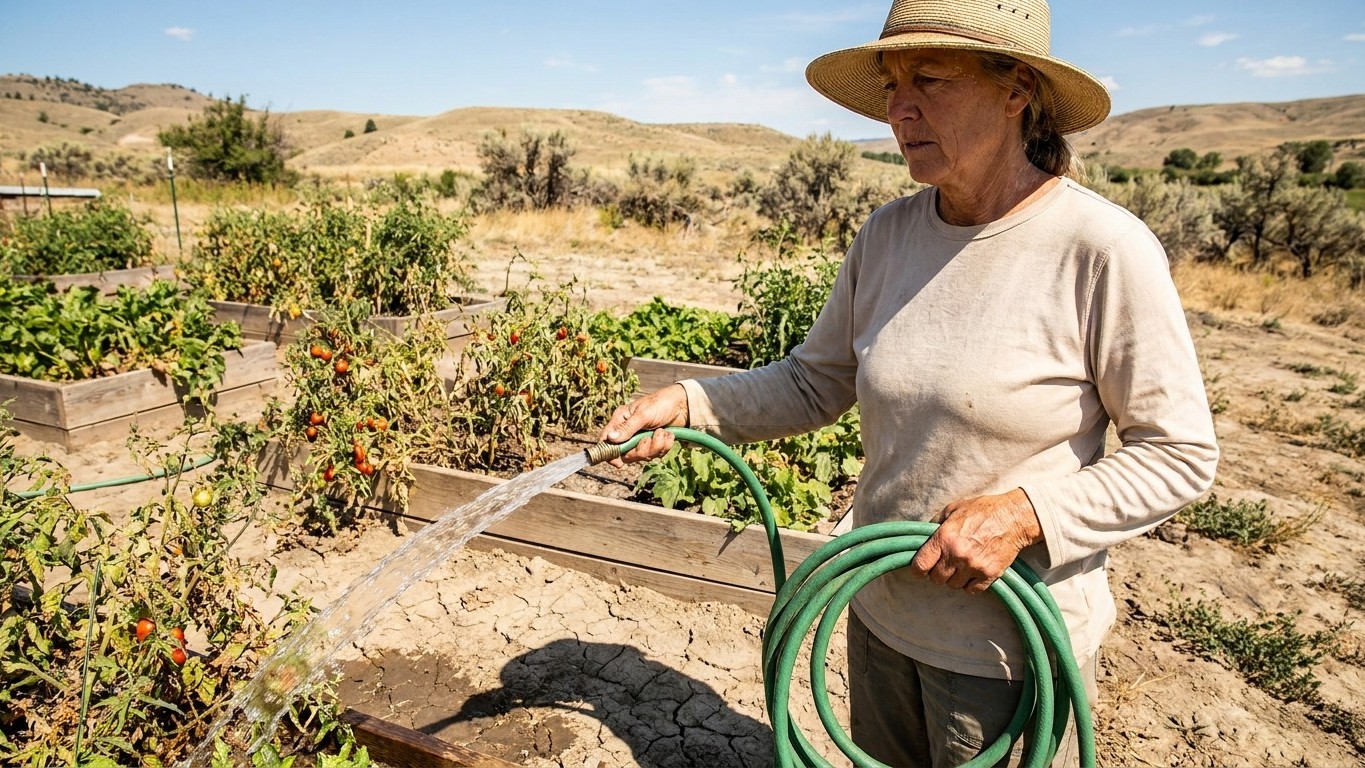

Montana’s summer sky delivers about 0.87 inches of rain in August, its driest month, while the mercury climbs past 90F on 28.3 days a year on average. Together those numbers mean the sky covers only a small slice of what a garden bed needs, and the gardener has to carry the rest, especially through the hottest stretch of summer.
What changes here

Start with the two numbers that matter most: 0.87 inches of rain in August, the driest month of the Montana summer, and 28.3 days a year that hit 90F or higher at the reference station. Read together, they say something simple and actionable: the month when plants need the most water is the same month the sky provides the least, and the heat that drives that need shows up on nearly a month’s worth of days every year.
A vegetable bed or a perennial border generally wants around an inch of water a week to keep growing without stress. August’s 0.87 inches, spread across roughly four and a half weeks, works out to about 0.2 inches arriving from the sky in an average week that month. That leaves the gardener responsible for carrying something close to 0.8 inches a week by hose or drip line, just to reach the one-inch target, before accounting for the extra evaporation that comes with a 90-plus-degree afternoon.
June looks different. With 2.22 inches falling that month, the sky is doing much more of the work, and a gardener who waters on a June schedule into July and August will fall behind fast, since July drops to 1.22 inches before August tightens further. The shift from June to August is not gradual; it is a step down in supply right as the heat load, measured by those 28.3 days above 90F, is building toward its peak.
Soil texture decides how far that carried water actually goes. The same inch applied to a sandy bed moves through the root zone within a day and needs replenishing sooner, while the same inch on heavy clay can sit in the ground for the better part of a week, doing more good over time but risking waterlogged roots if it is added again too soon. Neither texture changes the amount of rain the sky delivers in August; it changes how much of the water the gardener adds actually stays available to the roots, and for how long.
How to water when it matters
The method that works on Montana ground is deep, infrequent watering at the base of the plant, done in the morning. Deep watering pushes moisture down to where roots can follow it, training the plant to grow downward instead of staying shallow. Morning watering gives the leaves and soil surface time to dry before evening, which matters because damp foliage sitting overnight is what most fungal disease needs to take hold. Watering at the base, rather than overhead, means almost none of that water is lost to evaporation before it ever reaches a root.
Checking the soil at root depth, rather than trusting the surface, is what keeps the schedule honest. A finger or a small trowel pushed two inches down tells the real story: dry at that depth means it is time to water, moist means it can wait, even if the top of the soil looks dusty and dry.
Texture sets the rhythm. Sandy soil holds little moisture and drains fast, so it asks for shorter, more frequent soakings rather than one big weekly dose. Heavy clay holds a week’s worth of water but drowns roots of oxygen if it is watered again before that week is up, so the wait between soakings matters as much as the amount applied.
A reasonable starting point for an established bed on Montana ground through the hot stretch of summer is about 1 to 1.5 inches of water a week, split into two deep soakings rather than one. That number is a starting point to test against a particular yard, not a fixed rule, since a raised bed, a slope, or a patch of unusually sandy or heavy soil can shift it in either direction.
- Check the soil two inches down with a finger or trowel before watering at all; if it’s moist, wait another day.
- Water at the base of the plant, not over the leaves, using a soaker hose, drip line, or the spout of a watering can held low.
- Water in the early morning, ideally before 9 a.m., so the surface has hours to dry before evening.
- Apply roughly 1 to 1.5 inches a week on average ground, split into two sessions rather than daily sprinkling.
- On sandy soil, shorten the interval between waterings; on heavy clay, lengthen it and confirm dryness before adding more.
- Add two to three inches of mulch around the base to slow evaporation between soakings, especially on the days that reach 90F or higher.
What goes wrong
Watering a little every day
A quick daily sprinkle feels responsible, but it wets only the top inch or so of soil. Roots follow the moisture, staying shallow and close to the surface, which is exactly where a 90-degree afternoon does the most damage. This is the costliest habit on Montana ground, because it multiplies the effect of those 28.3 days of heat instead of buffering against them.
Wetting the leaves at night
An evening watering session that soaks the foliage leaves it wet through the cool overnight hours, which is prime conditions for fungal disease to spread. The plant gets the water it needs but pays for it with a higher disease risk, especially in a wet spring stretch like June’s 2.22 inches of rain layered on top of irrigation.
Trusting a summer thunderstorm
A loud storm can look like it solved the watering problem for the week, but many summer thunderstorms drop their rain fast enough that most of it runs off rather than soaking in, especially on ground that’s already dry and hard. The only way to know is to check with a finger two inches down after the storm passes, not to assume the sky did the job.
Skipping the mulch
Bare soil left exposed to a 90-degree sun gives back a large share of whatever water was just applied, straight into the air through evaporation. A two- to three-inch layer of mulch slows that loss enough to stretch the interval between waterings, which matters most in August, when the sky is only offering 0.87 inches to begin with.
Local help
Montana State University Extension offers region-specific guidance on soil, irrigation timing, and plant selection for Montana conditions. Watering restrictions vary by city, county, and water district, and they change from year to year depending on drought conditions, so check with a local water provider for the rules that actually apply to a given address.
Common questions
How often should I water my garden in Montana during August?
With August delivering only about 0.87 inches of rain on average, most beds need supplemental watering two to three times a week, checked against soil moisture two inches down rather than a fixed calendar.
Is morning or evening better for watering in Montana’s heat?
Morning is better. It lets foliage and soil surface dry out before evening, cutting the disease risk that comes with leaves staying wet overnight.
Does one summer rainstorm mean I can skip watering that week?
Not necessarily. A hard, fast storm often runs off before it soaks in, so check the soil at root depth with a finger or trowel before deciding to skip a watering session.
Do sandy and clay soils need different watering schedules in Montana?
Yes. Sandy soil drains fast and needs shorter, more frequent soakings, while heavy clay holds water for close to a week and needs longer gaps between waterings to avoid drowning roots.