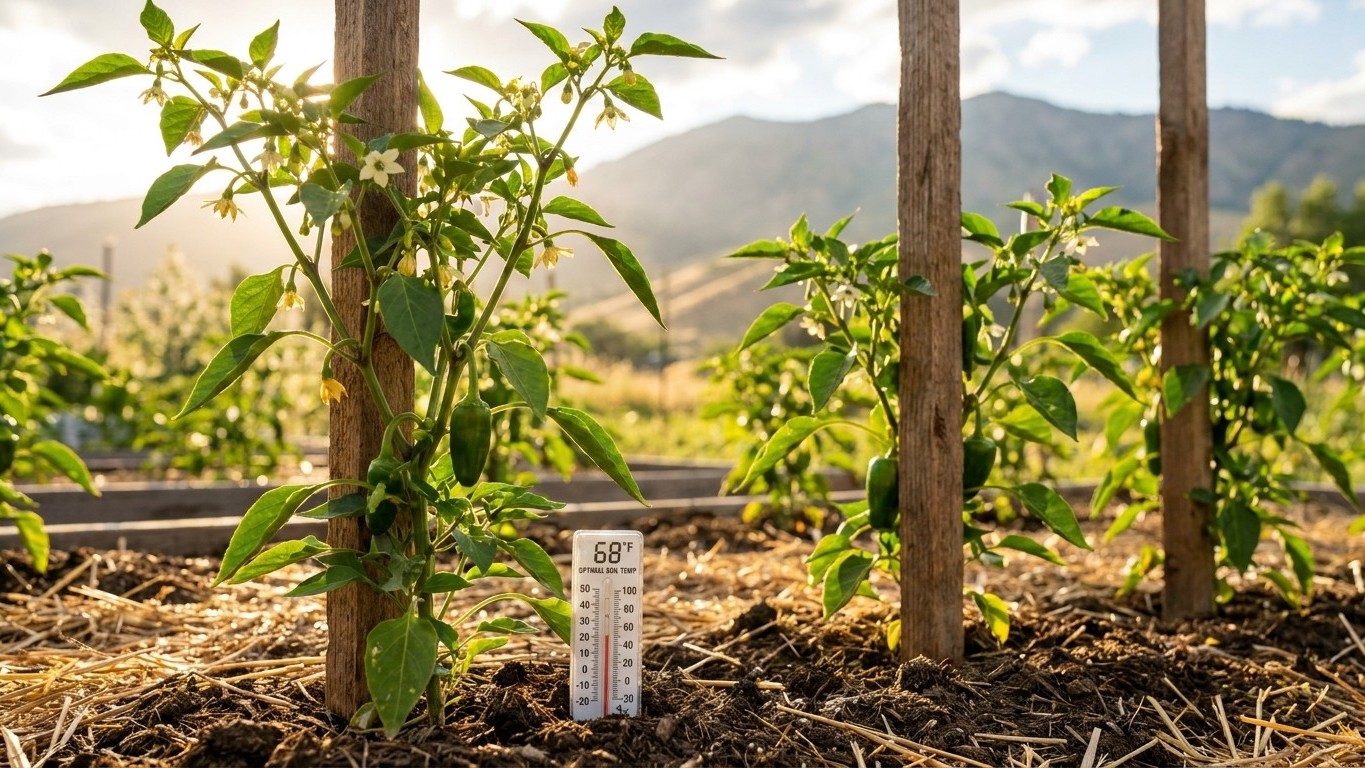

In Middle Tennessee, expect roughly 40 days a year at or above 90°F, and that heat load is the number that decides whether pepper flowers turn into fruit. Pair it with cool nights that this page can’t measure for you, an 8- to 10-week indoor head start, and a transplant date tied to 60°F soil after frost, and you have the whole season mapped out for peppers grown anywhere in the state.
The short answer

Forty days. That’s the average number of days per year the Nashville reference station reaches 90°F or hotter, based on NOAA’s 1991-2020 Climate Normals. It sounds like a modest number until you realize those 40 days rarely land in a tidy row spread evenly across summer. They tend to cluster in July and into August, exactly when a pepper plant is trying to set its main flush of fruit. Pepper blossoms are fussy about heat. Push daytime temperatures much past 90°F, especially with high humidity holding overnight lows up too, and the flowers abort. The plant keeps growing leaves and stems, maybe keeps blooming, but the fruit doesn’t set. Growers sometimes describe it as the plant “sulking,” which isn’t scientific but captures the frustration of a healthy-looking pepper patch that isn’t producing.
Forty days above 90°F also means there are plenty of days that don’t reach that mark, and that’s where a lot of Tennessee gardeners get their real production window. A stretch of 85°F afternoons with reasonable humidity is close to ideal for pepper fruit set. The practical takeaway from the heat side alone: don’t judge a pepper plant’s health by a slow week in the hottest part of summer. That’s often the climate doing exactly what the climate does, not a disease or a nutrient problem.
The other end of the fruit-set window matters just as much, and this is where the data gets thinner. Peppers also fail to set fruit when nights drop below 55°F. That’s a real threshold, documented by Utah State University Extension, and it applies just as much in Tennessee as anywhere else peppers are grown. The problem is that this site tracks days at or above 90°F for Tennessee, but it does not carry summer overnight low temperatures for any Tennessee location. That’s not a small omission. It means a gardener in Nashville, one in Knoxville, and one up on the Cumberland Plateau could all be looking at meaningfully different night temperatures in the same week, and no single number here can stand in for all three.
The honest advice is to watch your own nights. Don’t guess based on how far south you live or what the daytime high was. A location can run hot in the afternoon and still drop into the mid-50s overnight if it sits in a valley, near a river bottom, or at higher elevation, and Tennessee has plenty of all three. A basic min-max thermometer on the porch, checked through late spring and again in early fall, tells you more about your pepper timing than any statewide average ever will.
When to start seed here
Working out a seed-starting date for peppers is really just arithmetic done backward from the transplant date, and the transplant date itself depends on two separate conditions that both need to be true at once: frost has passed, and the soil has warmed to 60°F. Here’s how to walk through it for your own county.
- Find your last spring frost window. For the Nashville reference station, NOAA’s 1991-2020 Climate Normals put the 32°F freeze probability window between March 31 and April 12. That’s not a single date but a band reflecting year-to-year variation, and it applies to the Nashville area specifically. East Tennessee and the Cumberland Plateau run cooler and later in spring, so a gardener in those regions should expect their own last-frost window to fall later than Nashville’s, not on the same calendar date.
- Add the soil-temperature check. Frost passing doesn’t mean the soil is ready. Peppers need the soil itself at 60°F before transplant, and soil warms more slowly than air, especially in shaded beds or heavy clay. In practice, this often pushes the real transplant date a week or two past the last frost date, even in a mild spring. A simple soil thermometer, pushed a few inches down and read in the morning, settles the question better than guessing from the air temperature.
- Count backward 8 to 10 weeks. Utah State University Extension recommends starting pepper seed indoors 8 to 10 weeks before that transplant date. If your working transplant date lands in mid-April, for example, count back 8 to 10 weeks from that date to land on your indoor sowing window. The 2-week spread in that range gives some flexibility for slower-germinating varieties or a cooler-than-usual indoor setup.
- Build in a buffer for a stalled spring. Because the last-frost window itself spans nearly two weeks at the Nashville reference station, and because soil warms on its own schedule regardless of the calendar, it’s worth sowing on the earlier side of your 8-to-10-week count rather than the later side. A pepper seedling that’s ready a week early and has to wait indoors is a minor inconvenience. A seedling started too late, forced into cold soil, rarely catches up.
The arithmetic holds for any Tennessee county once you swap in your own frost data and your own soil readings. What doesn’t transfer directly is the Nashville-specific date range itself: a gardener on the Cumberland Plateau or in the higher hills of East Tennessee needs to start from a later frost window, which shifts the whole indoor-sowing calculation later as well.
What goes wrong here
Most pepper problems in a Tennessee garden trace back to the same handful of climate-driven failures, and most of them have a straightforward fix once you know what’s actually happening.
- Blossom drop from a hot spell. When daytime temperatures push into or past that roughly 90°F territory-average range, pepper flowers can abort before setting fruit. The plant isn’t sick. It’s protecting itself. There’s no product that reverses this, but light afternoon shade cloth over the row during the hottest stretch, and consistent soil moisture so the plant isn’t drought-stressed on top of heat-stressed, both reduce how much drop you see.
- Blossom drop from a cool night. The same failure, opposite cause. Since summer night minima aren’t tracked on this site, the fix starts with observation: log your own overnight lows on a basic thermometer during any unusually cool stretch, spring or fall. If nights are dropping toward the mid-50s, row cover pulled over the plants in late afternoon holds a little extra warmth through the night and can be the difference between a plant that sets fruit and one that just holds blossoms.
- Sunscald. Tennessee summer sun is strong enough to scald exposed pepper fruit, especially on plants that have lost leaf cover to disease, pruning, or wind damage. Scalded fruit shows a pale, papery, sunken patch on the side facing direct sun. The remedy is mostly preventive: avoid heavy pruning during peak summer, and don’t strip lower leaves unless disease demands it. A plant with full foliage shades its own fruit.
- Blossom-end rot. This shows up as a dark, sunken spot on the bottom of the fruit and is a calcium-uptake problem, almost always triggered by inconsistent watering rather than a true calcium shortage in the soil. Irregular rain followed by a dry stretch, which Tennessee summers deliver often enough, interrupts the water flow the plant needs to move calcium into developing fruit. Even, consistent watering, ideally with mulch to buffer soil moisture swings, is the fix that actually works more often than a calcium spray.
Common questions
Do all peppers stop setting fruit in the same heat?
The 90°F failure point is a general threshold for peppers as a category, per Utah State University Extension, not a variety-by-variety rating. This page doesn’t carry heat tolerance ratings for individual varieties, so treat the threshold as a baseline for any pepper you’re growing rather than a fixed rule that applies more to one type than another.
Should I trust the last-frost date for my whole county?
Only loosely. The March 31 to April 12 window comes from a single reference station near Nashville. Anywhere with different elevation, valley placement, or distance from urban heat, particularly East Tennessee and the Cumberland Plateau, should expect a later window and plan seed-starting and transplant dates accordingly.
What if my nights stay warm all summer, even in the 60s?
That’s on the favorable side of the 55°F threshold, which is good for fruit set. This site doesn’t track night minima for any Tennessee location, so there’s no way to confirm from here whether a given yard runs warm or cool overnight. A simple thermometer log through the season is the only reliable way to know.
Is 8 weeks or 10 weeks better for starting seed indoors?
Utah State University Extension gives the range as 8 to 10 weeks before transplant without specifying which end suits which variety. Slower-germinating seed or a cooler indoor growing setup generally benefits from the earlier end of that range, giving the seedling more time to reach transplant size on schedule.