
Wyoming pepper growers work with roughly 130 frost-free days at elevation, a late spring frost that can linger into mid-May, and summer heat that spikes just often enough to stall fruit set. The practical answer: choose early to mid-season varieties, start seed indoors well ahead of transplant time, and time that transplant to warm soil rather than the calendar. Everything else, from blossom drop to sunscald, traces back to two temperature thresholds peppers cannot tolerate for long.
The short answer

The 1991-2020 NOAA NCEI Climate Normals for the Cheyenne reference station put the state’s heat load at 10.4 days a year reaching 90 F or above. That’s a modest number as far as western states go, and it matters directly for pepper fruit set: Utah State University Extension notes that fruit set fails once daytime temperatures push past 90 F, because the plant drops blossoms rather than sets fruit under that kind of stress. With only about ten days a year crossing that line on average, most Wyoming pepper plants aren’t fighting heat stress all summer long. But those ten-plus days rarely arrive one at a time. Heat tends to stack into short runs during July and August, and a five- or six-day stretch above 90 F, even inside an otherwise mild Wyoming summer, is enough to knock blossoms off a plant that was setting fruit just fine the week before.
The other failure point sits at the opposite end of the thermometer. Fruit set also fails when nights drop below 55 F, and that threshold matters just as much in a state where elevation swings hard from one county to the next. This site tracks daytime heat, not summer night minimums, so there’s no published figure here for how cool your particular nights run in July. Cheyenne sits above 6,000 feet, and mountain valleys and high plains elsewhere in the state can drop well below what a garden at lower elevation sees on the same date. Growers need to watch their own thermometer through the season rather than assume a safe night range based on latitude or on how cold winter gets in their area. A backyard at 5,000 feet and one at 7,500 feet in the same county can post very different July nights, and no statewide average captures that gap.
Put those two limits together and the short season becomes the real constraint. A pepper plant that dodges both a hot spell and a cool night still has to flower, set fruit, and ripen inside a frost-free window that runs about 130 days at elevation, with frost possible in any month at the higher sites. That’s why variety choice in Wyoming leans toward earlier maturing types rather than the long-season peppers that do well in states with a steadier, longer summer.
When to start seed here
The math for starting pepper seed indoors works backward from two fixed points: the local frost date and the number of weeks a transplant needs before it goes in the ground. Here’s how to run that arithmetic for your own county.
- Find the local last spring frost window. For the Cheyenne station, NOAA NCEI’s 1991-2020 Climate Normals put the 32 F freeze probability window between May 7 and May 18. That’s a range, not a single date, so lean toward the later end unless you’re prepared to cover plants overnight.
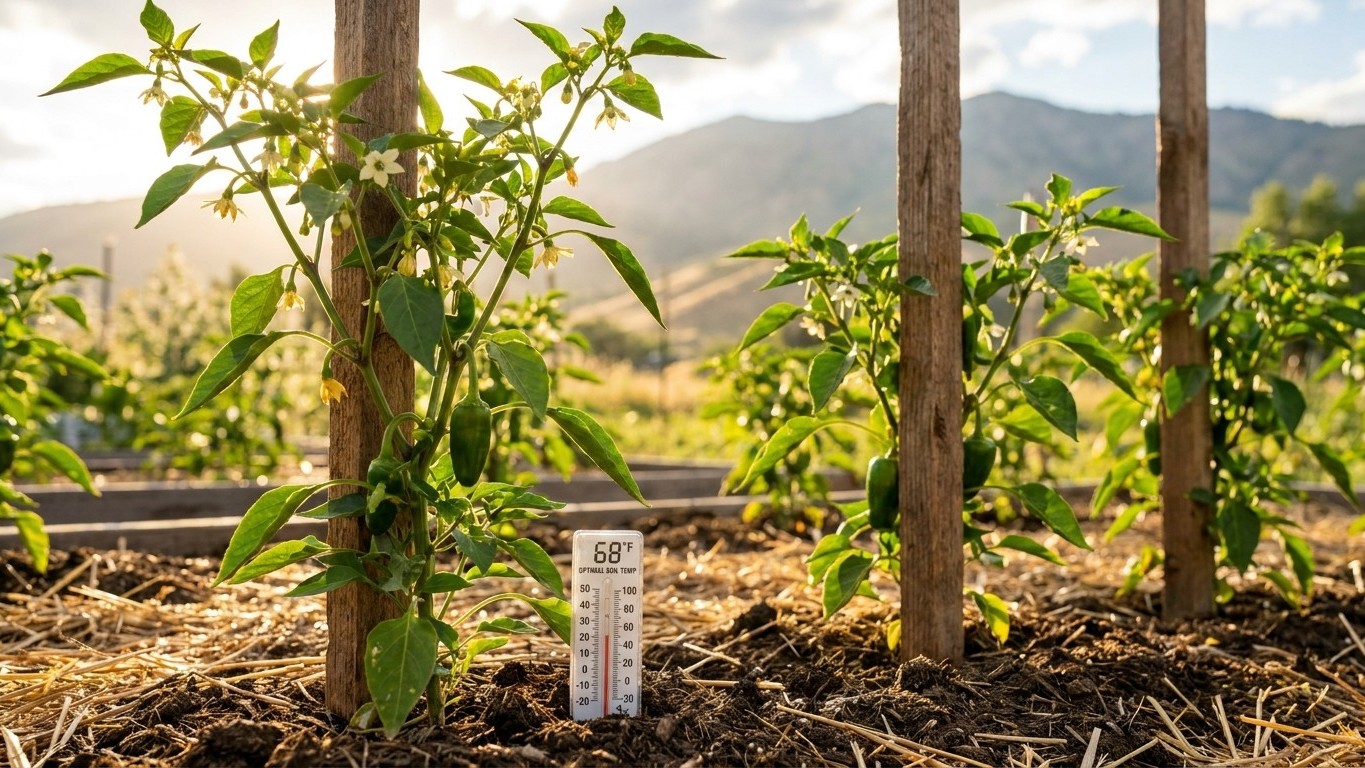
- Wait for soil, not just air. Utah State University Extension recommends transplanting peppers only after frost has passed and soil temperature has reached 60 F. Cold soil stunts pepper roots even when the air feels warm enough, so a soil thermometer pushed a few inches into the bed tells you more than a date circled on the calendar.
- Count back 8 to 10 weeks for indoor seed starting. If your transplant target lands around May 18, seed should go into trays roughly 8 to 10 weeks earlier, somewhere in the second to third week of March depending on which end of that range you plan for.
- Add the time from flowering to ripe fruit. Utah State University Extension also notes that peppers typically need 35 to 45 days from flowering, not from the sowing date, to finish ripening. That count only starts once blossoms open, so a plant transplanted in mid-May still needs several more weeks of good weather after it flowers before fruit is ready to pick.
- Check the total against your frost-free window. With roughly 130 frost-free days at 6,000 feet, and frost possible in any month at higher elevations, stack the weeks indoors, the weeks to flowering, and the 35 to 45 days to ripening against your own county’s frost dates before committing to a longer-season variety.
What goes wrong here
Wyoming’s temperature swings cause a short, repeating list of pepper problems, and each one traces back to the same two thresholds.
- Blossom drop from a hot spell. When daytime temperatures climb past 90 F, even for a few days running, pepper flowers can drop before they set fruit. Utah State University Extension identifies this as one end of the fruit-set failure range. The fix is timing and shade: avoid pushing transplants out right before a forecast heat run, and use light shade cloth over plants during multi-day hot spells so blossoms have a better chance of holding.
- Blossom drop from a cool night. The same failure shows up at the opposite end, when nights fall below 55 F. Since this site doesn’t track summer night minimums, the fix starts with watching your own thermometer rather than assuming a safe range based on the calendar. Row cover pulled over plants on a night trending cool can hold enough warmth to keep blossoms from aborting.
- Sunscald on exposed fruit. Strong sun at elevation can scorch pepper fruit that isn’t shielded by leaf cover, especially on plants pruned hard or thinned out by wind. Leaving foliage intact around developing fruit, rather than stripping leaves for looks, is the simplest fix.
- Blossom-end rot from uneven watering. Peppers that dry out between waterings and then get soaked tend to develop the sunken, leathery patch on the fruit bottom known as blossom-end rot. It’s a calcium-uptake problem tied to inconsistent soil moisture in most gardens rather than a true soil deficiency, so the fix is a steady watering schedule and mulch to even out moisture swings between waterings.
Common questions
Can peppers be direct-seeded outdoors in Wyoming?
Not reliably. With only about 130 frost-free days at elevation and a last frost date that can run as late as May 18 at the Cheyenne station, direct-seeded peppers rarely have enough season left to flower, set fruit, and ripen before fall frost arrives. Utah State University Extension recommends starting seed indoors 8 to 10 weeks before transplanting, which is the standard approach across the state rather than an exception for cautious gardeners.
How long is the frost-free growing season in Wyoming?
Roughly 130 days at 6,000 feet elevation, based on NOAA NCEI climate data, though that window shrinks at higher sites where frost can occur in any month. That’s a tight span for a crop needing 8 to 10 weeks indoors plus 35 to 45 days from flowering to ripe fruit, which is why early and mid-season varieties fit the state better than long-season types.
Do frost dates vary much across Wyoming counties?
Yes, by a meaningful margin. The May 7 to May 18 window comes from a single reference station in Cheyenne, and elevation changes across the state shift both the last spring frost and the first fall frost considerably. Gardeners at higher elevation than the reference station should expect a shorter season and plan for possible frost outside that stated window.
What soil temperature is right for transplanting peppers?
Utah State University Extension sets that mark at 60 F soil temperature, checked after the frost date has passed rather than estimated from air temperature alone. A simple soil thermometer pushed a few inches into the bed gives a more reliable reading than guessing from how warm the days feel, since soil warms more slowly than air in spring.