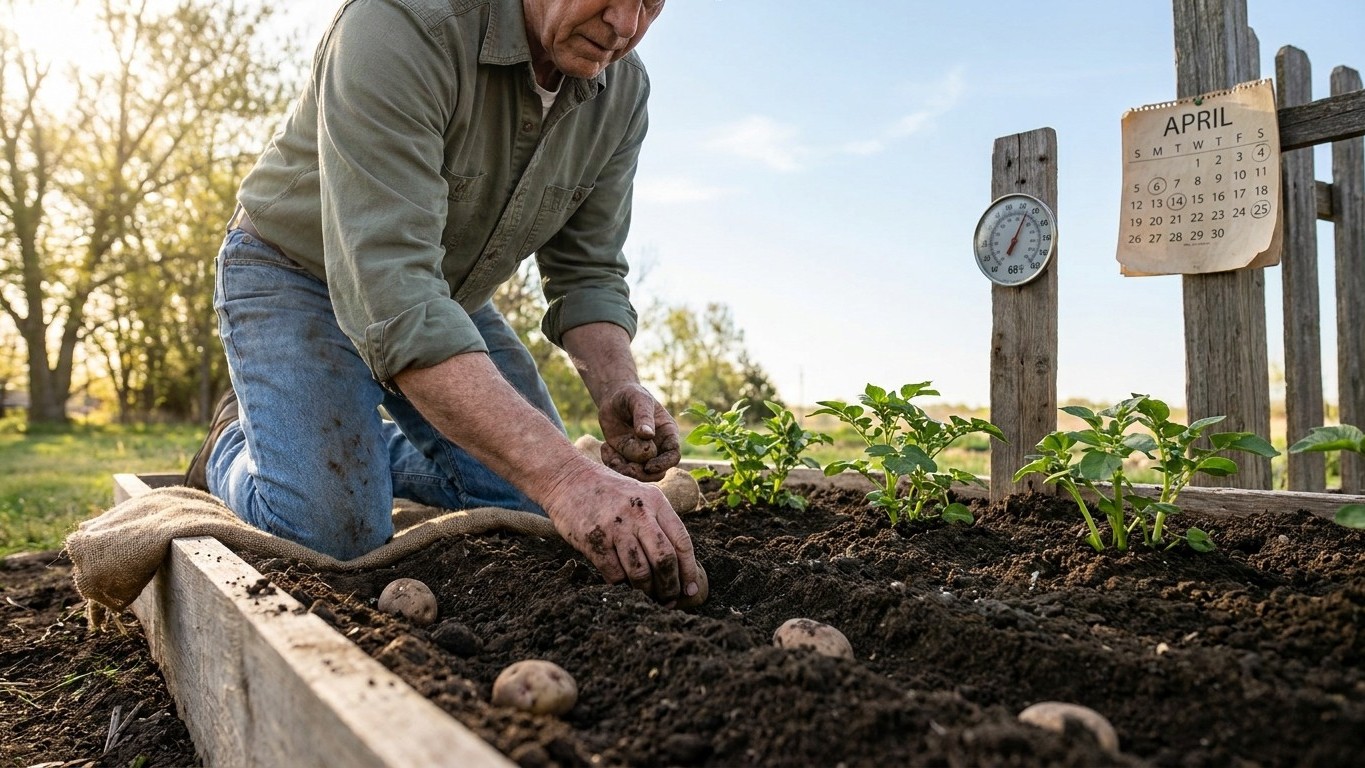

Kansas gardeners face a narrow window: plant potatoes too late and the Wichita-area heat load of 57.6 days a year above 90 F stalls tuber growth before the crop finishes sizing. Plant on schedule, working backward from the last spring frost, and a full harvest is realistic across most of the state.
The short answer

Two numbers decide how a Kansas potato season plays out. The first is heat load: at the Wichita reference station, NOAA NCEI Climate Normals for 1991-2020 put the average at 57.6 days a year reaching 90 F or higher. The second is timing: the same NOAA dataset places the last spring frost, at 32 F, somewhere between April 4 and April 18 for that station, based on the 30-70% freeze probability band.
Those two figures pull against each other. Potatoes need cool soil to size properly, and Utah State University Extension is explicit about the mechanism: tuber set and fill shut down once soil temperatures climb above 90 F. With nearly two months of 90-plus-degree air temperature a year in south-central Kansas, soil temperatures follow closely behind once June and July arrive. That means the plant does most of its useful bulking in a compressed spring window, not across a long summer.
So does that rule out potatoes in Kansas? No, but it does rule out a leisurely planting schedule. A gardener who plants at the standard interval before the last frost, chooses Potato Varieties That Suit Kansas, digs early, and treats the crop as a spring-into-early-summer operation will beat the heat ceiling most years. A gardener who plants late, waits for “warmer, safer” soil in May, or treats potatoes like tomatoes and lets them run through July is fighting the climate on its worst terms.
The practical takeaway is that Kansas isn’t a state where potatoes struggle outright. It’s a state where the calendar does the heavy lifting. Get the planting date right relative to that April 4-18 frost window, and the 57.6-day heat count becomes a deadline to beat rather than a wall the crop can’t get over. Miss the window, and no amount of watering during a 95 F July stretch will restart tuber growth once soil temperatures have crossed that 90 F threshold, because the problem isn’t moisture. It’s heat itself acting directly on the tuber-forming tissue, which is also why Harvesting and Storing Potatoes in Kansas at the right time matters just as much as planting on schedule.
That distinction matters more in Kansas than in cooler states, where the same planting mistake might just delay harvest by a week or two instead of capping it altogether.
When to plant here
Working out When to Plant Potatoes in Kansas means starting from the frost window and counting backward, not starting from a generic calendar date. Here’s the arithmetic, step by step:
- Start with the reference frost window: April 4 to April 18, per NOAA NCEI 1991-2020 data for the Wichita station.
- Potatoes go in the ground once soil temperature reaches 50 F, a benchmark shared by Utah State University Extension and the University of Maine Cooperative Extension.
- That 50 F soil threshold is typically reached 14 to 21 days before the last frost date, according to the same sources.
- Subtract 14 to 21 days from April 4 (the earlier end of the frost window) and you land in mid-to-late March for the earliest safe planting in the Wichita area.
- Subtract the same 14 to 21 days from April 18 (the later end of the window) and the planting date shifts to late March or the first days of April for a slightly more conservative approach.
- Check actual soil temperature with a soil thermometer rather than relying on the calendar alone, since a cold, wet spring can push the 50 F mark later regardless of the date on paper.
That gives a practical planting range of roughly mid-March through early April for the Wichita area, adjustable in either direction based on how the current season’s soil temperature is tracking. A gardener working from a different frost record can run the same subtraction: take the local last-frost date, pull back 14 to 21 days, and confirm with a soil thermometer before committing seed potatoes to the ground.
The reasoning behind planting this early, rather than waiting for guaranteed frost-free soil, comes back to the heat ceiling. Every week gained in March or early April is a week of cool-soil tuber development banked before the 90 F days start piling up. In a state averaging 57.6 of those days a year, that banked time is what separates a full-sized harvest from a disappointing one.
What the heat does to the crop
The mechanism is simple, and it’s the single most important fact on this page: potato plants form and fill tubers underground, and that process depends on soil temperature staying below roughly 90 F. Above that threshold, according to Utah State University Extension, tuber set and fill are inhibited. The plant can look perfectly healthy above ground, green and leafy, while doing essentially nothing useful below ground.
In Kansas, with 57.6 days a year averaging 90 F or higher at the Wichita reference station, that ceiling isn’t a rare event. It’s a recurring feature of most summers, typically stacking up across June, July, and into August. Soil doesn’t heat as fast as air, but sustained stretches of 90-plus-degree days push soil temperatures at typical planting depth past that same mark, especially in exposed or unmulched beds.
This is why Kansas functions best as a spring-crop state for potatoes rather than a full-season one. Plant early using the backward count from the last frost date, let the plant do its tuber development while soil is still cool through April, May, and early June, and dig before the worst of the summer heat sets in. Trying to stretch the season into July by planting later, or by hoping a well-watered plant will keep producing through the hottest weeks, runs directly into the mechanism above. Watering keeps the plant alive and green. It does not lower soil temperature enough to restart tuber fill once that threshold has been crossed for an extended stretch.
That’s a hard adjustment for gardeners coming from cooler states, where a longer, more forgiving summer window is normal. In Kansas, the crop’s real growing season is effectively bookended by the last frost on one side and the arrival of consistent 90 F days on the other, and that window is narrower than the frost-free season alone would suggest.
What goes wrong here
- Uncertified seed potatoes. Seed saved from a grocery-store potato or an uncertified source can carry viruses that reduce yield and won’t show symptoms until the crop is already in the ground. Buying certified seed potatoes from a known supplier is the remedy, and it’s a one-time decision that protects the whole season.
- Planting into cold, wet soil before it reaches 50 F. Seed pieces sitting in cold, waterlogged ground are prone to rot before they ever sprout. Checking soil temperature with a thermometer, rather than planting on a fixed calendar date regardless of conditions, avoids this.
- Skipping hilling and ending up with green tubers. Tubers that develop near the soil surface and get exposed to sunlight turn green and produce solanine, making them unfit to eat. Hilling soil up around the base of the plant as it grows keeps tubers covered and prevents this.
- Digging too early, before the plant has finished its cool-soil growth window. Pulling potatoes before the foliage has died back naturally sacrifices size and yield that the plant would otherwise have added during the remaining cool weeks. Waiting for the vines to yellow and die back, within the spring-to-early-summer window this climate allows, gets more out of the same planting.
Checking this against your own county
The April 4-18 frost window and the 57.6-day heat count both come from a single reference station near Wichita. Neither figure is a promise for every Kansas county. Elevation, and the general difference between the state’s northern and southern tiers, can shift both numbers by a couple of weeks in either direction. A garden in a low-lying river valley may also see frost linger later into spring than an exposed upland site nearby.
Before locking in a planting date, confirm local conditions with Kansas State University’s Research and Extension service. County-level extension offices track local frost patterns and can adjust the backward-counting method described above to fit conditions on the ground, rather than the airport-station averages used statewide.
Common questions
Can potatoes handle a full Kansas summer if I keep them watered?
No. Watering addresses drought stress, but it doesn’t lower soil temperature. Once soil crosses roughly 90 F for sustained periods, tuber set and fill stop regardless of moisture, per Utah State University Extension.
What variety class should I plant for a Kansas spring crop?
Early-season varieties, which mature and can be dug sooner, generally line up best with a climate where the useful cool-soil window closes as summer heat arrives. Mid-season varieties can work if planted at the earliest safe date. Late-season classes carry more risk here since they need more cool-weather time than the season reliably offers. Neither Utah State University Extension nor the University of Maine Cooperative Extension publishes a specific number of days to maturity, only these season classes.
Is certified seed really necessary, or can I use my own saved potatoes?
Certified seed is worth the cost. Home-saved or uncertified potatoes can carry viral diseases invisibly, and there’s no way to correct that once the crop is planted. Buying certified seed each season is the straightforward fix.
When should I dig potatoes in Kansas to avoid the heat?
Dig once the foliage has died back naturally, which in a Kansas spring planting typically falls before the heaviest run of 90 F days sets in. Digging too early sacrifices size; waiting until deep summer heat has already stalled the crop doesn’t gain anything back.