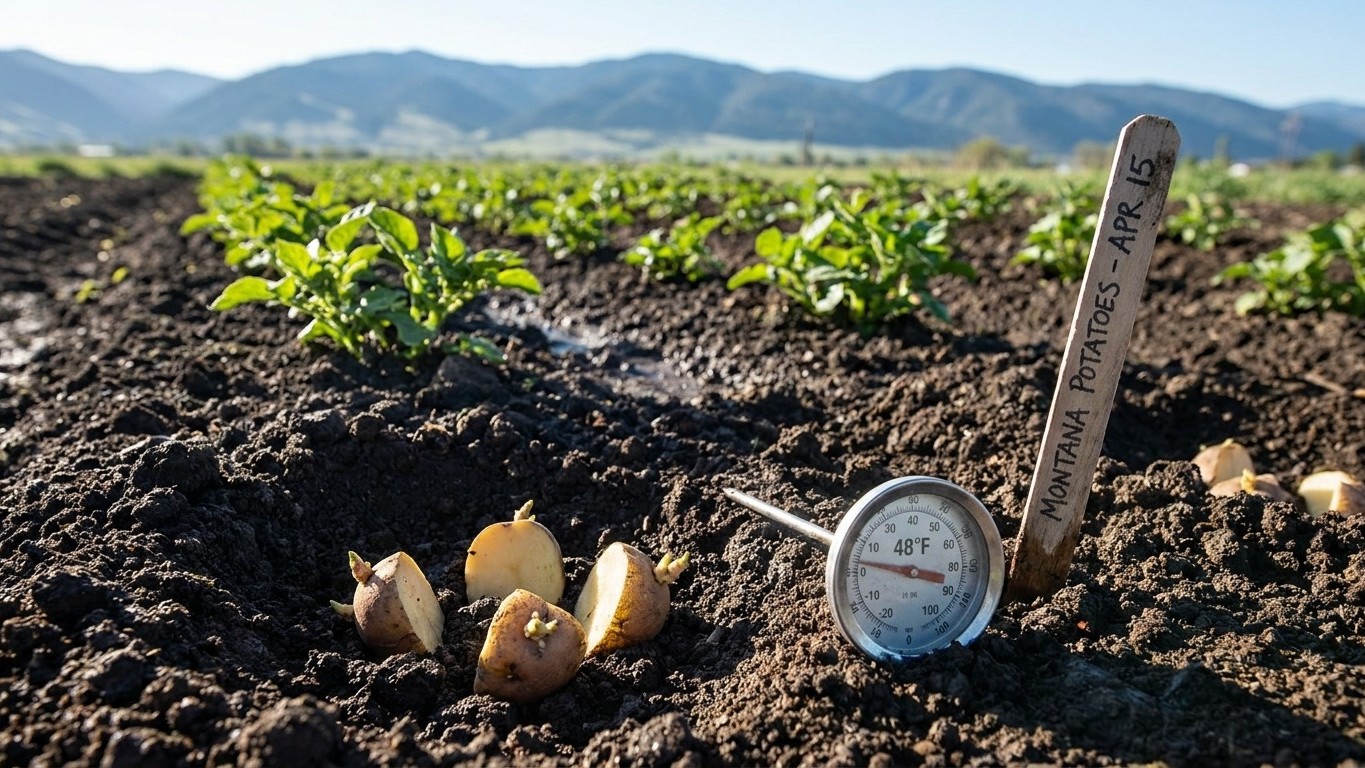

Billings averages just 28.3 days a year at 90°F or hotter, according to NOAA NCEI Climate Normals for 1991-2020, and the last spring frost typically falls between April 29 and May 10. That combination means most Montana gardeners can grow a full-season potato crop rather than racing the clock to beat summer heat. What still decides the outcome is soil temperature at planting, not the calendar, and Montana’s elevation swings shift these numbers by weeks from one valley to the next.
The short answer

Two numbers set the terms for growing potatoes in Montana. The first is heat load: Billings, the reference station for south-central Montana, logs 28.3 days a year reaching 90°F or above, per NOAA NCEI Climate Normals 1991-2020. The second is the frost window: the last spring freeze at that same station falls between April 29 and May 10. Neither number, on its own, tells you when to plant or what to expect from the crop, but together they answer the question the title asks.
Utah State University Extension documents the mechanism that ties those two figures to a garden outcome: tuber set and fill are inhibited once soil temperatures climb above 90°F. That is a soil threshold, not an air threshold, and it matters because soil generally runs a few degrees cooler than peak air temperature except during sustained heat waves. With only 28.3 days a year crossing 90°F in the air at Billings, the odds of soil sitting above that mark for days on end are low compared with hotter states, where 60, 80, or more days a year clear that bar.
What that margin means for variety choice
Because Montana’s growing season generally stays under the heat ceiling, gardeners are not forced to rush an early variety into the ground just to dodge summer heat, the way growers in hotter climates often are. Early, mid-season, and late varieties can all finish out a Montana season, since neither Utah State University Extension nor University of Maine Cooperative Extension publishes a fixed number of days to maturity for any variety, only the season class. Choosing among Potato Varieties That Suit Montana comes down to storage plans and how the harvest is used, boiling or baking, rather than to outrunning the heat, and reviewing the steps for Harvesting and Storing Potatoes in Montana beforehand helps match the variety to how long it needs to keep.
The exception sits in the warmer valleys, the Yellowstone and Bitterroot corridors especially, where south-facing garden beds and dark soil can push localized soil temperatures higher than the regional air average suggests. A gardener there should treat the 28.3-day figure as a baseline, not a guarantee, and watch soil directly during the hottest stretch of July.
When to plant here
The planting date is not read off a calendar. For a full breakdown of timing, see When to Plant Potatoes in Montana. It is counted backward from the local last-frost window, using soil temperature as the real trigger. Here is the arithmetic, using Billings as the reference point, so it can be redone for any Montana county.
- Start with the last spring frost date for the local area. At the Billings reference station, NOAA NCEI puts that window between April 29 and May 10.
- Identify the planting trigger: potatoes go into the ground once soil reaches 50°F, per Utah State University Extension and University of Maine Cooperative Extension Bulletin #2077.
- Apply the 14-to-21-day rule: soil typically reaches 50°F that many days before the last frost date, not after it.
- Counting 14 to 21 days back from April 29 lands in the April 8 to April 15 range; counting the same window back from May 10 lands between April 19 and April 26.
- That gives a working statewide window of roughly early to late April for the milder valleys, always confirmed against a soil thermometer rather than the date alone.
Mountain valleys elsewhere in Montana run colder and later than Billings, sometimes by several weeks, so this arithmetic has to be rerun with a local frost date before it means anything for a specific garden.
What the heat does to the crop
The mechanism is simple and it is the whole point of this page: once soil temperature climbs above 90°F, tuber set and fill stop, according to Utah State University Extension and University of Maine Cooperative Extension. The plant is not damaged in a way that shows up as wilting or scorch. It simply stops building the tubers underground, and no amount of irrigation reverses that. Watering keeps the plant alive and can moderate soil temperature slightly, but it does not restart tuber growth once the soil crosses that line. That distinction matters because it is easy to mistake a heat-stalled crop for a thirsty one and respond with more water instead of shade or timing changes.
In Montana, with only 28.3 days a year reaching 90°F at the Billings reference station, that ceiling is rarely breached for long stretches. This is a meaningful difference from hotter states, where growers are often pushed toward digging a spring crop before summer heat arrives, because the season simply cannot support tuber development straight through July and August. Montana gardeners, by contrast, generally have room to run potatoes across a full season without engineering an early spring-only harvest.
The risk that remains is concentrated, not chronic. Where 90°F days cluster, typically in mid-to-late July, and that stretch overlaps with the plant’s peak tuber-bulking period, yield can still take a hit in exposed beds. Mulching to keep soil temperature down during that window is a reasonable management step, but it manages exposure. It does not change the 90°F threshold itself.
What goes wrong here
- Uncertified seed potatoes. Uncertified seed carries virus, which shows up as weak, uneven plants and a smaller harvest with no obvious single cause. Buying certified seed potatoes each season is the direct fix.
- Planting into cold, wet soil. Montana springs can stay saturated well past the frost date in low-lying gardens, and seed pieces set into cold, wet ground rot before they sprout. Waiting for the 50°F soil mark, confirmed with a thermometer rather than a guess, avoids this.
- Skipping hilling. Tubers that push up near the surface and catch sunlight turn green and develop solanine, making them unsafe to eat. Hilling soil over the row as plants grow keeps developing tubers covered.
- Digging too early. Pulling potatoes before the vines have died back means the skins have not set, and those tubers bruise easily and rot quickly in storage. Waiting for vine dieback protects the harvest that’s already there.
Checking this against your own county
The Billings numbers describe one reference station in one part of Montana, and the state’s terrain does not sit still. Elevation changes frost timing by weeks, not days: a garden at 3,000 feet in the Yellowstone Valley and one at 4,500 feet in a mountain valley can be a full month apart on both the last spring frost and the first fall freeze. North-to-south differences add another layer, with the Flathead Valley and the high plains near the Canadian border running on different clocks entirely.
A statewide figure is a starting point for planning, not a substitute for a local one. Montana State University Extension, listed in the USDA NIFA land-grant extension directory at montana.edu/extension, publishes county-level frost data and planting guidance that should replace the Billings figures used here once a specific garden location is known.
Common questions
Can potatoes handle a Montana heat wave in July?
A short heat wave is unlikely to ruin the crop outright, since Billings only averages 28.3 days a year at 90°F or above. The risk is concentrated in whether that heat lands during tuber bulking, when soil above 90°F halts sizing regardless of watering.
Does mulching lower soil temperature enough to matter?
Mulch moderates soil temperature swings and can help keep beds under the 90°F threshold during a hot stretch, but it manages exposure rather than raising the ceiling itself. It is a reasonable step in exposed, south-facing gardens.
Should I plant an early variety just to avoid summer heat?
Not necessarily in Montana. Because the state stays under the 90°F soil threshold most of the season, early, mid-season, and late varieties can all be grown through to finish, with the choice driven more by storage needs and end use than by heat avoidance.
What if my local frost date is later than the Billings range?
Rerun the 14-to-21-day backward count using your own last-frost date rather than the Billings window. Mountain valleys and northern counties often run weeks later, and Montana State University Extension publishes county-specific data to make that adjustment accurate.