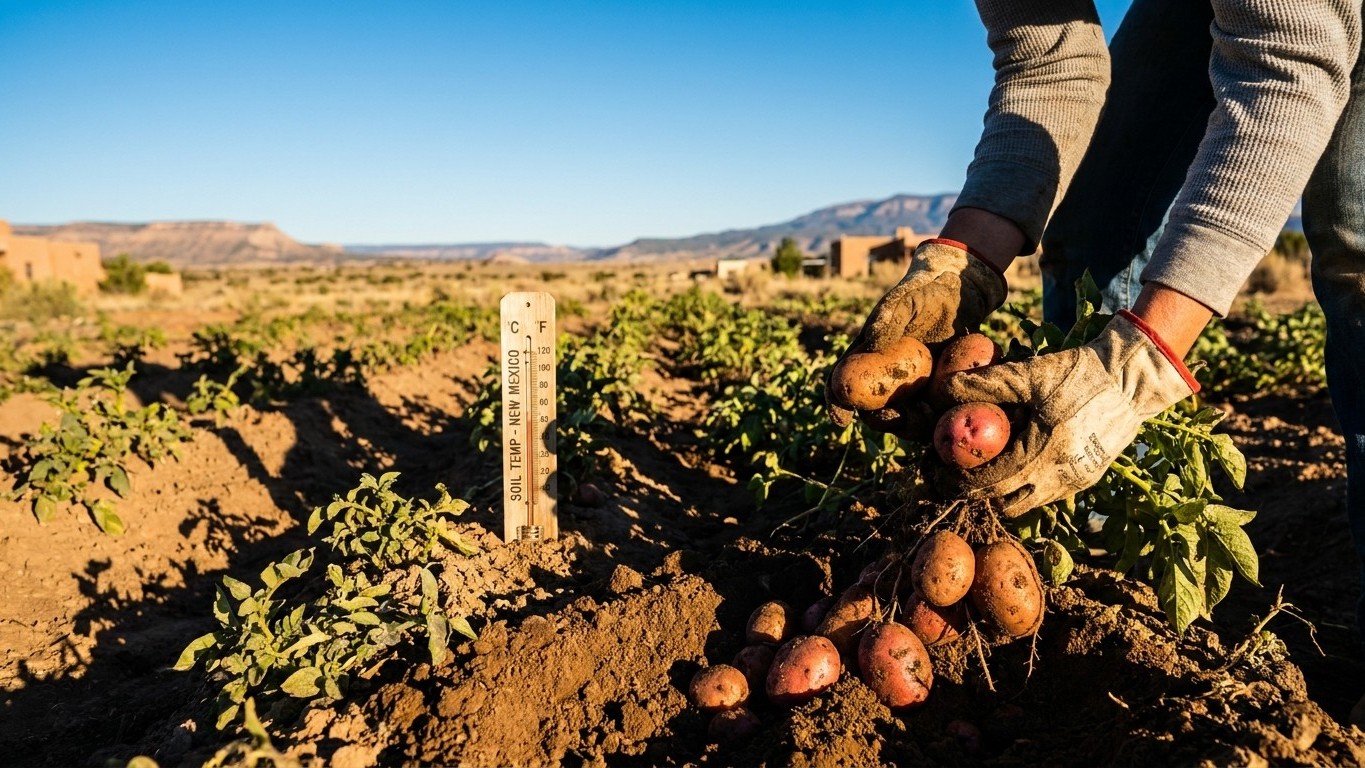

New Mexico’s growing conditions split sharply by elevation, but the reference numbers for Albuquerque tell most gardeners what they need to know: plant early, dig before deep summer heat sets in, and don’t count on a fall crop to save a season that starts late.
The short answer

Albuquerque reaches 90 F or higher on an average of 42.5 days a year, according to NOAA NCEI Climate Normals covering 1991-2020. That’s a real heat load, and it lands squarely in the window most New Mexico gardeners would otherwise use to let a potato crop finish sizing up through July. The last spring frost at the Albuquerque reference station falls between March 31 and April 12, per the same NOAA NCEI normals dataset. Those two figures together decide the shape of the whole growing plan.
Potatoes don’t stop growing because a thermometer reads a scary number in the shade. What matters is soil temperature, and Utah State University Extension is explicit that tuber set and fill are inhibited once soils climb above 90 F. In a place logging over forty days a year at or above that mark in the air, soil temperatures at planting depth will cross that threshold for stretches of the season, especially in the lower Rio Grande valley and the southern part of the state. Higher-elevation gardens in the northern counties and mountain valleys run cooler and get more slack.
The practical answer for most of New Mexico: treat potatoes as a spring crop. When to Plant Potatoes in New Mexico comes down to planting as early as the soil allows, pushing the plants through their bulking phase before the 90 F days pile up, and getting tubers out of the ground before peak summer heat rather than trying to nurse them through it. Knowing the right moment for Harvesting and Storing Potatoes in New Mexico matters just as much as the planting date. Waiting for a fall planting to dodge the heat isn’t a reliable substitute here either, because the reference frost window doesn’t leave a long enough cool stretch afterward for a full crop cycle before the ground cools down again in most of the state’s growing zones.
Season class and use, not days-to-maturity
Neither Utah State University Extension nor the University of Maine Cooperative Extension publishes a days-to-maturity figure for potato varieties, and this page won’t invent one. What both sources do publish is season class, and that’s the number that actually matters when narrowing down Potato Varieties That Suit New Mexico and planning around a short cool window.
| Season class | Typical role in the New Mexico calendar | Common use |
|---|---|---|
| Early season | Best fit for a heat-pressed spring crop; reaches harvestable size before the heaviest 90 F stretch | Boiling, salads |
| Mid-season | Workable in higher-elevation gardens with a longer cool window | Baking, general kitchen use |
| Late season | Riskiest choice statewide; needs a long cool stretch this climate rarely offers at lower elevations | Baking, storage |
When to plant here
The planting date isn’t picked off a calendar page. It’s counted backward from the local last frost date, using soil temperature as the real trigger. Here’s the arithmetic, in the order a gardener actually uses it.
- Start with your local last spring frost window. At the Albuquerque reference station, NOAA NCEI’s 1991-2020 normals put that window between March 31 and April 12.
- Check soil temperature at planting depth, not air temperature. Both Utah State University Extension and University of Maine Cooperative Extension point to 50 F soil as the trigger for planting seed potatoes.
- Count back 14 to 21 days from your last frost date. Soil typically reaches 50 F roughly two to three weeks ahead of that frost date in most temperate gardens, which is why the two figures are paired rather than used separately.
- Use that window as your planting target, adjusted by what a soil thermometer actually reads. If a cold snap or wet spell keeps soil below 50 F past the target date, wait: cold, wet soil does more damage than a slightly later start.
For a gardener working off the Albuquerque figures, that math lands the planting window somewhere in mid to late March at lower elevations, sooner than a lot of instinct says is safe for New Mexico. That’s the point: cool-season soil temperature, not frost fear alone, sets the date, and getting the crop in early is what buys time before the 90 F days start stacking up.
What the heat does to the crop
The mechanism is simple and it’s the whole reason dates matter here more than variety choice does. Above 90 F in the soil, tuber set slows and tuber fill stops. The plant can look green and healthy above ground while doing almost nothing useful below it. This isn’t a stress response that watering corrects. Extra irrigation cools the soil surface briefly, but it doesn’t change what’s happening at tuber-forming depth once ambient heat has built up over a run of hot days, and it does nothing to reverse a tuber-set window that’s already closed.
Cross that mechanism against Albuquerque’s 42.5 days a year at or above 90 F, and the read for New Mexico gardeners is direct. Lower-elevation gardens, especially in the southern half of the state and along the Rio Grande corridor, will hit that 90 F threshold repeatedly through late spring and summer. A potato crop planted late, or one dragging into July hoping to keep sizing, is fighting a ceiling that irrigation can’t lift. A crop planted at the early edge of the soil-temperature window and dug once the plants signal maturity, rather than left in the ground chasing extra size through the hot stretch, is working with the climate instead of against it.
Higher-elevation gardens, up in the northern mountain valleys and foothill counties, see far fewer of those 90 F days and have more room to run a longer-season variety. That’s exactly why a single statewide planting date or variety recommendation doesn’t hold up here: the same 90 F ceiling applies everywhere, but how often the state’s gardens actually reach it varies enormously by elevation.
What goes wrong here
- Uncertified seed potatoes. Seed pulled from a grocery bag or a neighbor’s leftover harvest often carries viruses that certified seed programs test against. A weak, virus-carrying start compounds every other problem this climate already creates. Buy certified seed potatoes from a garden supplier or extension-recommended source.
- Planting into cold, wet soil to beat the calendar. Pushing seed potatoes into soil that hasn’t reached 50 F, just to hit an early date, invites rot before sprouts ever emerge. Check soil temperature with an actual thermometer rather than guessing from the date alone.
- Skipping the hilling and ending up with green tubers. Tubers that push up near the surface and catch sunlight turn green and develop solanine, which makes them unsafe to eat. Hill soil or mulch up around the stems as plants grow so developing tubers stay covered.
- Digging too early out of heat anxiety. Worry about the coming hot stretch can push gardeners to dig before tubers have finished sizing, sacrificing yield for nothing, since the plant itself will signal readiness through die-back of the foliage.
Checking this against your own county
Every figure on this page comes from the Albuquerque reference station, and Albuquerque isn’t Taos, Las Cruces, or Silver City. Elevation swings of a few thousand feet across New Mexico move both the last frost date and the count of 90 F days by weeks in either direction, sometimes more in mountain valleys that trap cold air overnight even in spring.
Treat the dates and heat figures here as a statewide starting point, not a instruction for your specific garden. For local frost dates, soil temperature guidance, and variety recommendations suited to your county’s elevation, check with New Mexico State University’s Cooperative Extension Service, listed at aces.nmsu.edu.
Common questions
Can I grow potatoes in southern New Mexico’s summer heat?
Not through a full summer stretch. With soil above 90 F, tuber set and fill stop, and southern, lower-elevation counties log the most days at or above that threshold. The workable approach is an early spring planting, timed off the 50 F soil rule, dug before the heaviest heat arrives rather than left in the ground through it.
Does watering more help potatoes survive hot soil?
No. Extra water cools soil only briefly at the surface and doesn’t change what’s happening at tuber-forming depth once soil has warmed past the 90 F threshold. The fix is timing, planting early enough that bulking finishes before the heat builds, not compensating with irrigation once it has.
Why does certified seed matter more here than elsewhere?
It matters everywhere, but a climate that already limits the growing window leaves little margin for a weak start. Uncertified seed can carry viruses that reduce vigor and yield before heat stress even becomes a factor, stacking one problem on top of another.
Should I try a fall crop to avoid the summer heat entirely?
The reference frost window at Albuquerque, March 31 to April 12 for the last spring frost, doesn’t leave the kind of long cool stretch in fall that a full second crop cycle would need in most of the state’s lower elevations. Spring planting, timed off soil temperature, remains the more reliable path for most New Mexico gardens.