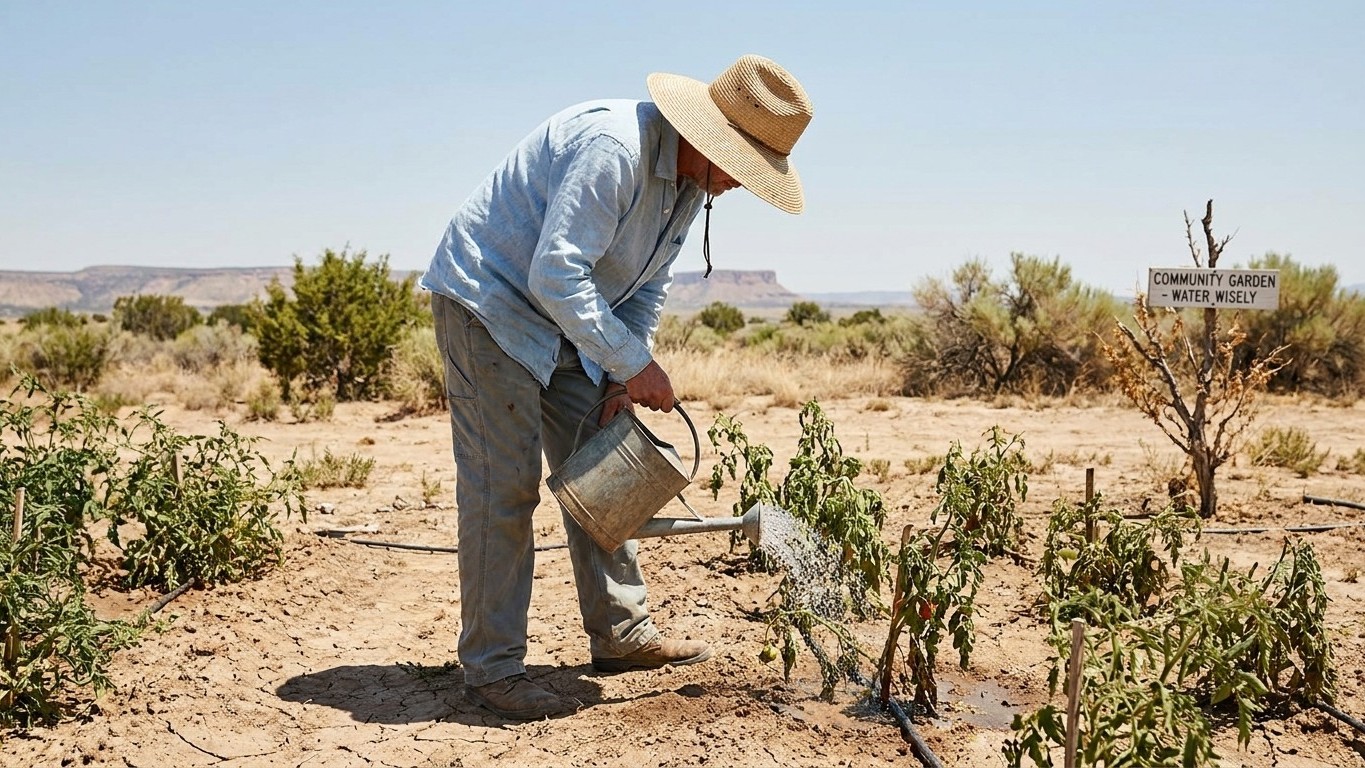

In New Mexico, an inch of rain a week is close to a myth for most of the growing season. June, the driest summer month, averages just 0.57 inches of rain for the entire 30 days, while the region racks up 42.5 days a year at 90F or hotter. That combination means a garden here survives almost entirely on water carried by hand, timed to beat the heat rather than to simply top off what falls from the sky.
What changes here

Start with the two numbers that define the season. June, the driest month of summer, averages 0.57 inches of rain. The same calendar stretch sits inside a year that reaches 90F or above on 42.5 days on average, at the reference station used for these normals. Put those two side by side and the message is direct: the driest month lands right in the middle of the hottest stretch, so whatever moisture June does deliver evaporates faster than it would in a cooler, wetter climate.
Do the arithmetic and the gap gets concrete. June runs about 4.3 weeks, so 0.57 inches spread evenly works out to roughly 0.13 inches of rain per week from the sky. A vegetable or flower bed generally wants close to a full inch of water a week to keep growing without stress. Subtract what June actually provides and the gardener is left carrying about 0.87 inches of that inch themselves, week after week, through the driest stretch of summer.
None of that rain arrives as a gentle, soaking drizzle either. New Mexico’s summer moisture tends to show up as isolated thunderstorms, often tied to the seasonal monsoon pattern, dumping a burst of rain in a short window rather than spreading it out. On hard, dry, or compacted ground, a good deal of that burst runs off before it ever reaches root depth. Sandy soil takes the water in quickly but drains it through just as fast, leaving little behind by the next afternoon; heavier, clay-rich ground resists the water at first, then holds what does soak in for much longer. Either way, the rain gauge on the porch and the moisture actually available to roots two days later can tell very different stories.
How to water when it matters
The method that works in this climate is deep, infrequent watering delivered at the base of the plant in the early morning, and each part of that sequence earns its place for a specific reason. Deep watering pushes moisture down where roots can follow it, encouraging them to grow deeper into cooler, more stable soil instead of staying shallow near the surface, which is exactly the layer that heats fastest on a 90-plus-degree afternoon. Watering at the base, rather than overhead, sends that moisture straight to the root zone instead of losing a share of it to evaporation off leaves and open air. Morning watering lets plants take up moisture before the day’s heat and sun start pulling it back out of the soil, and it gives any foliage that does get splashed several hours to dry before evening, when damp leaves overnight can invite fungal problems.
Knowing when to water matters as much as how. Surface soil can look bone dry within hours of a good soaking, while the root zone two inches down is still holding plenty of moisture, so judging by the top crust alone leads to watering too often. Push a finger or a trowel two inches into the soil near the plant; if it’s dry at that depth, it’s time to water, regardless of how parched or damp the surface appears.
Soil texture sets the rhythm from there. Sandy ground holds little water and dries out at root depth quickly, so it generally wants shorter, more frequent soakings. Heavy clay holds a week’s worth of water at a time but can drown roots if it’s watered again before that reserve has had a chance to dry down. One starting point: about half an inch of water per soaking, applied slowly enough to soak in rather than run off.
- Check soil moisture two inches down with a finger or trowel before watering; dry at that depth means it’s time, regardless of the surface.
- Water at the base of the plant, not overhead, so moisture reaches roots instead of evaporating off leaves.
- Water early in the morning, before the day’s heat sets in, so roots take up moisture before evaporation competes for it.
- Apply roughly half an inch per soaking, slowly enough to soak in rather than run off.
- Repeat every three to four days on sandy soil, or about once a week on heavier, clay-rich ground, then adjust based on how fast your own plot dries at that two-inch depth.
Treat that half-inch, twice-a-week baseline as a starting point rather than a fixed rule. The only way to know if it’s right for a given bed is to check back at the same two-inch depth a couple of days later and see how much moisture is actually left.
What goes wrong
A little water every day
Daily light sprinkling feels responsible, but it keeps roots parked near the surface, the exact layer that bakes hardest during those 42.5 days a year of 90F-plus heat. Deep, infrequent watering trains roots to grow down into cooler soil; frequent shallow watering trains them to stay right where the sun does the most damage.
Watering the leaves at night
Overhead watering in the evening leaves foliage wet through the cool overnight hours, and that damp window is exactly when fungal disease gets its foothold. New Mexico’s generally low humidity offers some natural protection, but pooled water on leaves after dusk still hands fungus the moisture it needs before morning sun can dry things back out.
Trusting a monsoon downpour
A dramatic summer thunderstorm can look like it solved the watering problem for the week, but these storms often wet only the top half-inch of soil before runoff carries the rest away, particularly on hardened ground. Push a finger two inches down after the storm passes before skipping a scheduled watering.
Skipping mulch
Bare soil exposed to that same stretch of 90-plus-degree days loses moisture to evaporation almost as fast as it goes in. A two- to three-inch layer of mulch slows that loss and buffers root-zone temperature, which matters most here precisely because the hottest days and the driest month overlap.
Local help
The New Mexico State University’s Cooperative Extension Service tracks local growing conditions, soil questions, and seasonal advice county by county. Watering restrictions vary by water provider and change with drought conditions, so check current rules directly with your local water utility or municipal district before setting a fixed schedule.
Common questions
How much should I water in New Mexico during summer?
A bed generally needs close to an inch of water a week total. Since June, the driest month, only supplies about 0.13 inches of that from rainfall, most of the remainder has to come from hand watering, adjusted to your soil’s drainage.
Is it better to water in the morning or evening here?
Morning. It lets plants take up moisture before the day’s heat pulls it back out of the soil, and any foliage that gets wet has hours to dry before nightfall instead of staying damp overnight.
How do I know if a summer rainstorm was enough?
Don’t guess from the size of the storm. Push a finger two inches into the soil afterward; if it’s still dry at that depth, water anyway, since much of a heavy downpour can run off before soaking in.
Does mulch really matter this much in a dry climate?
Yes. With 42.5 days a year reaching 90F or higher, bare soil loses moisture to evaporation quickly. A few inches of mulch slows that loss and keeps root-zone temperatures more stable between waterings.