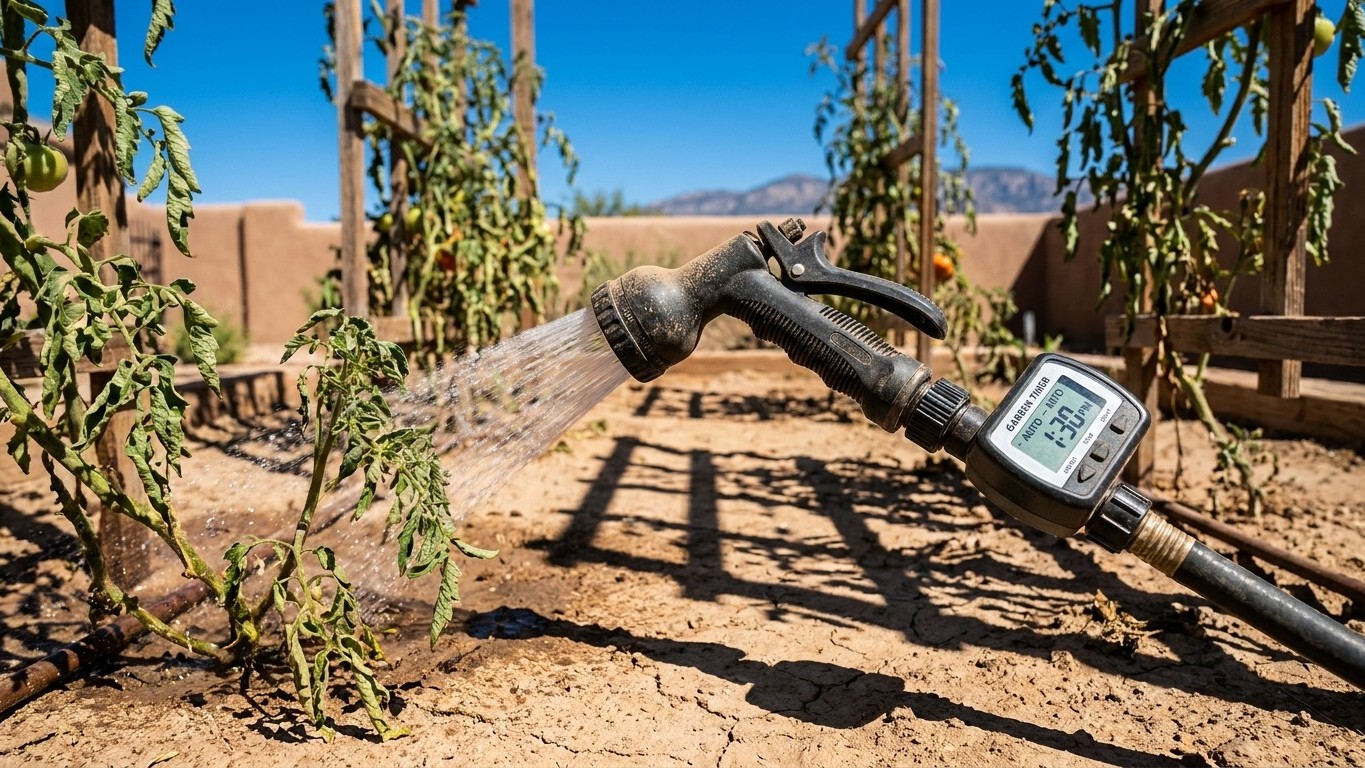

New Mexico gardens run on irrigation more than on rainfall, and the numbers back that up. Albuquerque averages 42.5 days a year at 90F or hotter, heat that pulls moisture out of soil fast, while the monsoon that’s supposed to save July and August often arrives late, thin, or not at all. Watering Through a Dry Spell in New Mexico is less about a single fix and more about a routine that survives these gaps. Here’s what that means for a hose, a timer, and a patch of tomatoes.
What the climate asks of you

Start with the heat, because it’s the number that changes everything else: 42.5 days a year reach 90F or higher at the Albuquerque reference station, according to NOAA’s 1991-2020 Climate Normals. That’s not a handful of scorchers in late July. That’s a stretch of the growing season, from late spring into early fall, where soil moisture evaporates faster than most gardeners expect, and where a bed that looked damp at 7 a.m. can be bone-dry by 3 p.m.
New Mexico’s summer rainfall pattern is famously uneven. The state does get a monsoon season, typically arriving in July and building through August, but it comes as scattered, sometimes violent downpours rather than the steady soaking rain that gardens actually want. A storm can dump water fast enough to run off a hard-baked bed before it soaks in, then vanish for two weeks. That unevenness is the real problem, more than any single seasonal total: a garden can’t count on the sky showing up on schedule.
A vegetable bed wants roughly an inch of water a week, delivered steadily. In a New Mexico summer, that inch mostly has to come from a hose or a drip line, not from the clouds. Treat any rain that does fall as a bonus that might cut a watering session short, not as a plan you can build a schedule around.
Soil makes it worse or better
New Mexico’s ground varies enormously by county, from sandy arroyo bottoms to heavy clay in old floodplain soils, and that texture decides how far your water budget stretches. Sandy soil drains fast and needs more frequent, shorter waterings. Clay-heavy soil holds moisture longer but can suffocate roots if it’s watered again before it’s had a chance to dry. Since the state doesn’t hand out one soil type, dig a shovel’s worth in your own yard before you set a schedule. A local NMSU County Extension office can tell you what’s typical for your area. Gardeners growing in raised beds or pots face a different equation entirely, since Watering Pots and Containers in New Mexico dry out far faster than in-ground soil under that same relentless heat.
How much, how often
Deep and infrequent beats shallow and daily, every time. A quick daily sprinkle wets the top inch of soil and trains roots to stay near the surface, right where the heat from those 42.5 days above 90F does the most damage. A deep soak once or twice a week pushes moisture down where roots can follow it, out of the worst of the heat.
The only reliable way to know it’s time to water is to check, not to guess by the calendar. Push a finger or a trowel two inches into the soil near the base of the plant. If it’s dry at that depth, water. If it’s still cool and damp, wait another day and check again. This single habit does more for a New Mexico garden than any watering app.
- Check soil at two inches deep before watering, every time, rather than watering on a fixed schedule.
- Water in the early morning, before the heat of the day sets in and before those 90-degree afternoons pull moisture back out of the soil.
- Aim the water at the base of the plant, not the leaves, to cut down on evaporation loss and reduce fungal problems.
- Give sandy soil shorter, more frequent soakings, since it drains fast and holds little reserve between waterings.
- Give clay-heavy soil longer, less frequent soakings, and never work or water clay ground that’s already wet, since it compacts and starves roots of oxygen.
- Expect to irrigate through the driest stretches, since New Mexico’s summer rain arrives unevenly and can’t be counted on to cover that weekly inch on its own.
Established perennials, shrubs, and anything native to the region can often stretch to once a week or even less once their roots are settled. Vegetable beds, containers, and anything newly planted need closer attention, especially through a run of 90-degree days when the soil dries out fast regardless of what type it is.
Restrictions and rules
Watering restrictions are common across New Mexico, and they change from year to year and from one water provider to the next depending on drought conditions and reservoir levels. Some municipalities set specific watering days by address, restrict daytime watering hours, or ban hosing down driveways and sidewalks during dry stretches. Others tighten those rules further during declared drought emergencies.
Because rules shift with conditions and vary by city, county, and water district, this article won’t list specific days or hours, since anything printed here could be outdated by the time you read it. The only reliable source is your own water provider or municipal utility, which posts current restrictions and can tell you whether outdoor watering is limited to certain days or times right now.
Given how little rain falls through New Mexico’s driest summer weeks, restrictions here are more likely, not less, than in wetter states. Check with your local water utility before setting an automatic irrigation timer, and check again if a drought is declared partway through the season. A timer set once in May and forgotten is exactly the kind of thing water districts flag during enforcement sweeps.
Using less
Cutting water use in a New Mexico garden isn’t about watering less, it’s about wasting less of what you do use. A few techniques do most of the work, and they stack on top of each other rather than replacing one another.
- Mulch, two to three inches deep, around every bed. It slows evaporation from soil baked by those 42.5 annual days above 90F and keeps roots several degrees cooler through the hottest afternoons.
- Drip irrigation instead of overhead sprinklers. Drip lines put water at the root zone with almost none lost to evaporation or wind drift, which matters in a state where wind and dry air pull moisture out of the air fast.
- Group plants by water need rather than scattering thirsty vegetables among drought-tolerant natives. It stops you from overwatering the natives just to keep the vegetables alive.
- Work organic matter into the soil every season. It helps sandy soil hold water longer between soakings and helps clay soil drain a little better, softening the extremes on either end.
- Rain barrels, where local rules allow them. An inch of rain falling on a thousand square feet of roof yields roughly 600 gallons. In New Mexico’s wetter monsoon month, that’s a real, if occasional, top-up for container plants or a small bed. In the driest stretch of summer, when storms may skip your neighborhood entirely, expect the barrel to sit empty for stretches and plan backup watering rather than relying on it.
None of these replace paying attention to the soil itself. But combined, they can cut the number of watering sessions a garden needs through a New Mexico summer without cutting corners on plant health.
Common questions
What USDA hardiness zone is New Mexico in?
New Mexico spans zones 4b through 9a, a wide range reflecting the state’s elevation changes from high desert to river valley. Albuquerque itself falls within that range, but a garden in the mountains or a lower-elevation valley will differ, so check your specific county rather than assuming the statewide range applies to your yard.
When is the last spring frost in New Mexico?
At the Albuquerque reference station, the last spring frost typically falls between March 31 and April 12, based on NOAA’s 1991-2020 normals. Suburban and rural gardens, especially at higher elevation, often see frost linger one to two weeks longer, so treat this as a starting point and confirm with your county extension office.
When does the first fall frost usually arrive?
The same Albuquerque data puts the first fall frost between October 29 and November 9. Outlying and higher-elevation areas tend to see it arrive earlier than that window, sometimes by a week or two, which shortens the effective watering season for warm-weather crops.
Where can I get local advice specific to my county?
New Mexico State University’s Cooperative Extension Service, at aces.nmsu.edu, maintains county offices across the state that track local soil conditions, frost dates, and current watering guidance tailored to your specific area rather than statewide averages.