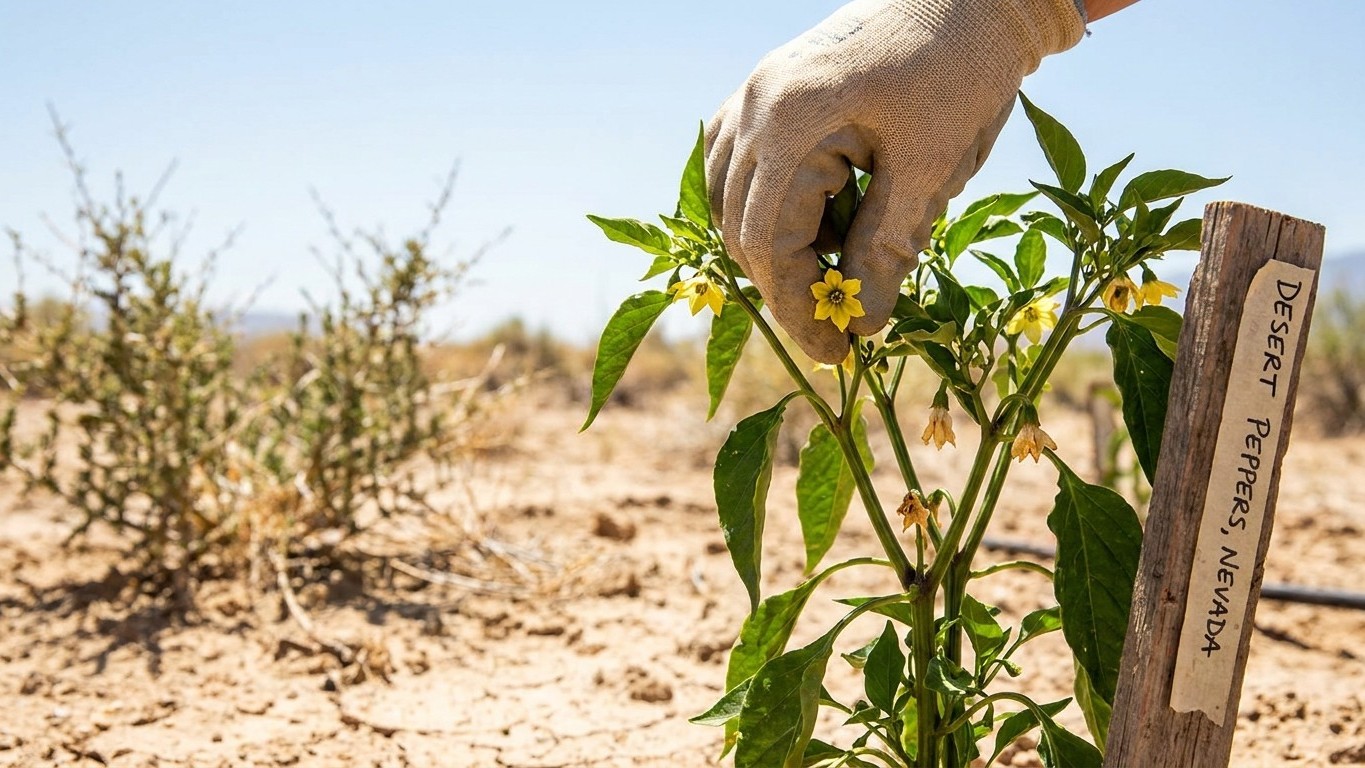

Nevada gardeners face a narrow window for peppers, and it isn’t about frost alone. In the low desert, summer heat above 90 F shuts down fruit set for weeks at a stretch, while at elevation the same crop can stall from nights that never warm up enough. Getting a harvest here means timing the transplant and watching both ends of the thermometer, not just the calendar.
The short answer

Las Vegas averages 131.3 days a year at or above 90 F, according to NOAA NCEI Climate Normals for 1991-2020. That’s not a handful of scorching afternoons, it’s roughly four and a half months where daytime highs regularly cross the threshold that stops pepper flowers from setting fruit. Pepper plants don’t die in that heat, and they’ll often keep blooming, but the blossoms drop before they turn into peppers. Growers in the Las Vegas Valley and other low-elevation parts of the state should expect a real midsummer gap in production, even with healthy, green, well-watered plants.
That gap matters because it changes how you plan the season. A gardener who transplants early enough to get a first flush of fruit set before the heat locks in, then waits out the worst weeks, and picks up a second round as temperatures ease in early fall, will get more peppers than one who plants once and hopes the whole summer works in their favor. Knowing When to Start Pepper Seed in Nevada is the first step in building that plan, since a transplant timed too late misses the early window entirely. Choosing from among the Pepper Varieties That Ripen in a Nevada Season can also help close that gap, since some cultivars set fruit faster in the narrow windows on either side of the summer heat. The 131.3-day figure is the reference-station average for the Las Vegas area specifically, a garden in a different part of the state, at a different elevation, will see a different number of 90-plus days, sometimes far fewer.
The other end of the fruit-set problem is cold, not heat, and it’s just as real. Nights below 55 F cause the same blossom drop as days above 90 F, according to Utah State University Extension guidance on peppers. Understanding Why Peppers Fail to Set Fruit in Nevada means watching both ends of the thermometer, since this site tracks days at or above 90 F for Nevada locations but does not carry summer night minimum temperatures for those same sites. That’s a real gap, and the honest way to handle it is to say so rather than guess.
Don’t infer your nighttime lows from where you sit on the map or from how cold your winters get. A high desert valley and a mountain-adjacent town at similar latitude can have very different summer night temperatures depending on elevation, air drainage and local terrain. If you garden somewhere that stays cool after sundown even in July, a thermometer left outside overnight for a week or two will tell you more than any regional assumption. That single piece of data, checked yourself, is the missing half of the fruit-set picture that no broad climate table can safely fill in for you.
When to start seed here
Pepper transplants need 8 to 10 weeks of indoor growing before they go in the ground, and they should go out only after your last frost and once soil has warmed to 60 F, per Utah State University Extension. Because Nevada’s frost dates vary enormously by elevation, run the math yourself using your own county’s typical last frost rather than a statewide date. Here’s the sequence, worked in words so you can plug in your own numbers:
- Find your local last spring frost date. Nevada’s range is wide: NOAA NCEI normals for Las Vegas show 32 F freeze risk clearing between roughly January 7 and February 1, but that figure reflects an urban desert extreme and is not usable as guidance for the rest of the state : Reno, Carson City and anywhere at elevation see frost end months later in spring, and start months earlier in fall. Skip the statewide guess and get the number for your own valley.
- Confirm soil has reached 60 F, not just that frost has passed. Cold soil stalls pepper roots even on a frost-free day, so check with a soil thermometer a few inches down rather than relying on the calendar alone.
- Count backward 8 to 10 weeks from your transplant date. If your soil typically hits 60 F in mid-May, for instance, that points to a seed-starting window in early-to-mid March indoors, the exact week depends on your own transplant date, not a fixed statewide day.
- Build in a buffer for a slow spring. A cool, wet stretch can delay soil warming by a week or two even after frost risk has passed, so treat your calculated start date as an earliest point, not a guarantee.
- Watch for the heat window closing in from the other direction. Given the Las Vegas area’s 131.3-day average above 90 F, low-desert gardeners benefit from starting on the early edge of that 8-to-10-week range so plants are established and flowering before the hottest stretch locks in.
The arithmetic is simple once you have your own local numbers: last frost date, plus time to 60 F soil, minus 8 to 10 weeks, equals your indoor seed-starting date. Every input in that equation is local, which is exactly why a single Nevada-wide planting calendar doesn’t work for a state that spans low desert and mountain valleys.
What goes wrong here
- Blossom drop in a hot spell. Flowers form, then fall off without setting fruit once days push past 90 F for several days running. This is the direct consequence of the Las Vegas area’s 131.3-day average above that mark. There’s no fix for the heat itself, but staggering plantings so an early crop sets fruit before the hottest weeks, and expecting a second flush once temperatures ease, keeps the season from being a total loss.
- Blossom drop after a cool night. The same dropped-flower symptom shows up when nights fall below 55 F, per Utah State University Extension. Since this site doesn’t track summer night lows, the only reliable fix is to monitor your own garden with an outdoor thermometer during bloom and note when temperatures dip into that range, especially in higher valleys where nights can turn cool even in summer.
- Sunscald on exposed fruit. Nevada’s strong, direct sun can scorch pepper skin where foliage is thin or where leaves have been stripped by wind or over-pruning. Leaving natural foliage cover in place, and avoiding heavy leaf removal during the hottest months, protects fruit from developing pale, papery scald patches on the side facing the sun.
- Blossom-end rot. Peppers develop a sunken, leathery patch at the blossom end when water delivery is inconsistent, which is common in dry heat where soil can swing from soaked to bone-dry between waterings. Steady, even soil moisture, helped by mulch to slow evaporation, addresses the underlying cause more reliably than any additive applied after the damage shows.
Checking this against your own county
Nothing here replaces a call or visit to your local extension office. Nevada’s growing conditions shift dramatically between the low desert around Las Vegas and the higher valleys around Reno and Carson City, and only someone working with your county’s data can give you a frost date, a typical soil-warming week, and a sense of your summer night lows that actually applies to your garden. University of Nevada, Reno Extension (extension.unr.edu) is the state’s land-grant extension service and the right first stop for county-specific planting guidance, soil testing resources, and answers on how your local climate lines up with the general patterns described here.
Common questions
Can peppers survive Nevada’s summer heat even if fruit set stops?
Yes. The plants typically stay alive and green through hot stretches; they simply stop converting blossoms into fruit until temperatures moderate. Keeping plants watered and healthy through the heat sets them up to resume fruiting once conditions improve.
Is there one frost date for the whole state?
No. Nevada’s elevation range is too wide for a single statewide date. The Las Vegas area’s NOAA-normal freeze window is an urban desert extreme that doesn’t apply to Reno, Carson City, or other higher-elevation communities, which see frost end later in spring and begin earlier in fall. Check with your county extension office for a local figure.
Does mulch help with blossom-end rot in dry heat?
Mulch slows soil moisture loss between waterings, which addresses the uneven watering that commonly causes blossom-end rot. It’s a practical step in dry, high-heat conditions where soil can dry out quickly between irrigation cycles.
How do I know if my nights are too cool for fruit set?
Set an outdoor thermometer in your garden and check it during bloom, particularly overnight. If readings fall below 55 F, expect blossom drop regardless of daytime warmth. Since regional data on summer night lows isn’t available here, direct measurement in your own yard is the only reliable way to know.