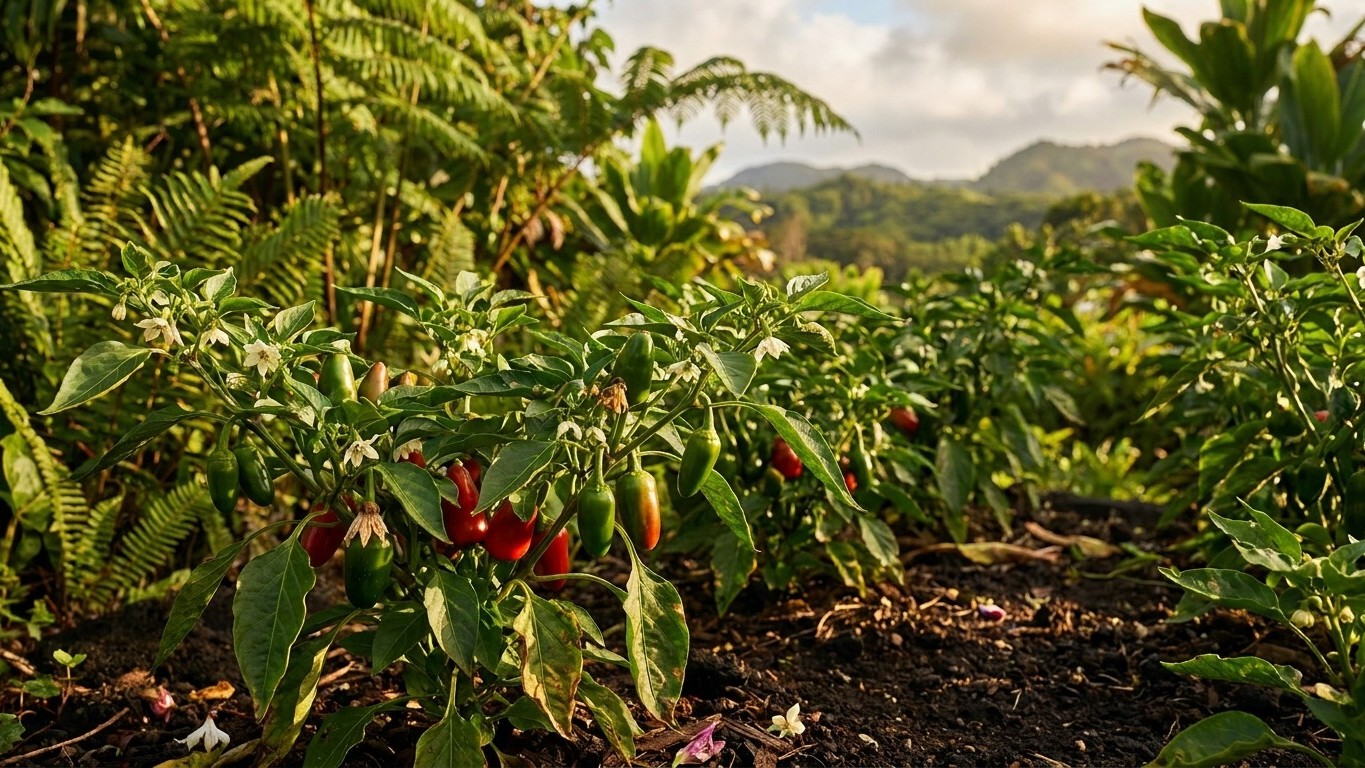

Peppers set fruit in a narrow band: nights need to stay above 55 F and days need to stay below 90 F. Lowland Hawaii spends about 18.7 days a year at or above that hot threshold, at the Honolulu reference station, which puts real heat pressure on plants during mid-summer. There’s no frost season here to build a planting date around, so timing hinges on soil temperature, elevation and which side of the island you’re on.
The short answer

Start with the number: 18.7 days a year at or above 90 F, measured at the Honolulu reference station over the 1991-2020 climate normals period. That’s not the average summer temperature, it’s a count of how many days actually cross the line where pepper fruit set starts to fail. Eighteen or nineteen days sounds modest until you notice they tend to cluster, back-to-back stretches in July and August when a plant can drop several rounds of blossoms in a row without setting a single pepper. A garden on the leeward side of Oahu or in a hot inland pocket of the Big Island will feel more of those days than a garden tucked into a windward valley with steady trade-wind airflow, even though both sit under the same state-level average.
Heat isn’t the only failure point, though it’s the one this data can quantify. Pepper flowers also abort when night temperatures drop below 55 F, and that threshold matters just as much as the hot one, sometimes more, depending on where you garden—for a deeper look at all the ways fruit set breaks down here, see Why Peppers Fail to Set Fruit in Hawaii. The trouble is that this site does not carry summer night minima for Hawaii locations, so there’s no verified number to hand you here. Elevation changes overnight lows fast in the islands: a garden at 2,000 feet on Maui or in upcountry Kona can run considerably cooler after dark than a coastal lot a few miles away, and no single statewide figure would describe both accurately.
That means the honest move is to watch your own thermometer rather than guess from a map. Don’t assume a cooler-sounding location is automatically safe, and don’t assume a tropical latitude rules out cool nights, because elevation and wind exposure override latitude in Hawaii more than almost anywhere else in the country. A cheap min-max thermometer left in the garden for a few weeks during your intended fruit-set window will tell you more than any regional average could. If you’re seeing blossoms open and then drop with no pepper forming, and daytime heat doesn’t explain it, check whether your nights are dipping under that 55 F line before you blame the soil or the variety—and if the variety is in question, it’s worth reviewing Pepper Varieties That Ripen in a Hawaii Season to see which ones are built for this climate’s tight fruit-set window.
Put together, the short answer is this: Hawaii’s real constraint on pepper fruit set is less about the state being “too hot” in a blanket sense and more about hitting the 18.7-day stretch of 90-plus heat during flowering, layered on top of a cool-night risk that varies by elevation and that only your own garden can confirm.
When to start seed here
Utah State University Extension frames pepper timing around two things: soil temperature at transplant and the eight-to-ten-week head start needed indoors before that. Hawaii’s missing piece, the one that trips people up, is that there’s no frost date to count back from. NOAA’s climate normals for the reference station show no freeze occurring in inhabited areas of the islands at all, not even a light-frost percentile worth publishing. That’s not a fluke of one recent stretch of weather, it’s a structural feature of the climate: frost only forms on the high volcanic summits, Mauna Kea, Mauna Loa, Haleakala, places nobody is planting pepper starts. So the calendar for the rest of the state has to run on a different anchor entirely.
Here’s how to build your own version of that arithmetic, step by step:
- Drop the frost date from the equation altogether. It doesn’t apply anywhere you’d actually be gardening in Hawaii, so don’t try to reverse-engineer one from a mainland calendar or a seed packet written for a temperate state.
- Find your soil temperature instead. Peppers transplant out once soil reaches 60 F, and in most lowland Hawaii gardens that threshold is met year-round or close to it, which shifts the real question from “when is it warm enough” to “when is it not too hot, and are the nights holding above 55 F.”
- Count back 8 to 10 weeks from your intended transplant date for starting seed indoors. If you’re aiming to move transplants outside in early spring to dodge the worst of the mid-summer 90-degree stretch, count backward from that date, not from a frost-free date that doesn’t exist here.
- Cross-check the target transplant window against the 18.7-day heat count. Timing your transplant so that flowering and early fruit set happen before the hottest weeks arrive gives the plant its best shot, since the 35 to 45 days pepper varieties typically need to move from flower to harvestable fruit run from flowering, not from the seed-starting date.
- Factor in your elevation and exposure. A leeward, low-elevation garden may need to shift the whole window earlier to clear the heat, while a windward or upcountry garden with cooler nights may need to watch the 55 F floor instead.
Redo this arithmetic for your own county rather than borrowing a generic date, since a Kona coffee-belt garden and a Hilo lowland garden can call for noticeably different windows despite sitting on the same island.
What goes wrong here
- Blossom drop during a hot spell. When daytime highs push through the 90 F mark, especially several days in a row, pepper flowers abort before they ever set fruit. This is the direct, measurable risk tied to Hawaii’s 18.7 annual days at or above that threshold. The remedy is timing: aim for flowering to land outside the heaviest stretch of hot days, and give plants afternoon shade cloth during any heat spell that arrives unannounced.
- Blossom drop from a cool night. The opposite failure looks identical at first glance, flowers open and fall without setting fruit, but the cause is a night dipping under 55 F rather than a hot day. Because summer night minima aren’t tracked here at the state level, the only reliable fix is a min-max thermometer in your own garden bed, run through your planned fruit-set window, so you know which end of the scale is actually hurting you before you change anything.
- Sunscald on exposed fruit. Hawaii’s sun intensity, especially at higher elevations where atmospheric filtering is thinner, can scald pepper skins that lose their leaf cover, whether from pruning, wind damage or heat-stressed defoliation. Keep the plant’s natural canopy intact rather than pruning hard for airflow, and use light shade cloth over exposed rows during the sunniest stretch of the season.
- Blossom-end rot. This shows up as a dark, sunken patch on the fruit’s bottom end and traces back to inconsistent water delivery interrupting calcium uptake, not a soil calcium shortage in most cases. Even watering, especially through any dry leeward stretch or windy period that dries soil fast, does more to prevent it than adding amendments.
Checking this against your own county
Everything above is built on state-level and single-station data, useful for setting expectations but not a substitute for what’s happening in your actual yard. The University of Hawaii’s College of Tropical Agriculture and Human Resources, CTAHR, runs the state’s extension service and is the named authority to check against local rainfall patterns, elevation-specific advice and pest pressure that a statewide number can’t capture. Their extension office can be reached through CTAHR’s extension service directory, which routes to island and district-level offices covering Hawaii, Honolulu, Maui and Kauai counties.
Local extension staff can tell you things this data simply doesn’t hold, like how your specific district’s night temperatures typically run in mid-summer, or which pepper varieties local gardeners have had the best luck with under your elevation and rainfall pattern. That’s worth a phone call before you commit a full season’s seed-starting schedule to a statewide average.
Common questions
Does Hawaii ever get frost where people garden?
No. NOAA’s climate normals for the reference station show zero freeze days per year in inhabited areas, and every freeze percentile comes back not-computable because it essentially never happens. Frost is confined to the high summits of Mauna Kea, Mauna Loa and Haleakala, well above any garden.
If there’s no frost date, how do I know when to transplant pepper starts?
Watch soil temperature instead. Peppers go outside once soil reaches 60 F, which in most lowland Hawaii locations happens for much of the year, shifting the real question to avoiding the hottest stretch of days during flowering rather than waiting out a cold snap.
Why are my pepper flowers dropping even though it’s not that hot?
Check your nighttime lows. Fruit set fails below 55 F as well as above 90 F, and cool nights at higher elevations or in windward valleys can cause the same blossom drop as a heat spell. This site doesn’t carry night-minimum data for Hawaii, so a thermometer in your own garden is the only way to confirm which threshold is at play.
How long after flowering should I expect peppers to be ready?
Utah State University Extension puts the window at 35 to 45 days from flowering, not from seed-starting or transplanting. Count from the first open blossoms on your plants, and factor that window against your local heat pattern so fruit development doesn’t land in the middle of your area’s hottest stretch.