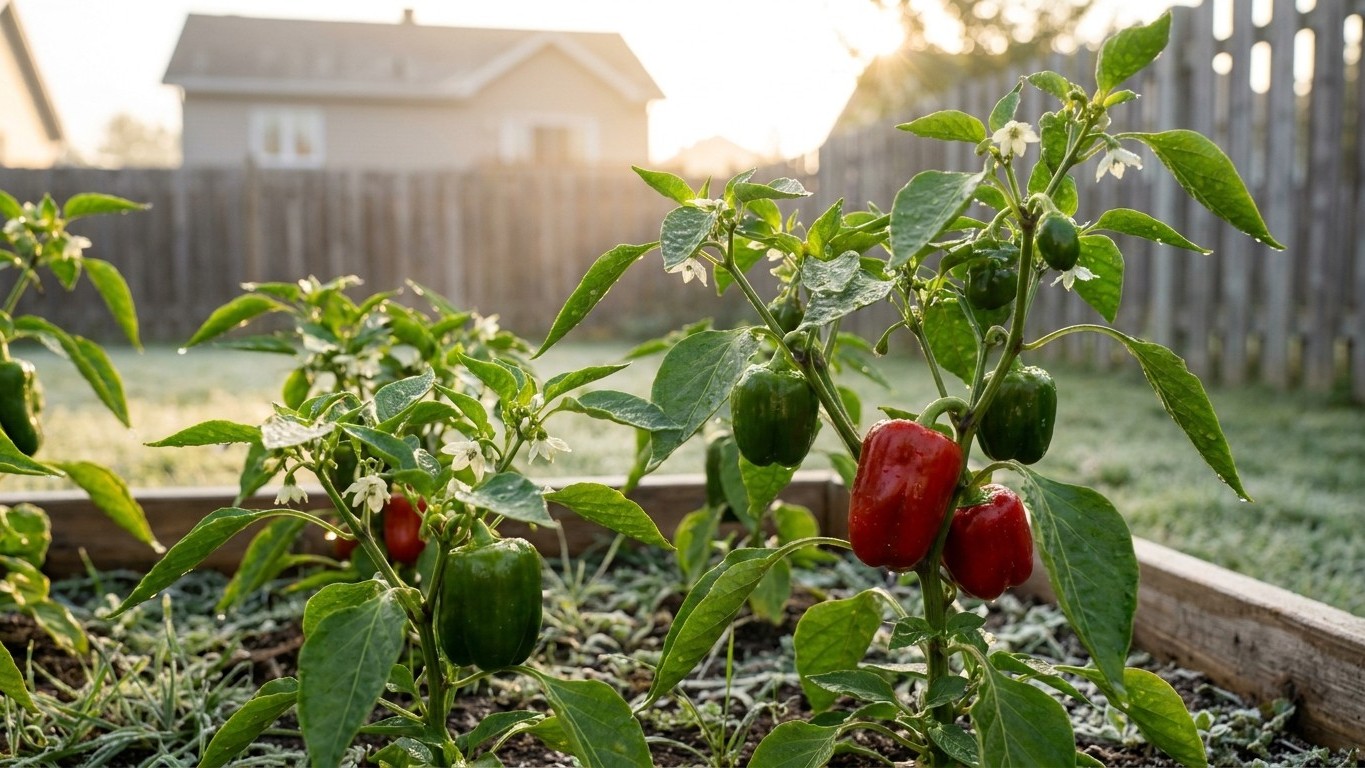

Quebec’s peppers rarely stall out from too much heat, but they stall out plenty from the other direction. The math that matters here starts with a near-total absence of scorching days and a spring frost date that’s a coin flip, not a guarantee. Get When to Start Pepper Seed in Quebec right along with the transplant window, and fruit set takes care of itself.
The short answer

Montreal’s reference station recorded an average of 0.0 days a year at or above 90 F over the 1981-2010 period, according to Environment and Climate Change Canada’s Canadian Climate Normals. For pepper growers, that number is close to reassuring. Utah State University Extension notes that pepper fruit set fails once daytime highs push past 90 F, because the flowers abort rather than pollinate. If your county tracks anywhere close to the Montreal normal, that particular failure mode almost never shows up. You’re not fighting heat stress here the way a grower in a hotter climate zone would be.
That’s one side of the ledger. The other side is the one Quebec growers actually need to watch, and it’s the side this site can’t hand you a number for. The same Utah State University Extension guidance is explicit that pepper fruit set fails at both ends: nights that drop below 55 F stop pollination just as effectively as days over 90 F do. Quebec summers, especially away from the warmest pockets along the St. Lawrence, can dip into that range on a clear, dry night even in July. A single cool night here or there won’t wreck a plant, but a run of them during flowering will leave you with blossoms that drop instead of setting fruit.
This site tracks days-above-90 by territory because that figure is published in the climate normals. Summer night minimums aren’t part of that dataset, and there’s no reliable way to back into them from latitude, from the coldest month of the year, or from any other proxy. A river valley, a hilltop, and a low frost pocket a few miles apart can post very different overnight lows on the same night, and none of that shows up in a regional average. The only real fix is to watch your own thermometer through the flowering weeks and note how often it’s dropping under 55 F after dark. If it’s happening several nights in a row while plants are blooming, that’s very likely why fruit isn’t setting, not a soil or fertilizer problem.
So the short answer splits in two. Heat-driven fruit failure: rare to the point of being nearly absent based on the Montreal normal. Cold-night fruit failure: possible, unmeasured by this site, and worth tracking yourself with a simple outdoor thermometer during the weeks your plants are flowering. For a deeper look at Why Peppers Fail to Set Fruit in Quebec, both of these mechanisms are worth understanding before you troubleshoot soil or fertilizer. Choosing among the Pepper Varieties That Ripen in a Quebec Season can also help hedge against those cool-night stretches by giving fruit a shorter window in which it needs to set and mature.
When to start seed here
Working out a seed-starting date is just subtraction, once you know the two anchor points. Here’s how the arithmetic runs for Quebec, and how to rework it for your own county.
- Start with the frost date. Environment and Climate Change Canada’s Canadian Climate Normals list an average last spring frost of May 6 at the MONTREAL/ST-HUBERT A station, based on the 1981-2010 period. This is a mean, not a safe cutoff. In roughly one year out of two, the last frost falls later than May 6, sometimes by a couple of weeks. Treat it as the middle of a window, not the edge of one.
- Add the soil-temperature check. Utah State University Extension recommends transplanting peppers only after frost risk has passed and the soil has warmed to 60 F. Air temperature can feel warm well before soil temperature catches up, particularly in clay-heavy ground or a shaded bed, so a simple soil thermometer pushed a few inches down is worth more than a calendar guess.
- Count back 8 to 10 weeks for the indoor start. That same guidance calls for starting pepper seed indoors 8 to 10 weeks before the transplant date. If your working transplant target lands in mid to late May, once you’ve allowed for the frost date being a mean rather than a promise and given the soil time to reach 60 F, counting back 8 to 10 weeks puts the seed-starting date somewhere in the second half of March.
- Rework it for your own county. The May 6 figure is a single station’s average. Northern districts, upland areas, and river valleys with cold-air drainage can run measurably behind that date. Swap in your own area’s typical last-frost window before you count backward, and lean toward the later end of the 8-to-10-week range if your spring tends to stay cool longer than the provincial average.
What goes wrong here
- Blossom drop. Flowers form but fall off before setting fruit. In Quebec this is far more often a cold-night problem than a heat problem, given how rare 90 F days are here, though an unusual hot spell can still trigger the same response if it lines up with flowering. The remedy is tracking your own nighttime lows through bloom and, where a run of cool nights is the pattern, accepting that early flushes may not set and that later, warmer flowering windows usually will.
- Sunscald. Fruit exposed to direct, strong sun develops pale, papery, sunken patches on the side facing the light. It happens most on plants that have been over-pruned or that lost leaf cover to wind or disease partway through the season. The remedy is leaving the plant’s own foliage in place to shade developing fruit rather than stripping leaves for looks, and using light shade cloth over exposed rows during the sunniest stretch of summer if leaf cover is thin.
- Blossom-end rot. Fruit develops a dark, sunken, leathery patch at the blossom end while the rest of the pepper looks fine. This comes from inconsistent water reaching the plant, which disrupts calcium uptake even when there’s enough calcium in the soil. The remedy is even, regular watering rather than a heavy soak followed by a dry stretch, plus a couple of inches of mulch to keep root-zone moisture from swinging as widely between rains.
Checking this against your own county
Every figure here comes from a single reference station or a provincial dataset, and Quebec is too large and too varied for one station to speak for every backyard. Before you lock in a transplant date, check it against local guidance from Quebec’s ministry of agriculture, MAPAQ (Ministère de l’Agriculture, des Pêcheries et de l’Alimentation du Québec). MAPAQ publishes region-specific growing information that can confirm whether your area tends to run ahead of or behind the Montreal-area normals used in this article, particularly on frost timing and the length of the frost-free season, which matters more to pepper growers than almost any other single number.
Common questions
Do I need to worry about 90 F days for peppers in Quebec?
Based on the Montreal reference station’s average of 0.0 days a year at or above 90 F, heat-driven fruit failure is close to a non-issue across most of the province. Cool nights during flowering are the more realistic risk to plan around.
What’s the safest date to transplant peppers outdoors?
There isn’t a single safe date, only a mean. The average last spring frost at MONTREAL/ST-HUBERT A is May 6, but frost falls later than that in about half of all years. Combine that mean with a soil temperature reading of 60 F before you transplant, rather than relying on the calendar alone.
How many weeks before transplanting should I start pepper seed indoors?
Utah State University Extension recommends 8 to 10 weeks indoors before transplanting. Counting back from a mid-to-late-May transplant target puts most Quebec seed-starting dates in the second half of March, adjusted earlier or later depending on your local frost pattern.
Why are my pepper flowers dropping without setting fruit?
Fruit set fails at both temperature extremes: nights below 55 F or days above 90 F during flowering. Since 90 F days are rare in Quebec, cool nights are the more likely cause here. Track your own nighttime lows during bloom rather than assuming it’s a soil or watering issue.