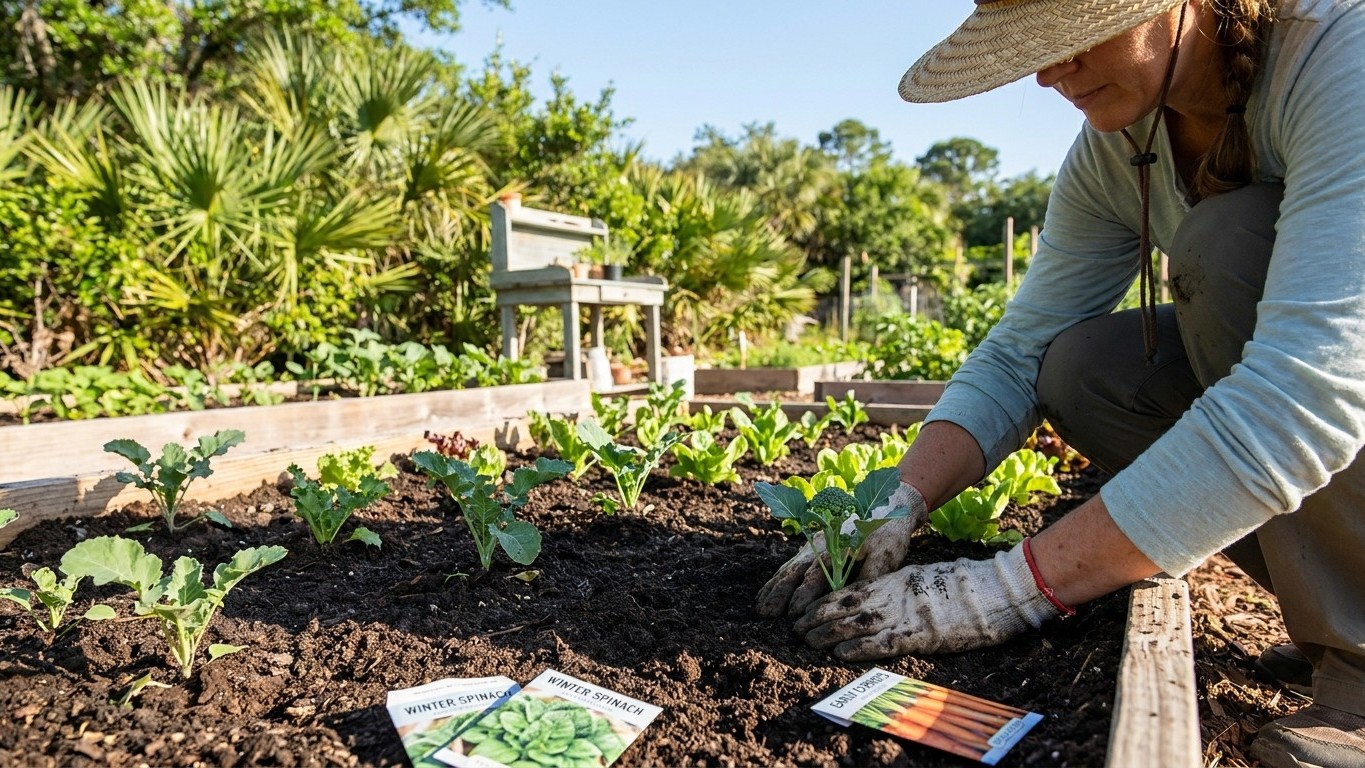

Florida’s answer depends entirely on where you’re standing. In Jacksonville and the rest of north Florida, frost is still possible through early March, so cold-hardy vegetables go outside now while tender ones wait under cover. In central and south Florida, where frost essentially doesn’t happen, the calendar flips: February is one of the best months of the year to plant, and gardeners there are already setting out crops that north Florida won’t touch until spring.
What goes in the ground in February

The decision here turns on two different mechanisms pulling in opposite directions. In north Florida, soil temperature and a lingering frost window still call the shots. In central and south Florida, cold isn’t the limiting factor at all; the real constraint is how many weeks remain before summer heat, humidity and disease pressure take over the garden.
At the Jacksonville weather station (USW00013889), NOAA’s 1991-2020 climate normals put the last spring freeze in a 30 to 70 percent probability band running from February 16 to March 7. That’s a window, not a fixed date, and three of the thirty years in that record saw no freeze at all. Treat it as a real risk that fades gradually, not a switch that flips on one morning.
For north Florida gardeners, that means cold-hardy crops go into the ground now: collards, kale, mustard greens, spinach, lettuce, English peas, onions, garlic, radishes, carrots and beets, plus transplants of broccoli and cabbage. All of these shrug off a light freeze. Tender crops, meaning tomatoes, peppers, beans, corn, squash and cucumbers, are still a gamble until that frost window closes. A low tunnel or a frost cloth over the bed buys a few weeks of insurance if you’re set on pushing the season.
South of roughly Ocala, frost stops being a meaningful threat. Central Florida sits in USDA zones 9b to 10a, and south Florida runs 10b to 11b on the current Plant Hardiness Zone Map, which is built on average annual extreme minimum temperatures. There, February usually lands in the mild stretch of the dry season, and it’s genuinely one of the best planting windows of the whole year. Tomatoes, peppers, beans, sweet corn, cucumbers and summer squash can all go into the ground now, timed to mature before the heat and rain of late spring bring disease pressure with them.
| Region | Frost risk in February | Plant now | Wait or gamble |
|---|---|---|---|
| North Florida (near Jacksonville) | Real, fading through the month | Collards, kale, spinach, lettuce, peas, onions, garlic, root crops, broccoli/cabbage transplants | Tomatoes, peppers, beans, squash, cucumbers |
| Central Florida | Rare, essentially over | Everything from the north Florida list, plus tomatoes, peppers, beans, corn, cucumbers, squash | Little; watch soil moisture instead |
| South Florida | Not a factor | Full warm-season lineup; many gardeners are already mid-season | None from cold; heat becomes the limit by late spring |
What to start under cover
North Florida gardeners can still use the frost window as a planning tool rather than an obstacle. Count backward from the point when the last-freeze probability drops off, then add the number of weeks a given crop needs to reach transplant size indoors before it goes into the ground. Tomato and pepper seedlings need real time under grow lights before they’re sturdy enough for an open bed, so starting them now, indoors or in a heated cold frame, sets them up to go outside once the frost risk has genuinely passed rather than the moment the air simply feels warm.
The two ways this goes wrong are opposite failures. Start too early and the seedlings outgrow their pots before it’s safe to transplant, turning rootbound and stressed in the process. Start too late and there isn’t enough growing season left before summer heat shuts tomatoes and peppers down. Splitting a tray into two sowing dates a couple of weeks apart is a cheap way to hedge against guessing wrong either direction.
In central and south Florida, starting seed under cover matters less for frost avoidance and more for getting a head start on crops with a long time to maturity, like eggplant or certain pepper varieties, or for protecting very young seedlings from the drying wind common in the dry season. Direct-sowing beans, squash, cucumbers and corn straight into warm outdoor soil is usually simpler and just as reliable there, since the soil temperature that limits germination further north isn’t a concern.
What is ready to pick
North Florida gardeners are mostly harvesting what survived winter rather than anything freshly planted: overwintered collards, kale and leeks, plus cold-frame lettuce and spinach that kept growing through the cooler weeks. Citrus trees across the state are still dropping ripe fruit this month for varieties with a later harvest window, and it’s worth checking trees regularly rather than letting fruit sit and split on the branch.
Central Florida is where the state’s winter strawberry season is in full swing, since the region’s mild, dry winters are exactly what the crop needs to fruit heavily before spring heat arrives. Snap beans, greens and root crops planted in the fall are also coming out of the ground steadily through the month.
In south Florida, harvest is closer to continuous. Tomatoes, peppers and beans planted earlier in the cool season are producing, tropical fruit trees are between flushes, and greens sown in the fall are often at their peak flavor before the season’s heat pushes them toward bolting. Whatever the region, this is also a good month to check anything in storage, winter squash, potatoes, onions, for soft spots or sprouting and pull those out before they spread rot to the rest of the batch.
The jobs that matter this month
Citrus care tops the list statewide. This is the window for finishing dormant-season pruning on citrus and other fruit trees before new growth starts, and for applying the first fertilizer round of the season once the worst freeze risk has passed in north Florida, since a heavy nitrogen application right before a hard freeze pushes tender new growth that cold will damage. Blueberries, another major Florida crop, benefit from pruning and mulching now, ahead of their spring bloom.
Soil preparation and mulching go together this month. Freshening mulch around beds and trees helps hold the moisture that Florida’s dry season pulls out of sandy soil, and it’s far easier to lay down before plants fill in and make the job fiddly. A basic soil test now, checking pH and nutrient levels before the spring planting push, catches problems while there’s still time to amend the bed rather than discovering a deficiency after the crop is already struggling.
Pest scouting matters more in February than gardeners expect, because Florida’s mild winters let aphids, whiteflies and caterpillars persist through the season instead of dying back the way they would further north. Checking the undersides of leaves on brassicas and citrus regularly catches an infestation while a strong spray of water or a targeted treatment still handles it, rather than after populations explode with the warmer weather ahead.
Ordering seed for the coming warm season is worth doing now rather than later, since popular tomato and pepper varieties routinely sell out before spring. It’s also a sensible month to sketch out crop rotation for beds that grew tomatoes, peppers or eggplant recently, since replanting the same nightshades in the same spot builds up soil-borne disease over time.
What not to do in February
The most common mistake in north Florida is trusting a warm afternoon over the calendar. A run of 75-degree days in early February doesn’t mean the frost risk has passed; the probability band from NOAA’s data runs into early March, and a single overnight freeze after a mild stretch can wipe out tender transplants set out too soon. Wait for the window to actually close rather than reacting to a warm week.
The mirror image of that mistake is uncovering cold-hardy crops or removing frost cloth too early after a mild spell, only to have them exposed when the next cold front comes through. Keep protection in place until the risk has genuinely eased, not just until the weather feels done with winter.
On citrus specifically, timing nitrogen wrong causes real damage. Fertilizing too early, while frost is still likely, pushes soft new growth that a freeze will burn back, undoing the benefit of feeding in the first place. Holding off until the frost window has largely passed protects that investment.
Statewide, overwatering during the dry season is an easy trap, since sandy Florida soil drains fast and gardeners can overcorrect by watering on a fixed schedule instead of checking actual soil moisture. Feel the soil a couple of inches down before turning on the hose; established plants often need less than the calendar suggests.
Checking this against your own county
A statewide month is a starting point, not an instruction. Florida stretches from a real winter climate near the Georgia line to a nearly frost-free tropics at its southern tip, and elevation, distance from the coast and even a nearby lake can shift these windows by weeks in either direction. A garden in the Panhandle and one in the Keys are not on the same clock, even though both are technically “Florida in February.”
The University of Florida’s IFAS Extension publishes county-level planting guidance and can confirm how these general windows apply to your specific location before you commit a tray of seedlings to the ground.
Common questions
Is it safe to plant tomatoes outdoors in Florida in February?
It depends on the region. In north Florida, near Jacksonville, frost risk lingers into early March, so tomatoes set out now face real danger unless they’re under cover. In central and south Florida, where frost is rare to nonexistent this time of year, tomatoes planted in February are common and generally do well.
What vegetables tolerate frost in north Florida?
Collards, kale, mustard greens, spinach, lettuce, English peas, onions, garlic, and root crops like carrots, beets and radishes all handle a light freeze without serious damage, which is why they’re the safe February choices in the state’s northern counties.
Why does south Florida’s growing calendar work opposite to the rest of the country?
Because frost almost never occurs there, the limiting season isn’t winter cold, it’s summer heat and humidity, which bring disease pressure and stress that many vegetables can’t handle. That flips the calendar: the main growing season runs through the cooler months, including February, rather than through summer.
When should citrus trees be fertilized in Florida?
Timing matters more than a fixed date. Applying nitrogen while frost is still likely pushes tender new growth that a freeze can damage, so it’s safer to wait until the local frost window has largely passed before starting the season’s fertilizer program, and to check county-specific guidance for exact scheduling.