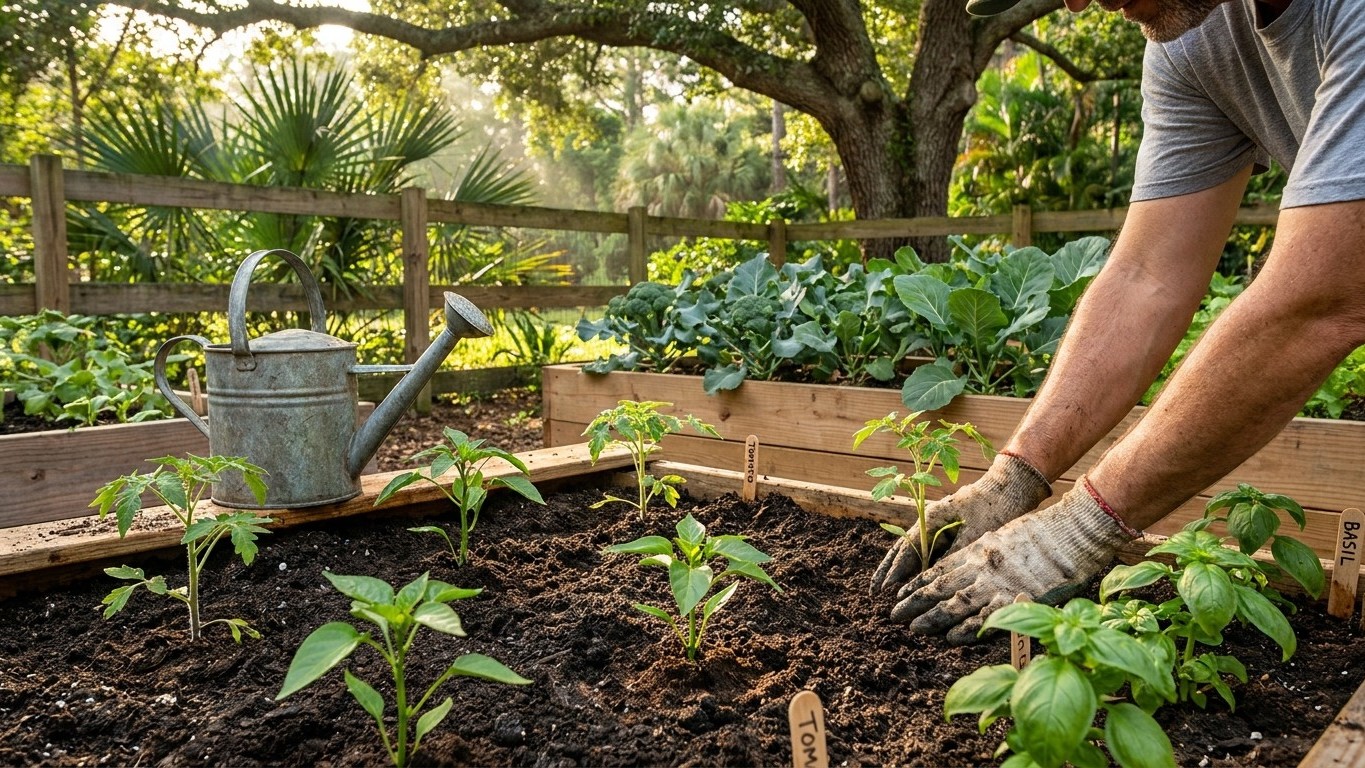

September in Florida means the fall garden opens, not the frost season. In north Florida, the first freeze doesn’t arrive until late November at the earliest, so summer heat, not cold, decides what goes in this month. Tomatoes, peppers, and heat-tolerant herbs still go in early in the month, while broccoli, collards, and lettuce start once the worst heat breaks. Central and south Florida run on nearly the opposite calendar, with their real cool-season garden still weeks away.
What goes in the ground in September

Florida’s planting calendar doesn’t run on frost the way most of the country’s does. At the Jacksonville station used in NOAA’s National Centers for Environmental Information 1991-2020 climate normals, the first fall freeze arrives somewhere between November 26 and December 13, and the last spring freeze falls between February 16 and March 7. September sits nowhere near either window. The decision for this month isn’t whether it will freeze. It’s whether the soil is still too hot to germinate.
That distinction matters more in north Florida, which sits near USDA Plant Hardiness Zone 8b on the USDA’s hardiness map, than it does farther south. Central and south Florida run through zones 9 to 11b on that same map, where a hard freeze is rare enough that the growing calendar flips: the productive season runs through winter, and summer, including September, is the hardest stretch to garden in.
North and central Florida
Early September still carries brutal soil temperatures here, but the second half of the month usually cools enough to direct-sow or transplant the start of the fall garden.
- Broccoli, cabbage, and cauliflower transplants, set out once daytime heat eases
- Collards and kale, direct-seeded or transplanted, since both tolerate lingering heat better than other brassicas
- Carrots, beets, and radishes, direct-sown once soil drains well and isn’t waterlogged from late-summer storms
- Bush beans and southern peas, still viable for one more warm-season round early in the month
Tomatoes and peppers set out now are the fall crop, timed to fruit before any cold arrives, not a repeat of the spring planting.
South Florida
Gardeners here face a different problem: not cold, but rain and humidity. September sits inside the region’s wettest stretch, and soil that stays saturated for days encourages damping-off in young seedlings. Raised beds with sharp drainage, or containers that can be moved under cover during heavy downpours, do better than open ground for anything started from seed. Waiting two to three weeks longer than north Florida gardeners, until the heaviest rain settles, is often the safer bet.
| Region | September’s role | Frost risk this month |
|---|---|---|
| North Florida (near Jacksonville, zone 8b) | Start of the fall garden as heat breaks | None; first freeze not until Nov 26-Dec 13 |
| Central and south Florida (zones 9-11b) | Still peak heat and rain; fall garden waits | Rare to none most years |
What to start under cover
Starting seed indoors or under row cover in September is an exercise in counting backward, not forward. For north Florida, the anchor point is that first fall freeze window of November 26 to December 13. A gardener starting broccoli or cabbage seed now, rather than waiting for store-bought transplants, needs to work out how many weeks that crop takes to reach transplant size, then count back from the earlier edge of that freeze window, not the later one.
Get that math wrong in one direction and seedlings sit rootbound in trays for weeks, waiting on soil that’s still too hot to receive them. Get it wrong the other way and plants go into the ground so late they’re barely established before growth slows. Neither failure is fatal in Florida’s mild fall, but both cost real weeks of harvest.
Cover doesn’t always mean warmth
In early September, “under cover” often means shade cloth over seed trays, or flats started indoors under lights where air conditioning holds temperatures down. That solves the real problem this month: soil and air too warm for reliable germination of cool-season seed like lettuce, spinach, and many brassicas. Once trays are past their first true leaves, they harden off outdoors as the month’s heat eases.
In central and south Florida, where frost isn’t part of the calculation at all, starting under cover in September is mostly about beating rain and humidity rather than heat. Seed started in trays under a covered porch or in a garage with good airflow avoids the fungal problems that hit direct-sown seedlings during the region’s wettest weeks. Those trays move outside once the heaviest storm activity begins to taper.
What is ready to pick
September still belongs to the summer garden as much as it opens the fall one. Okra keeps producing through the month for anyone who planted in spring or early summer, and pods left more than a couple of days past a couple of inches turn woody fast, so picking every two to three days matters more than any other single task on the summer harvest list.
Roots, vines, and herbs winding down
Sweet potatoes planted in spring approach their harvest window by late September in much of the state, though many gardeners wait until foliage starts to yellow before digging. Seminole pumpkin, a Florida heirloom squash that shrugs off the humidity that kills most other squash varieties, is often ready to pull off the vine this month, with a hard rind and a hollow sound when tapped the signs to check. Southern peas planted earlier in summer are usually finishing their run, and peppers and eggplant that survived the worst heat keep bearing as temperatures ease slightly. Basil planted in spring is often bolting to flower by now; pinching flowers back extends the harvest a few more weeks.
On the fruit side, figs and some muscadine grape varieties finish their main harvest in early fall across much of the state, and persimmons in north Florida begin coloring up toward the end of the month, though they’re rarely fully ripe until closer to first frost.
The jobs that matter this month
Storm prep comes before planting
September sits inside Florida’s most active stretch for tropical storms and hurricanes, and that should shape most of this month’s task list before a single seed goes in the ground. Staking tomato and pepper plants, securing trellises, and clearing anything that could become storm debris matter more now than almost any other task on the calendar. A trellis that survives a dry spring can go down in a single afternoon of tropical storm winds.
Drainage works in both directions this month. Beds that pool water for more than a day after a downpour need attention now, whether that’s raised mounding, French drains, or simply redirecting a downspout, because standing water during the wettest weeks of the year rots roots fast. At the same time, any dry stretch between storms means checking soil moisture directly rather than assuming recent rain covered it.
Soil, pests, and succession
Soil preparation for the fall garden pays off directly this month. Working compost into beds before cool-season transplants go in gives it weeks to break down, rather than competing with young roots for nitrogen. Testing soil pH now, ahead of brassicas that prefer a more neutral range than Florida’s naturally acidic sandy soils often provide, gives time to adjust with lime before transplanting.
Pest scouting matters more in September than gardeners often expect. Heat and humidity together push whitefly and aphid populations up fast, and both can move onto tender fall transplants the moment they go in the ground if the surrounding area isn’t checked first. A few minutes turning over leaves on existing plants before adding new ones catches an infestation before it spreads. Succession sowing of fast crops, radishes, bush beans, and lettuce started every couple of weeks, keeps something coming out of the garden through the transition rather than one harvest followed by a gap.
What not to do in September
The most common mistake this month is treating warm air as permission to plant like it’s spring. Soil several inches down stays hot long after the evening air feels bearable, and seed that needs cooler soil to germinate, lettuce especially, will simply sit or rot rather than sprout, no matter how promising the forecast looks.
Another frequent error is assuming frost protection matters this month anywhere in Florida. It doesn’t. Covering plants against cold in September is wasted effort, since the earliest freeze window doesn’t open until late November even in the coldest part of the state. That effort is better spent on hurricane prep, since that’s the real weather risk on the calendar this month.
Heavy nitrogen feeding is a third trap, especially for tomatoes and peppers going into their fall run. A plant pushed hard with nitrogen this month puts energy into leafy growth right as day length starts shortening, when it should be shifting toward setting fruit before any cool weather arrives. A balanced or lower-nitrogen feed serves the fall crop better than the fast green growth nitrogen encourages.
Pulling shade cloth or row cover too early after a few mild days is the fourth mistake, especially in central and south Florida. A cooler week in early or mid-September doesn’t mean the heat is done. Afternoon temperatures regularly spike back up before the month ends, and seedlings hardened off too fast under full sun can scorch or bolt within days.
Checking this against your own county
Everything above describes Florida in broad strokes, and the state doesn’t garden in broad strokes. The frost dates cited here come from a Jacksonville station, useful for north Florida but meaningless for Orlando or Miami, where the growing calendar runs almost entirely opposite. Latitude alone moves these windows by weeks across the state’s length, and rainfall during hurricane season can vary sharply between neighboring counties in a given year.
The University of Florida’s IFAS Extension network keeps county-level planting guides that reflect these differences directly, down to varieties suited to sandy coastal soil versus inland clay. Checking a county’s own extension office before finalizing a fall planting list catches the local exceptions a state-wide page like this one can’t. Find the local office through the UF/IFAS Extension directory.
Common questions
Is Florida too hot to plant vegetables in September?
North Florida usually cools enough by mid to late September for the fall garden to begin. Central and south Florida generally need a few more weeks before soil temperature and humidity drop enough for reliable germination.
Does Florida get frost in September?
No. Even in north Florida, the earliest fall freeze window doesn’t open until November 26 at the earliest, based on the Jacksonville climate station. Central and south Florida rarely see frost at all.
What vegetables can I plant in Florida in September?
Broccoli, cabbage, collards, kale, carrots, beets, and radishes typically start this month in north and central Florida as summer heat eases, alongside a final round of fall tomatoes and peppers.
When does south Florida’s fall garden actually start?
Because south Florida’s growing calendar runs opposite the rest of the state, with summer as the hardest season to garden in, most of the real fall planting push shifts into October or later, once the wettest weeks of hurricane season begin to taper.