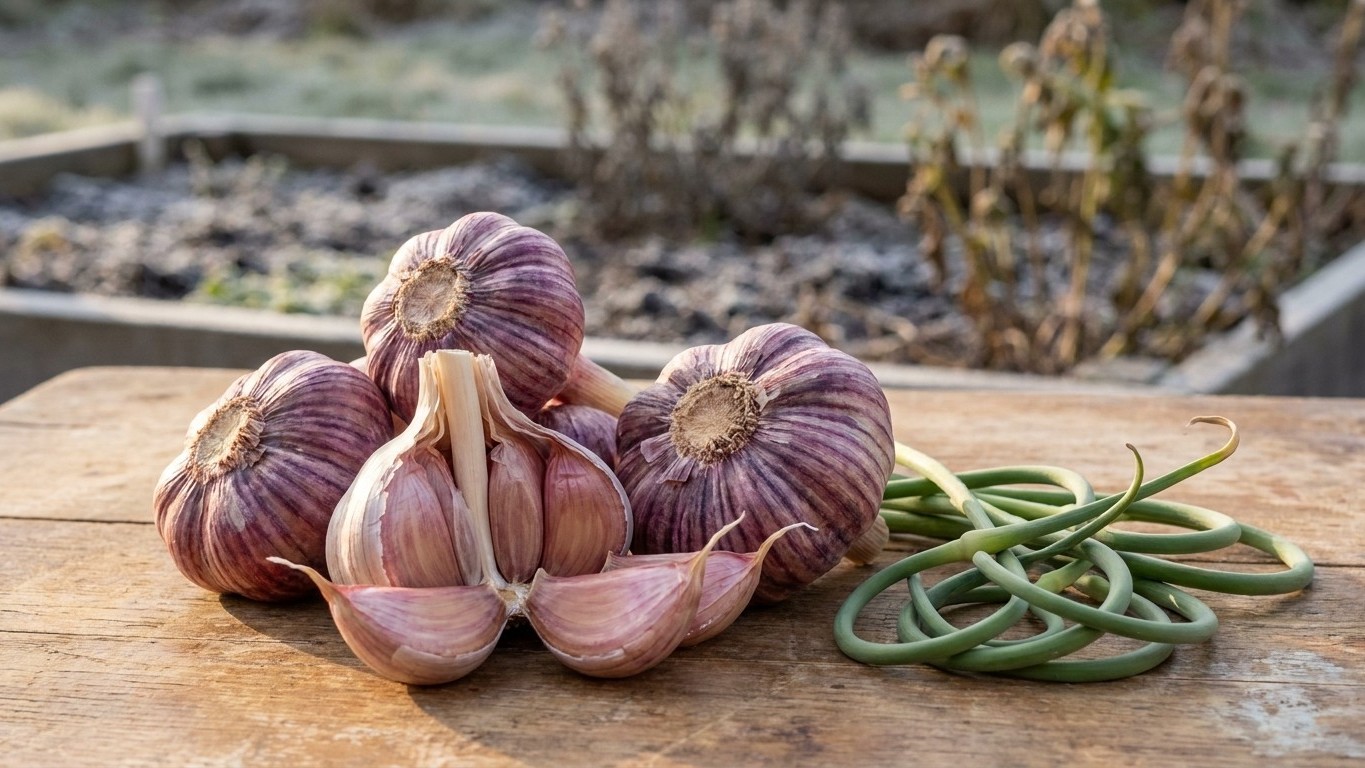

Vietnamese Red Garlic is a hardneck, Purple Stripe type with a mild spice that fades fast and a pleasant finish. It stores only 3 to 4 months at room temperature, so it belongs in your kitchen rotation early, not tucked away for winter. Whether it grows well for you comes down to one thing: does your region give it enough real cold?
What Vietnamese Red Garlic Actually Is

This variety belongs to the Purple Stripe family, one of the botanical groups that make up hardneck garlic (Allium sativum var. ophioscorodon). Purple Stripe types are known for their striped, often glossy wrappers, and Vietnamese Red Garlic follows that pattern with its striped coloring. As a hardneck, it sends up a rigid central stalk called a scape, which growers cut off before it flowers, since the plant’s energy is meant to go into the bulb, not into seed production.
On flavor, the catalog description for this variety calls it a mild spice that dissipates quickly with a pleasant finish, so the heat you taste up front doesn’t linger. That makes it a garlic suited to dishes where you want the aromatic hit without a slow burn.
The practical number to know before you plant it is storage life. Vietnamese Red Garlic keeps only 3 to 4 months at room temperature, well short of the 6 to 10 months some softneck varieties manage. Bulbs give 4 to 12 cloves that peel easily, which is a genuine kitchen convenience, but it also means this is a “use it, don’t hoard it” garlic. There are no published disease or pest resistances for this variety, which is worth knowing before you plant it in a bed with a history of white rot or nematodes, since you won’t get any built-in protection.
Will It Get The Cold It Needs Where You Are
Garlic doesn’t divide into cloves by instinct alone. A hardneck bulb like this one needs a sustained stretch of cold after planting, a process called vernalization, or the plant simply lifts as a single round, undivided bulb the following summer. That’s the single most common reason home growers end up disappointed with garlic: not disease, not poor soil, but a winter that never got cold enough for long enough.
Purple Stripe hardnecks, as a group, are among the more cold-dependent types of garlic. They generally want an extended run of weather below roughly 40°F, stretching across several weeks, to trigger that clove division. This is not a light frost overnight and done. It’s a season’s worth of consistently cold ground.
Where the cold comes easily
In the traditional cold-winter garlic belt, states like Minnesota, Vermont, Montana, and much of the Upper Midwest and interior Northeast, that vernalization period is never in question. Ground freezes hard, stays cold for months, and the cloves get more chill than the minimum requirement. Growers there plant in fall and can largely stop worrying about whether winter will “do its job.”
Where it’s marginal
Move into the mid-Atlantic and upper South, places like Virginia, North Carolina, and Tennessee, and the picture gets murkier. Winters there dip into the 30s and 40s regularly but with more variability, some years generous, some years mild and short. Vietnamese Red Garlic can succeed in these zones, but yields and clove division tend to be less consistent than in a true cold-winter climate. Choosing a planting site that stays cold and doesn’t warm up in false-spring thaws matters more here than it does further north.
Where it falls short
In warm-winter regions, coastal and southern California, the Gulf Coast, Florida, and most of Texas, ground temperatures rarely stay cold long enough on their own. Two real options exist for growers there. The first is refrigerating the seed cloves before planting, typically in a home refrigerator for several weeks, to simulate the chill the ground won’t provide. The second is choosing a variety that simply asks for less cold in the first place, since softneck types and some Artichoke varieties tolerate mild winters without any pre-chilling at all. Skipping both steps and planting Vietnamese Red Garlic straight into a warm-winter garden is the setup for that single-bulb disappointment.
When To Put The Cloves In
Garlic planting is anchored to the first fall frost date for your area, not to a fixed calendar day, because what matters is giving the cloves enough time to root into the soil before it locks up with cold, while keeping top growth minimal going into winter. Roots that establish now feed a stronger start next spring; leaves that grow too tall too soon just get burned back by hard freezes.
In cold-winter states, that generally means planting 2 to 4 weeks before the ground is expected to freeze solid, often landing in late September through October depending on elevation and latitude. In milder regions, the mid-Atlantic and upper South, growers commonly wait until October or into November, since the ground stays workable and frost-free longer. In warm-winter areas where refrigeration substitutes for a real winter, planting often happens in December or even January, timed so the chilled cloves go into cool (not frozen) ground and mature before summer heat arrives.
Sources on exact regional windows don’t always agree, and that’s worth saying plainly rather than papering over. Local frost patterns, soil drainage, and even a single early cold snap can shift the right week by more than a little. The safer rule of thumb across all regions: aim for roots, not shoots, before the ground goes cold.
Hardneck Or Softneck: What This One Asks Of You
Vietnamese Red Garlic is a hardneck, and that habit shapes almost every part of growing and using it. Hardnecks send up a scape, that curling flower stalk, which should be cut once it forms a loop or two, redirecting the plant’s energy into bulb growth instead of into producing a stalk that would otherwise be lifted as a bulb and cut, not pollinated.
In exchange for that extra step, hardnecks like this one give you fewer, larger cloves per bulb (4 to 12 in this case) arranged in a single ring around the stalk. Those cloves peel more easily than the tightly packed, papery-skinned cloves of a softneck, which is a real time-saver at the cutting board. The tradeoff is storage: hardnecks in general, and this variety specifically at 3 to 4 months, don’t keep nearly as long as softnecks, some of which last 8 to 10 months in a cool, dry pantry.
That tradeoff isn’t arbitrary. Hardnecks evolved to handle harsher winters, and their biology reflects it, cold-hardy but shorter-lived once cured. Softnecks, better suited to milder climates, trade some of that cold tolerance for a longer shelf life and the classic braidable stems. If you’re in a genuine cold-winter region, Vietnamese Red Garlic fits the climate that shaped it. If you’re gardening somewhere mild, remember that even with refrigeration tricks to satisfy its chill requirement, you’ll still be working with a garlic that wants to be eaten within a few months of harvest, not stored through next spring.
Growing And Curing It Without Losing The Crop
Plant cloves pointy end up, about 2 inches deep and spaced 4 to 6 inches apart in rows a foot or so wide, in soil that drains well since sitting water rots cloves before they root. A layer of mulch, straw or shredded leaves 3 to 4 inches deep, matters more for an overwintered crop like garlic than it does for most vegetables, because it buffers root-zone temperature swings and helps prevent the alternating freeze-thaw cycles that can heave cloves right out of the ground.
Through spring, garlic wants steady moisture, but that changes as harvest nears. Stop watering roughly 2 weeks before you expect to lift the bulbs, since wet soil at that stage promotes rot rather than growth and can stain or soften the wrappers. The signal to lift is foliage: when the lower third to half of the leaves has yellowed and died back but the top leaves are still green, the bulbs are typically mature. Waiting for all the leaves to brown often means the bulb has already started splitting its wrapper underground, which shortens storage life even further on a variety that’s already short-lived at 3 to 4 months.
Curing is where a lot of good harvests get wasted. Bulbs need to hang or lie in a shaded, dry space with good airflow for roughly 2 to 3 weeks, stems and roots intact, before trimming and storing. Skipping this step, or curing in a humid or sun-exposed spot, invites mold and softens cloves that would otherwise have kept fine for their full 3 to 4 month window.
Common questions
Can I plant Vietnamese Red Garlic in a warm-winter climate at all?
Yes, but it needs help. Refrigerating the cloves for several weeks before planting substitutes for the cold the ground won’t provide. Skipping that step in a warm climate usually means undivided, single-clove bulbs at harvest.
Cutting the scape early, once it forms one or two loops, generally redirects more energy into bulb growth, though this variety carries no published data quantifying that yield difference.
Why does it only store 3 to 4 months when other garlic lasts all winter?
Storage life is tied to variety, not growing skill. Hardneck types in general, and this Purple Stripe specifically, simply have a shorter shelf life than softneck garlic, which can keep 8 to 10 months. Plan to use this one within its window rather than saving it for later.
Is Vietnamese Red Garlic resistant to common garlic diseases?
No resistances are published for this variety. That absence is itself useful information, worth factoring in if your soil has a history of white rot or similar issues, since you shouldn’t count on built-in protection.