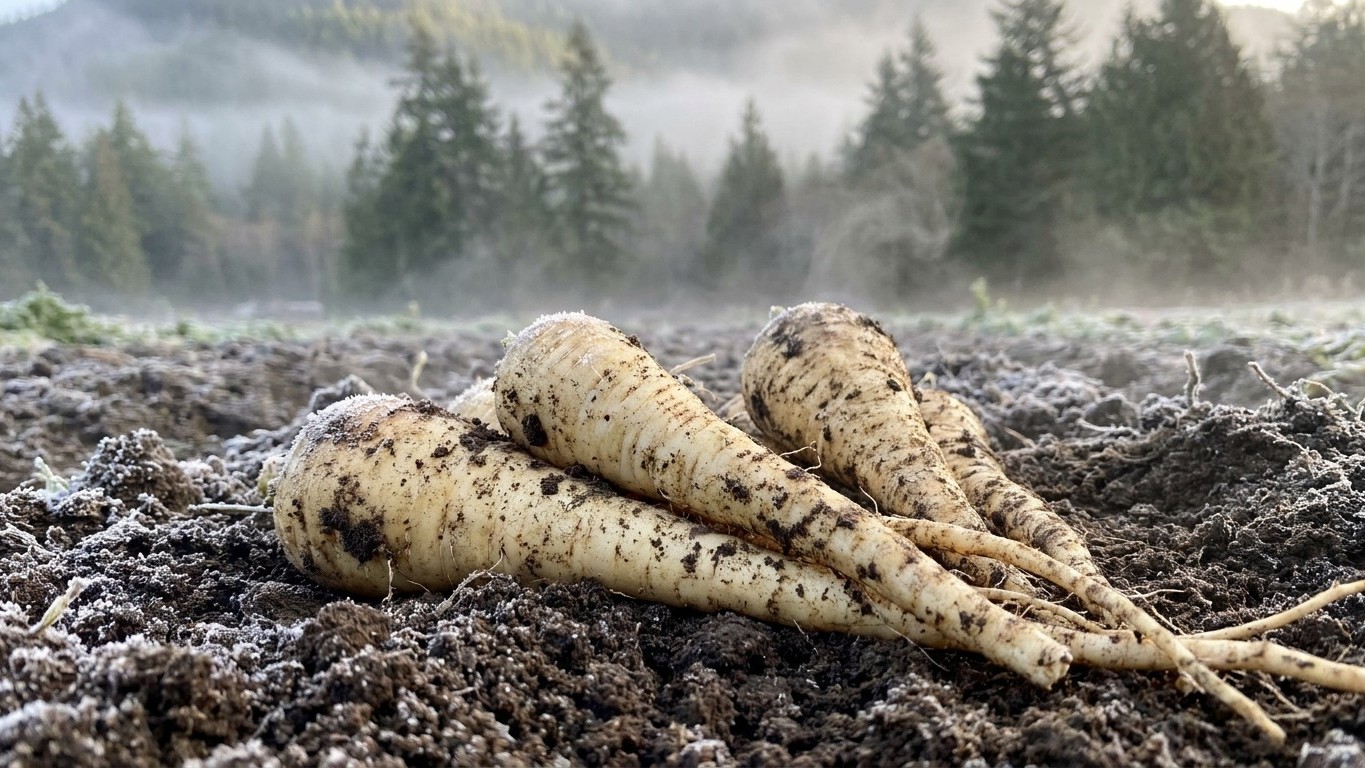

Parsnips will grow across British Columbia’s milder valleys and coastal lowlands without much trouble, but sweetening them into that nutty, almost caramelized dessert-parsnip flavor depends on frost exposure the reference climate station doesn’t reliably deliver. Coastal BC winters run cool, not cold, and that distinction changes everything about the final result on your plate.
The short answer

The question that actually decides this isn’t which hardiness zone a map assigns to your garden. It’s whether your patch of British Columbia gets several weeks of genuine frosty weather in the ground, because that’s the mechanism that converts stored starch into sugar inside a parsnip root. Warmth grows the plant. Cold sweetens it. Those are two separate jobs, and a mild coastal winter can fail at the second one even while doing the first perfectly well.
At the reference station for this territory, Vancouver International Airport, the Canadian Climate Normals for 1981 through 2010 put the mean daily minimum temperature of the coldest month at 33.5°F. Read that carefully: it’s not the record low, and it’s not a monthly average blending day and night. It’s the typical overnight low during the coldest stretch of the year, and it sits just above freezing. That’s a climate where hard frost happens, but it isn’t the dominant feature of winter the way it is in, say, the BC Interior or the northern Prairies.
What that means for parsnips is straightforward but easy to get wrong. A mean minimum of 33.5°F suggests a lot of winter nights hover right around the freeze line rather than diving well below it for sustained periods. Some years will bring enough cold snaps to trigger real sweetening. Other years, especially in a warm winter along the immediate coast, the roots may sit in ground that barely freezes at all, and the flavor stays flatter and starchier than gardeners expect from a parsnip recipe or a seed packet photo.
This is also a single-station answer, and British Columbia is not one climate. Vancouver’s mooring on the Pacific gives it winters that Kamloops, Prince George, or the Okanagan simply don’t share. Interior and upland districts run colder overnight and would sweeten parsnips more reliably than the coastal figure above suggests, but this page doesn’t have measured normals for those locations, so it can’t put a number on them. Treat the Vancouver figure as a coastal baseline, not a province-wide verdict.
So the honest short answer: parsnips will grow well in most of British Columbia’s populated lowlands, but sweetening is not guaranteed by climate alone near the coast. Leaving roots in the ground through whatever cold does arrive, rather than harvesting early, is the single biggest lever a gardener here actually controls.
Does the season fit?
Parsnips are sown directly in place, not transplanted, and the clock for maturity starts the day seed goes into soil. Utah State University Extension puts full maturity at 100 to 120 days from seeding, with sowing recommended 2 to 3 weeks before the last spring frost. Here’s how that math plays out against Vancouver’s own frost dates.
- Sowing window: Environment and Climate Change Canada’s normals put the mean last spring frost at Vancouver International Airport at March 18. Sowing 2 to 3 weeks earlier puts seed in the ground somewhere between roughly late February and the first days of March. Remember that March 18 is a mean date, not a guarantee; in half of all years, frost arrives later than that.
- Germination lag: Parsnip seed is notoriously slow. Expect 14 to 21 days before seedlings break the surface, meaning nothing visible happens until mid-to-late March even from an on-time sowing. Gardeners who give up and re-sow bare soil after ten days are usually just impatient, not failed.
- Maturity target: Counting 100 to 120 days forward from a late-February to early-March sowing lands maturity somewhere between early June and early July.
- Frost window at the other end: The mean first fall frost at the same station is November 10. That leaves roughly four to five months of slack between the roots reaching maturity and the season’s first real cold snap.
That gap is the useful part. Because the growing season here comfortably outpaces the 100-to-120-day requirement, there’s no pressure to harvest the moment roots size up. Parsnips can sit in the ground through October and into November, waiting for whatever frost the season brings, which is exactly the strategy that gives coastal BC gardeners their best shot at sweetness despite a mild mean minimum.
What goes wrong here
- Forked or split roots in heavy, stony ground. Parsnips push a single taproot straight down, and anything that deflects it, compacted clay, rocks, old root channels, splits the root into forks. Utah State University Extension recommends deep, sandy soil, and says heavy soil needs to be double dug before sowing. Where BC gardens sit on clay-heavy or rocky ground, work the bed a full spade’s depth deeper than usual and remove stones by hand rather than skipping the step.
- Forked roots from overwatering. This is a separate cause from soil texture, not a variation on it. Overly wet, waterlogged beds encourage the same forking and rotting at the root tip, even in soil that’s otherwise loose and workable. Water deeply but let the top few inches dry between soakings rather than keeping the bed constantly saturated.
- A season that runs out before frost. This is a lesser risk here given the four-to-five-month gap between maturity and first frost, but late sowings pushed into April, or a spring that arrives later than the March 18 mean, can squeeze the timeline. Sow as close to the recommended 2-to-3-week-before-last-frost window as the ground allows, and don’t wait for guaranteed warmth.
- A winter too mild to sweeten. With a mean coldest-month minimum sitting just above freezing at the coastal reference station, some winters simply won’t deliver enough sustained cold. There’s no soil fix for this. The best available response is leaving roots in the ground as long as possible into the cold season rather than harvesting on a fixed calendar date, so the crop captures whatever frost does show up.
North Carolina Extension’s Gardener Plant Toolbox states it plainly: “All parts of this plant contain furocoumarins which can make skin sensitive to light causing burns so be sure to wear gloves, long sleeves and long pants when dealing with it.” That’s not limited to the leafy tops. Roots, foliage, and stems all carry the compound.
What makes this worth taking seriously is the mechanism, because it isn’t intuitive. Furocoumarins don’t burn skin on contact by themselves. The reaction needs sap on the skin and sunlight hitting that same skin, together. That’s why the injury tends to show up hours after a bright afternoon spent pulling tops or digging roots, rather than the moment sap touches you, and why the sensation of anything wrong can be delayed long enough that gardeners don’t connect it to the parsnip patch at all. It also explains why the useful protection is covering up before you start, with gloves, long sleeves, and long pants, rather than washing your hands afterward once the sun has already done its part.
Checking this against your own county
Vancouver International Airport is one station on a very large and climatically varied province. If your garden sits inland, at elevation, or well north of the Lower Mainland, your actual frost dates and coldest-month minimums will differ from the figures used here, sometimes by weeks. Before locking in a sowing date, check current planting guidance and regional frost data through the BC Ministry of Agriculture and Food, whose resources cover conditions across the province’s growing regions rather than a single coastal reading.
Local knowledge from other gardeners in your immediate area, especially anyone who’s grown root vegetables through a full winter nearby, is worth just as much as any published normal. Climate stations describe averages. Your specific slope, soil, and microclimate describe what actually happens in your bed.
Common questions
Can parsnips survive winter in the ground in British Columbia?
In most of the province’s milder valleys and coastal lowlands, yes, parsnips typically overwinter fine in the ground, since the crop tolerates freezing far better than most root vegetables. The open question isn’t survival, it’s whether enough cold accumulates to sweeten them.
Should I harvest parsnips before or after the first frost?
After, when possible. The starch-to-sugar conversion Utah State University Extension describes happens in response to cold exposure, so pulling roots before frost arrives locks in a starchier, less sweet flavor than waiting through at least part of the cold season.
Why did my parsnips come out forked instead of straight?
Two separate causes produce the same result: growing in heavy, stony, or compacted soil that deflects the taproot, or overwatering a bed that’s otherwise fine. Double digging heavy ground and easing off on watering address these as two different fixes, not one.
Is it dangerous to touch parsnip leaves while harvesting?
All parts of the plant contain furocoumarins that can sensitize skin to sunlight and cause burns, according to NC State Extension, so gloves, long sleeves, and long pants are worth wearing whenever you’re handling roots or foliage in bright sun, not just when trimming tops.