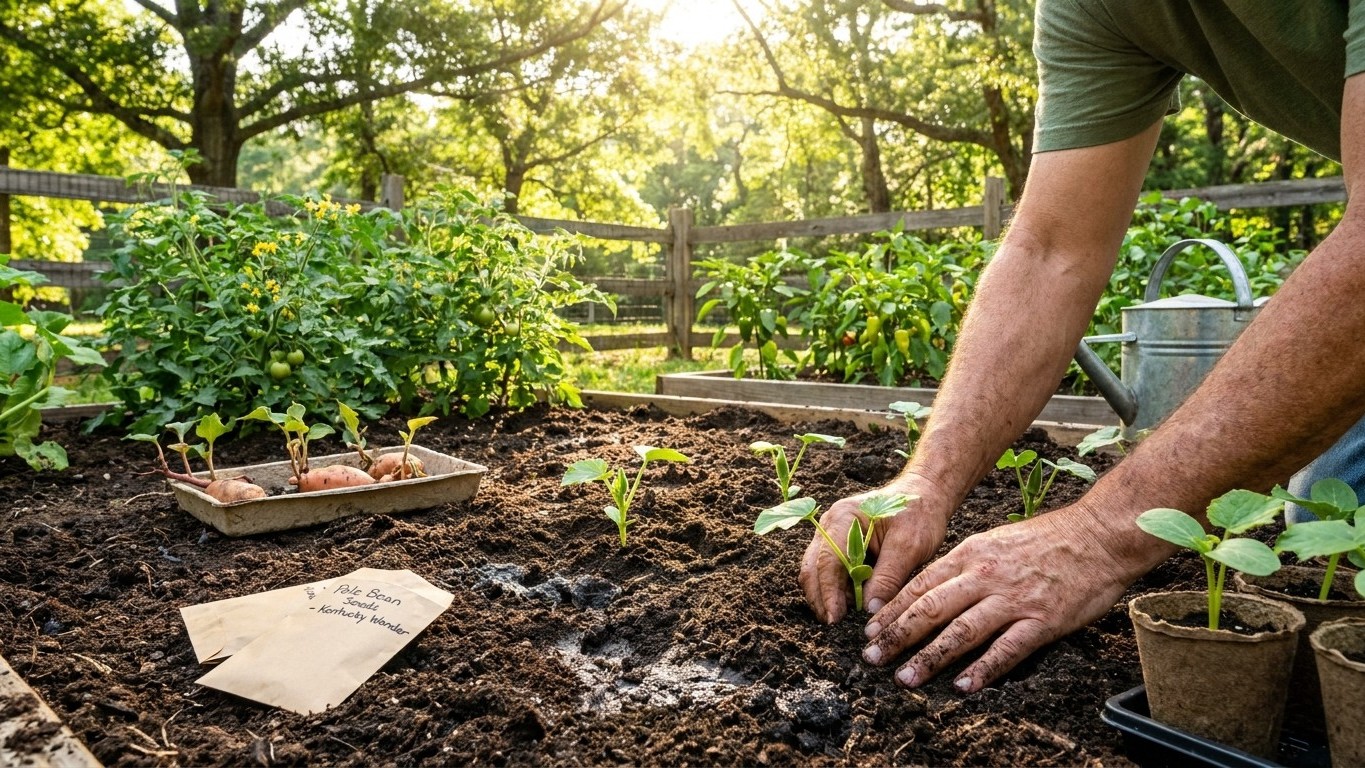

By June, Georgia has been growing-season warm for weeks. The state’s last spring frost window (March 11 to March 29) closed months ago, and the first fall frost is not due until November 13 at the earliest. Soil is hot, days are long, and this is the month for okra, southern peas, sweet potatoes, melons, and successive rounds of beans, squash, and cucumbers.
What goes in the ground in June

June sits deep inside Georgia’s frost-free stretch, and that changes the math completely. The question is no longer “will it freeze” but “is the soil hot enough and is there enough season left before the first fall frost.” With soil temperatures across most of the state comfortably above 70°F by early June, nearly every heat-loving crop is fair game for direct sowing.
Okra, southern peas (cowpeas), snap beans, cucumbers, summer squash, and sweet corn all go straight into the ground now, and all germinate fast in the warm soil. Sweet potato slips go in as transplants, not seed, and June is prime timing for them across most of the state. Cantaloupe, watermelon, and winter squash also go in now if they have not already, since these vines need a long stretch of heat to size up before harvest.
Tomatoes, peppers, and eggplant are a slightly different case. In north Georgia’s cooler pockets, June can still be a reasonable window to get late transplants in, but in the Coastal Plain those crops have usually been in the ground since spring and are already flowering or fruiting. Because Georgia’s hardiness range spans 6a to 9b (USDA Plant Hardiness Zone Map), a June planting decision in the mountains is not the same decision as one made near the coast.
North versus south timing
| Region | June soil and heat status | What’s typically happening |
|---|---|---|
| North Georgia mountains | Warming steadily, still moderate nights | Late tomato/pepper transplants still viable, first squash and beans going in |
| Piedmont (Atlanta area) | Fully warm, humid | Peak planting for okra, corn, peas, cucurbits |
| Coastal Plain / South Georgia | Hot early, intense by late June | Spring crops already producing; new plantings need heat-tolerant varieties |
One caution worth repeating: lettuce, spinach, and other cool-season greens are not a June crop anywhere in Georgia. Seed sown now in open soil will simply refuse to germinate or bolt within days once it does. Save those for cover.
What to start under cover
The clock that matters in June is not the calendar date, it’s the countdown to the first fall frost, which lands somewhere between November 13 and December 1 depending on location. Work backward from that window. Fall broccoli, cabbage, and other crucifers typically need roughly eight weeks of growth before transplant and another eight to ten weeks in the ground before they mature, which means seed started indoors now, under cover where the household can control heat, gives fall crucifers a real shot at beating the frost.
Starting these seeds outdoors in open June soil is the wrong move, not because of cold, but because of heat: crucifer seedlings scorch and bolt prematurely in Georgia’s early-summer sun. Starting under cover, meaning a shaded cold frame, a shielded seed tray near an air-conditioned window, or a covered nursery bed, keeps soil temperature down enough for germination.
The two ways this goes wrong are worth naming plainly. Start too early relative to the fall frost date and the transplants sit too long, becoming rootbound and leggy before conditions are cool enough to set them out. Start too late, particularly for gardeners near the northern edge of the state where fall frost can arrive by mid-November, and the plants run out of season before they mature a harvestable head. Splitting the difference by starting a portion of the fall crucifer seed now and a second batch two to three weeks later hedges against both failure modes.
What is ready to pick
June is one of the busiest harvest months in a Georgia garden, and the pace only builds as the month goes on. Summer squash and cucumbers planted in spring are usually producing steadily by now; check squash at six to eight inches long, before the skin toughens, and pick cucumbers while they’re still firm and dark green. Snap beans are ready when pods snap cleanly and seeds inside are still small.
Georgia’s early blueberry varieties and peach orchards typically peak through June, both signaled by full color and fruit that separates easily from the branch with a gentle twist. Spring-planted onions and garlic often finish bulbing this month too; the giveaway for onions is tops flopping over and starting to yellow, and for garlic it’s the lower leaves browning while the top few stay green.
New potatoes, the small, thin-skinned tubers dug before full maturity, are often ready to pull from spring plantings once the plants flower. Sweet corn from the earliest spring sowing can also be tasseling and filling ears by late June in warmer parts of the state; check by peeling back a bit of husk and pressing a kernel, milky juice means it’s ready.
The jobs that matter this month
Georgia’s June heat and humidity turn a handful of routine chores into deadlines. Mulching tops the list: a two to three inch layer around squash, tomatoes, and peppers now holds soil moisture and keeps roots from baking as afternoon temperatures climb, and it slows the weed flush that thrives in the same warmth.
Watering rhythm matters as much as mulch. Deep, infrequent watering in the early morning beats a light daily sprinkle, since shallow watering encourages shallow roots that struggle once real heat sets in, and morning watering (rather than evening) gives foliage time to dry before nightfall, cutting down on the fungal disease pressure that Georgia’s humidity practically invites.
Staking and caging tomatoes, trellising cucumbers, and setting supports for pole beans needs to happen before the plants sprawl across the bed, not after. Once a tomato vine flops over and starts rooting where it touches soil, disease and pest exposure both climb.
Succession sowing keeps the harvest coming instead of arriving all at once and then stopping. Beans, squash, and corn sown every two to three weeks through June spread out the yield and provide a backup if an early planting struggles. Pest scouting deserves a walk through the garden every few days: squash vine borer, Japanese beetles, and tomato hornworm all build populations fast in Georgia’s warm, humid summers, and catching an infestation early, before it spreads across a whole squash patch, is far easier than fighting it once established.
What not to do in June
The most common misstep this month is letting ready crops sit too long in the heat. Squash left on the vine even a day or two past its prime turns tough and seedy, and beans get stringy fast once the pods start to bulge with mature seed. Checking the garden every couple of days, rather than waiting for a weekend, avoids the waste.
Overhead watering at midday is another habit worth breaking. In Georgia’s humidity, wet foliage that doesn’t dry quickly becomes an invitation for fungal disease, and midday watering also loses more moisture to evaporation than it delivers to roots. Water early, at the base of the plant, and skip the sprinkler head.
Heavy nitrogen feeding once tomatoes, peppers, and beans start flowering is a mistake that shows up later as lush green plants with disappointing fruit set. Nitrogen pushes leaf growth at the expense of blooms; a lower-nitrogen, higher-phosphorus and potassium feed suits the flowering and fruiting stage better.
Leaving bare soil exposed between plants is also a habit that costs more in Georgia’s June sun than it would in a milder month. Unmulched soil bakes, stresses roots, and dries out fast enough that even a diligent watering schedule struggles to keep up. And when blossoms drop during a heat spike, resist the urge to intervene aggressively, since some blossom drop under extreme heat is a normal, temporary response rather than a problem to fix.
Checking this against your own county
A statewide June guide is a starting point, not an instruction sheet for any one backyard. Georgia’s elevation swing from the Blue Ridge Mountains down to the Coastal Plain, combined with a hardiness range that runs from 6a to 9b (USDA Plant Hardiness Zone Map), can shift real-world planting and harvest timing by several weeks between the north and south of the state. A garden in the mountains is often still catching up to warmth that a coastal garden reached weeks earlier.
For a planting calendar tuned to a specific county, the University of Georgia Extension is the reliable next stop, with local offices that track frost timing and soil conditions county by county.
Common questions
Is June too late to plant tomatoes in Georgia?
Not in most of the state, though timing depends heavily on region. In north Georgia’s cooler pockets, a June transplant can still mature before fall frost. In the Coastal Plain, where the season runs hotter and longer, June transplants face more heat stress on fruit set than earlier-planted ones, so choosing heat-tolerant varieties matters more than usual.
What vegetables can handle Georgia’s June heat best?
Okra, southern peas, and sweet potatoes are among the most heat-tolerant crops available and thrive in exactly the conditions June brings. Cucumbers and summer squash also hold up well as long as watering stays consistent.
Can I still start a fall garden if I missed early June?
Yes, particularly in southern Georgia where the first fall frost doesn’t arrive until closer to December 1. Starting fall crucifer seed under cover later in June still leaves enough runway before frost in most of the state, though gardeners near the state’s northern edge have a narrower margin.
Why are my June-planted seeds not germinating?
Cool-season seed like lettuce or spinach simply will not germinate reliably in Georgia’s June soil temperatures. If a warm-season crop like beans or squash is failing to sprout, check that the soil isn’t drying out between waterings, since June’s heat can crust and dry the top inch of soil faster than seedlings can push through.