
In most of Idaho, November lands well after the ground has already frozen or is close to it, so this isn’t a month for sowing seed outdoors and expecting a harvest. The real answer: garlic and shallots go in if the soil is still workable, cold frames and dormant plantings carry the rest, and the bulk of the work moves to pruning, soil, and planning for the season ahead.
What goes in the ground in November

The mechanism that matters here isn’t the calendar, it’s soil temperature and how close the ground is to freezing solid. At the Boise station (USW00024131), NOAA’s 1991-2020 Climate Normals put the first fall freeze between October 7 and October 21. That’s the mildest, lowest-elevation reference point in the state. By November, that freeze window has already passed even in the valley floor around Boise, and most of Idaho, sitting at higher elevation, crossed that threshold weeks earlier. So the honest starting point for November is this: the open-ground planting season for anything tender is over everywhere in the state.
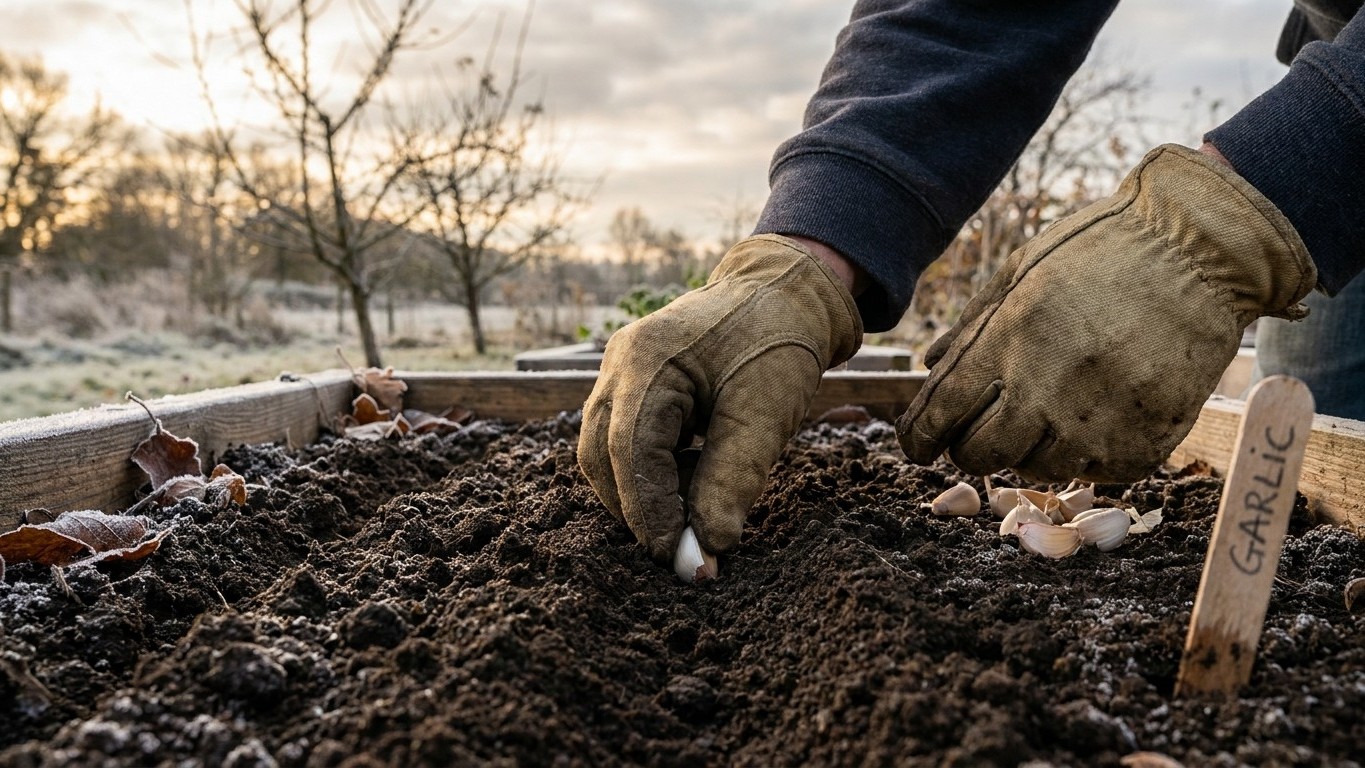
That doesn’t mean the ground is done working for the year. Garlic and shallots are the exception that actually wants a November planting in places where the soil hasn’t locked up yet, usually in the lower valleys around Boise, Twin Falls, and Lewiston. Cloves and bulbs need roughly four to six weeks of soil contact before a hard freeze to root in without pushing top growth, so a workable November is often the last real window before spring becomes the only option.
Beyond alliums, three things reliably belong outdoors this month:
- Cold frames and low tunnels holding spinach, mache, and hardy kale that were seeded weeks earlier and are now just sitting through cold rather than growing much.
- Bare-root and dormant plantings of fruit trees, berry canes, and roses, timed to root while the top stays dormant, as long as the planting hole can still be dug.
- Forced rhubarb and chicory, dug and moved into a dark, cool space indoors, where they’ll push tender stalks without a single frost worry.
Everything else on a typical seed rack, from lettuce to peas to spinach sown direct, is a gamble not worth taking at this point. The soil is either too cold to germinate seed reliably or close enough to freezing that any seedling that does emerge won’t survive long.
What to start under cover
Counting backward from the frost window is the only honest way to plan indoor starts, and for November in Idaho, the arithmetic argues against starting most spring transplants yet. The last spring frost around Boise falls between April 23 and May 7, per that same NOAA station record. Most transplants (tomatoes, peppers, brassicas) want six to ten weeks under cover before that date, which lands their sowing window in February or March, not November. Start them now and they’ll be leggy, rootbound, and stressed long before the ground is ready to take them.
The crops that make sense to start under cover this month are the slow ones, plus a few that aren’t headed for the garden bed at all. Long-season alliums grown from seed rather than sets, if a gardener wants a specific variety not sold as starts, sometimes get an early sowing indoors to build enough root mass before an eventual spring transplant, but this only pays off for varieties with genuinely long maturation. Perennial herbs with slow, uneven germination (rosemary, lavender, some thymes) also tolerate an early start better than fast annual vegetables do, since a slow germinator started too late simply runs out of runway before the transplant window arrives.
The other legitimate use of cover this month has nothing to do with spring transplants. Sowing spinach or mache into a cold frame now, so the seed germinates before the ground locks up hard and then sits semi-dormant through winter, sets up an unusually early harvest once temperatures lift even slightly. Forcing bulbs indoors, amaryllis and paperwhites, follows the same logic in miniature: the cold or dark period does the work, and the gardener just supplies the container.
The two failure modes to watch for are opposite problems. Starting too early produces stretched, weak seedlings that never recover their vigor by transplant time. Starting too late for anything genuinely slow (a two-year biennial herb, a long-season allium) means running out of season before the plant reaches usable size.
What is ready to pick
Outdoors, the honest answer is little to nothing across most of Idaho by November. Anything not already covered or hardened off has almost certainly been taken by frost. That’s not a gap in the calendar so much as a shift in where the food is coming from for the next stretch.
Kale and leeks left in the ground under a layer of mulch or snow cover keep sweetening as temperatures drop, and both can be pulled or cut as needed through the cold months rather than harvested all at once. Cold frame greens, spinach and mache seeded earlier in fall, hold at a small, steady size and can be cut sparingly without stripping the whole planting.
Indoors, sprouts and microgreens fill the gap for fresh greens on a counter rather than a garden bed, ready in one to two weeks from seed regardless of what’s happening outside. This is also the point in the season to walk through storage, whether that’s a root cellar, a cool basement, or a garage shelf, and check winter squash, potatoes, and onions for soft spots. One squash starting to break down against its neighbors will spread rot through the whole bin faster than most gardeners expect; pulling it the moment it turns saves the rest of the batch.
The jobs that matter this month
November carries more real deadlines than most gardeners give it credit for. Skipping these doesn’t just cost convenience, it costs next year’s harvest.
Dormant-season work with a real clock
- Pruning fruit trees and berry canes while they’re fully dormant, before sap starts moving, reduces disease spread and shapes growth for spring.
- Ordering seed now, rather than in late winter, means access to the varieties that sell out first, especially anything region-specific for shorter-season parts of the state.
- Testing and amending soil gives lime or sulfur time to actually shift pH before spring planting, something that doesn’t happen overnight.
- Turning compost one more time before it freezes solid keeps the pile breaking down instead of stalling until spring.
- Cleaning and sharpening tools protects the metal through a season of damp storage and saves a scramble come planting time.
Planning next season’s crop rotation belongs on this list too, and it’s easiest to do now, with this year’s results still fresh, rather than guessing in March. Walking the beds and fences for winter repairs, before snow makes the damage harder to see and fix, is the kind of job that always feels optional until a fence gives way under a heavy snow load. And that storage check mentioned above deserves a repeat visit every couple of weeks through the month, not a single pass, since rot in stored crops accelerates once it starts.
What not to do in November
The classic mistake this month is trusting a warm afternoon over the actual soil and season. A string of mild days doesn’t mean it’s safe to uncover a cold frame fully or skip mulching a bed one more week; the frost window is a range, and a single warm stretch inside it doesn’t cancel the freeze still coming.
Feeding nitrogen at this point in the season is another common error. Nitrogen pushes soft, tender new growth right when a plant should be shutting down for winter, and that new growth is exactly what gets hit hardest by the next freeze. If soil needs amending, this is the month for lime, sulfur, or compost, not a nitrogen-heavy fertilizer.
Leaving winter squash or pumpkins out in the garden past their harvest point is a quieter mistake with the same root cause: trusting the weather to hold. A few freeze-thaw cycles on the skin, even without a hard freeze reaching the flesh, sets up rot that shows up weeks later in storage rather than in the field.
And for anyone still holding off on garlic: waiting too long is the one delay in this whole month that can’t be undone. Once the ground freezes solid, that window closes until spring, and spring-planted garlic rarely bulbs up the same way.
Checking this against your own county
Idaho’s hardiness range runs from 3b to 7b on the USDA Plant Hardiness Zone Map (2023 edition, built on 1991-2020 normals), and that spread alone says a statewide month can’t be treated as an instruction. Boise, the reference point for the frost dates used here, sits at the milder end of that range. Higher elevations, mountain valleys, and most of north Idaho run colder and shorter, often by weeks rather than days.
Elevation and local terrain move a frost window more than latitude does in this state. Before acting on anything above, check it against the University of Idaho Extension for county-level guidance closer to home.
Common questions
Is it too late to plant garlic in Idaho in November?
It depends on whether the soil is still workable. In lower valleys like the Boise area, a workable November is often the last realistic window; at higher elevations, the ground may already be frozen by then, making spring planting the safer bet.
Can I still start vegetable seeds indoors in November for an Idaho garden?
For most transplants, no. Counting back six to ten weeks from the April 23 to May 7 last-frost window around Boise lands the right start date in February or March, not November. Starting now risks leggy, stressed seedlings.
What vegetables survive outdoors in Idaho through winter?
Kale and leeks, left under mulch or snow, and cold frame spinach or mache are the crops most likely to still be usable through the cold months, though growth mostly stops rather than continues.
Should I fertilize my garden beds in November?
Skip nitrogen. It encourages new growth right before hard freezes, which then gets damaged. Lime, sulfur, or compost, based on a soil test, are the amendments that actually make sense this month.
Gardeners who plant by the Moon can check the November 2026 moon planting calendar, a tradition rather than a proven method.
Related guides
Elsewhere? See what to plant in November in every state and province.