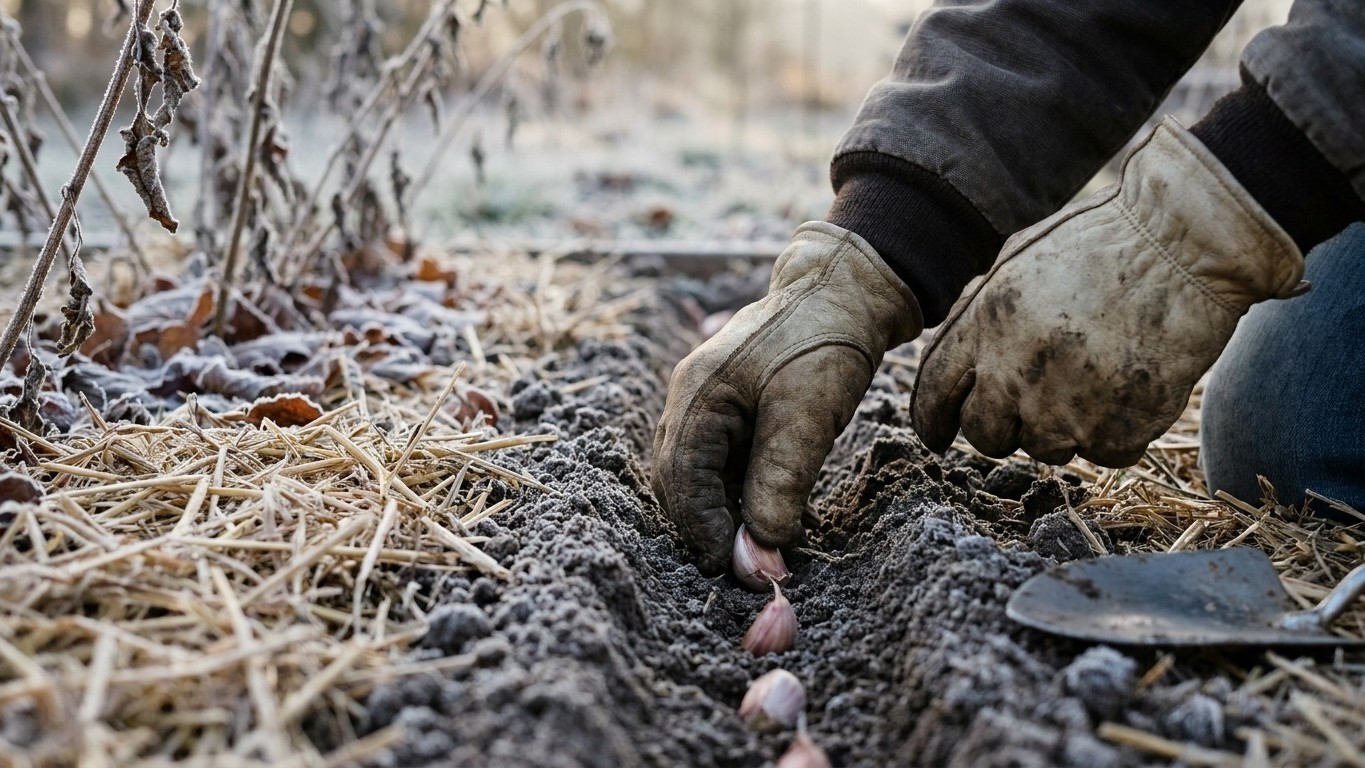

By November, Iowa’s ground is working against a gardener, not for one. The first fall freeze has already swept across the state somewhere between October 14 and October 25, and soil temperatures are sliding toward frozen. Garlic and shallots are the one real exception, going into workable ground while there’s still time to root before the freeze locks in. Past that, this is a month for cold frames, bare-root planting, and forcing roots indoors, not seed packets.
What goes in the ground in November

Soil temperature decides this month, not the wall calendar. Iowa sits in USDA Hardiness Zone 4b-6a, and the first fall freeze has already landed statewide by the time November opens. That means the honest starting point is this: almost nothing new goes into open ground this month across most of the state. The exceptions are narrow but real, and they matter for anyone who wants a head start on the following season.
Garlic and shallots top that short list. Both need roughly four to six weeks of unfrozen soil to grow roots before winter locks everything up, without pushing much top growth that would then get burned by the freeze. If the ground in a given yard is still workable, meaning it can be turned with a spade rather than chipped with a pick, garlic cloves and shallot sets can still go in, pointed end up, a couple inches deep, under a few inches of straw mulch.
Bare-root fruit trees, berry canes, and dormant shrubs are the other safe bet, provided the nursery stock is available and the planting hole doesn’t require fighting frozen clay. Roots that go in while dormant have all winter to settle before spring growth starts, which gives them an edge over anything planted after the thaw.
Cold frames and low tunnels change the math for hardy greens sown earlier in fall. Spinach, mache, and claytonia that are already established can be tucked under cover to keep growing slowly, even as the open beds around them go still. And indoors, this is the month to dig rhubarb crowns or Belgian endive roots and force them in a dark, cool spot for a harvest that has nothing to do with outdoor soil temperature at all.
What to start under cover
Counting backward from Iowa’s last spring frost, which lands somewhere between April 12 and April 24, is the only reliable way to time indoor sowing, and November comes up short for almost every transplant a vegetable garden needs. Onions and leeks typically want ten to twelve weeks under lights before transplanting, which points to a January or February start, not a November one. Tomatoes and peppers, needing six to eight weeks, land even later on the calendar. Starting them now would leave a gardener with rootbound, leggy seedlings stretching for light long before the ground outside is ready for them.
That doesn’t mean the seed trays sit empty. Microgreens and sprouts don’t care about frost windows at all, since they never leave the kitchen counter. Radish, pea shoot, and sunflower microgreens run their full cycle in one to three weeks under a grow light, making November a fine time to start a rotating tray for fresh greens through the darkest stretch of the year. Windowsill lettuce and herb pots fall into the same category: short-cycle, indoor-only, and immune to the outdoor freeze schedule.
The two failure modes to watch for run in opposite directions. Starting long-season transplants too early, thinking ahead to spring, produces weak, overgrown seedlings that struggle once they finally go outside. Starting too late in winter, once the urge to plant something finally arrives, can leave a gardener without transplants ready when the April frost window actually opens. November’s real job on this front is planning the backward count for January and February, not jumping the gun today.
What is ready to pick
Outdoors, the honest answer for most of Iowa is little to nothing by November. The growing season closed with the first fall freeze in mid to late October, and whatever wasn’t harvested by then has likely taken frost damage. But “little” isn’t “nothing,” and a few sources keep the kitchen supplied.
Kale and leeks are the toughest survivors in an unheated bed, especially under a layer of straw or snow, and both actually sweeten after a hard frost as the plant converts starches to sugars. A gardener who mulched a leek row in October can still pull dinner from it well into the cold. Cold-frame spinach, mache, and claytonia, if they were established before the frame went on, keep producing slowly through the same stretch, just at a fraction of summer speed.
Indoors, microgreens and sprouts fill the gap on a rotating one to three week cycle, giving fresh greens with zero dependence on outdoor weather. The other job this month is checking stored crops rather than harvesting new ones. Winter squash, potatoes, and onions in storage need a walk-through: squash with a soft spot or a sweet smell is starting to break down and should get used first, potatoes that have gone green or sprouted need trimming or tossing, and any onion that’s gone soft at the neck will spread rot to its neighbors if it stays in the bin.
The jobs that matter this month
A quiet garden still has a full task list, and November’s version leans toward structure and prep rather than harvest. Dormant pruning of fruit trees and berry canes belongs here specifically because the leaves are down, the branch structure is visible, and disease pressure is at its lowest point of the year. Cutting now, before the deep freeze sets in, lets wounds callous over a little before the coldest weather arrives.
Seed catalogs start moving fast in the weeks that follow, which makes November the moment to place orders for anything with a reputation for selling out, particularly heirloom varieties and anything grown from limited seed stock. Waiting until February often means settling for whatever’s left.
Soil work still counts if the ground is workable. A fall soil test gives lime or sulfur amendments the entire winter to react and adjust pH before spring planting, something a spring-only test can’t offer. Turning the compost pile one more time before it freezes solid keeps the pile active longer and sets up faster breakdown once temperatures rise again.
Tool maintenance and bed repair round out the list: cleaning soil and sap off blades, sharpening pruners and hoes, and fixing fence lines or raised bed corners while there’s no crop in the way to work around. None of this is filler. A rotted bed corner or a dull pruning saw discovered in April costs real time once the season is already moving. And stored crops need a repeat check on the same rhythm as the harvest section above, since rot in one squash or onion spreads if it’s not caught early.
What not to do in November
The most common mistake this month is trusting a mild afternoon over the calendar. A warm stretch in early November can trick a gardener into uncovering cold frames or pulling back mulch, right before temperatures drop again and undo the protection that mulch was providing. Once cold-tender greens or newly planted garlic get exposed to a hard swing back to freezing, the damage is done. The fix is simple: leave winter mulch and covers in place through the season, and only remove them once the freeze-thaw cycle is truly over in spring, not after one warm week.
Garlic timing trips people up in both directions. Planting too early lets cloves push visible green growth before winter, which then gets burned back and weakens the bulb. Planting too late means the cloves sit in cold, barely-thawed soil without enough time to root before the ground locks up completely. The window is narrow on purpose: get cloves in while soil is still workable, then mulch heavily and leave them alone.
Nitrogen fertilizer is the other classic error. Feeding trees, shrubs, or lawns nitrogen in fall pushes soft new growth right as the plant should be shutting down for dormancy, and that new growth is exactly what gets killed by the next freeze. If a fall feeding is warranted at all, it should lean toward phosphorus and potassium for root development, not nitrogen for top growth. Anyone unsure what a bed actually needs is better served by the soil test mentioned above than by a bag of all-purpose fertilizer applied on a schedule.
Checking this against your own county
A statewide frost window is a starting point, not an instruction. Iowa’s last spring frost falls between April 12 and April 24 and its first fall frost between October 14 and October 25 at one reference station, but elevation, local topography, and the straightforward distance between the state’s northern and southern counties can shift those dates by a couple of weeks in either direction. A county in the north can see frost arrive well before a county near the Missouri border does.
The Iowa State University Extension and Outreach service (extension.iastate.edu) publishes county-level guidance that accounts for those local differences, and it’s worth checking against the dates above before locking in a planting plan, especially for anything as timing-sensitive as garlic.
Common questions
Can you still plant garlic in November in Iowa?
Yes, as long as the ground is still workable rather than frozen solid. Garlic needs four to six weeks of unfrozen soil to root before winter, so an early-November planting under mulch is usually still within range, while a very late-month planting in a colder county may already be pushing it.
What USDA hardiness zone is Iowa in?
Iowa spans Zone 4b to Zone 6a on the USDA Plant Hardiness Zone Map, which is based on average annual extreme minimum winter temperature. That range means a plant rated hardy for the northern part of the state may not survive winter in a colder microclimate, and vice versa, so it’s worth checking a specific county rather than treating the whole state as one zone.
Is it too late to start seeds indoors in November?
For most vegetable transplants, yes. Counting backward from the April frost window, tomatoes and peppers want six to eight weeks before transplanting and onions or leeks want ten to twelve, which points to a January or February start. November is better suited to short-cycle microgreens and sprouts that never go outside at all.
What vegetables can survive outside in an Iowa garden through the cold months?
Kale and leeks are the most reliable, especially under straw mulch or snow cover, and both tend to sweeten after a hard frost. Spinach, mache, and claytonia can keep growing slowly under a cold frame or low tunnel if they were established before the frame went on.
Gardeners who plant by the Moon can check the November 2026 moon planting calendar, a tradition rather than a proven method.
Related guides
Elsewhere? See what to plant in November in every state and province.