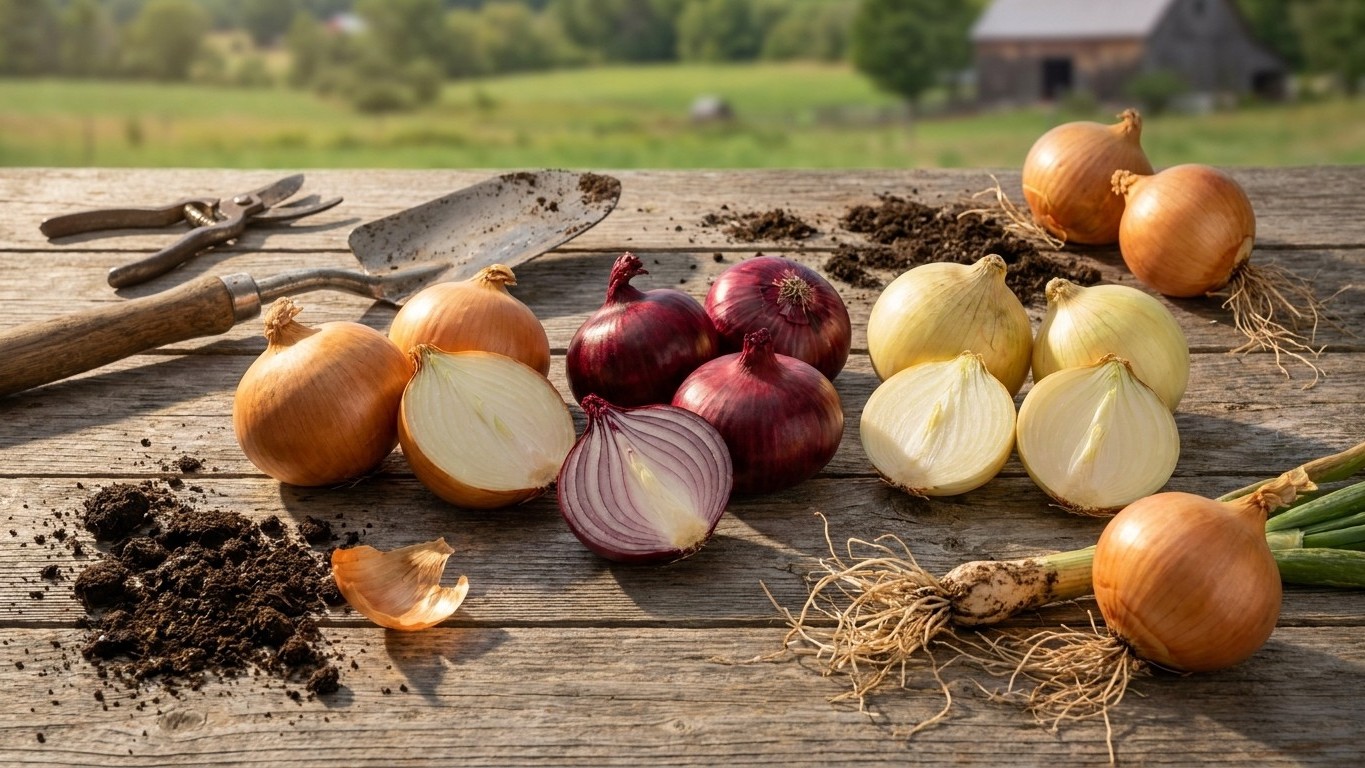

Lift onions when the tops fall over and start to yellow, not when a calendar says so. In Iowa that usually happens in late summer, once the plants have finished bulbing. Pulling them is only half the job, though. Fresh bulbs have wet necks and green-tinged skins, and they rot if they go straight into a cellar. Curing comes first: warm, dry, airy days until the necks are tight and the skins turn papery. Only then do the bulbs go somewhere cool and dry for the winter.
The short answer for Iowa
Des Moines sits at 41.53 degrees north, and on the longest day of the year it gets 15 h 01 of daylight. That figure is calculated from the latitude with the standard sunset formula, and it doesn’t count the roughly seven extra minutes that atmospheric refraction adds. It matters because an onion doesn’t bulb when the soil warms up. It bulbs when the day reaches a length its genetics recognize. Clemson Cooperative Extension puts the threshold for short-day varieties at about 12 hours, while long-day varieties wait for 14 to 16 hours. Iowa’s solstice day clears 14 hours with room to spare, so long-day onions bulb here reliably, and that sets the harvest rhythm.
The sequence runs like this. Sets or transplants go in during spring and spend those weeks building leaves. Each leaf becomes one ring of the future bulb, so leaf growth in spring is bulb size in summer. As days stretch toward the June solstice, the plant switches over and swells at the base. Once bulbing finishes, the necks soften and the tops topple. That toppling is your harvest signal, and in most Iowa gardens it arrives well after the solstice, in mid to late summer.
Reading the tops
Wait until most of the tops have flopped and started to brown. Pick a dry day, loosen the soil with a garden fork if it has packed down, and pull the bulbs gently rather than yanking them by the greens. Skip any onion with a thick, stiff, green neck or a flower stalk. It won’t cure properly, so eat it first. Rain on bulbs lying in the open invites rot, so check the forecast before you commit a whole bed.
Curing, step by step
Spread the bulbs in a single layer where air moves and rain can’t reach: a porch, a garage with the door cracked, a barn aisle, a shaded rack. Direct summer sun can scald the skins, so partial shade beats a hot driveway. Leave the tops and roots on at first. Curing takes anywhere from several days to a few weeks depending on humidity, and it is done when the neck is tight enough that you can’t squeeze it, the outer skins rustle, and the roots are dry and wiry. Then trim the tops to a short stub and brush off loose soil without washing the bulbs.
For storage, Clemson Extension’s guidance is blunt: “Ideal conditions are between 45 °F and 55 °F, and 50 to 60 percent humidity.” Onions want it dry. That is the opposite of carrots and beets, which is why one damp root cellar can’t serve both well. For more on the crop as a whole, see Onions in Iowa.
What will not work here
Iowa has no onion group that flatly refuses to bulb. At 15 h 01 on the longest day, even strict long-day types get what they need. The failures here come from timing, from variety choice, and from skipping the cure. Each one has a predictable result, and none of them is a mild setback.
- Short-day onions planted in spring: they trigger at about 12 hours, and Iowa days are already past that when spring planting happens. They bulb almost immediately, on plants that have barely grown leaves, and you harvest small bulbs.
- Long-day onions planted late: the bulb ends up the size of the plant on the day bulbing begins, so late planting doesn’t push the harvest back. It shrinks it.
- Sweet onions kept for winter: they carry fewer of the sulfur compounds that protect a bulb in storage, so they soften and sprout well before the pungent types do.
- Uncured bulbs sent straight to storage: a wet neck is an open door for rot, and one bad bulb spoils its neighbors.
- Onions stored beside carrots or other roots: a cellar damp enough for roots sits far above the 50 to 60 percent humidity onions need.
The second item deserves a closer look, because it catches the most gardeners. The onion makes a fixed number of leaves before day length flips the switch, and that trigger doesn’t wait for a slow start. A plant set out three weeks late hits the same solstice-driven deadline with three fewer weeks of leaf growth. The bulb comes out smaller, and the calendar date it finishes barely moves.
Damage during the growing season also shortens storage life. Chewed necks and tunneled bulbs rot first, so the pests covered in What Eats Onion in Iowa, and When are a storage problem as much as a summer one. This page doesn’t name cultivars, since variety lists belong with The Best Onion Varieties for Iowa.
What changes across Iowa
The 41.53 degrees north figure belongs to Des Moines, the reference city for this page, and the state is not one latitude. Iowa runs a long way from the Missouri line in the south to the Minnesota line in the north. This page doesn’t publish exact latitudes or day lengths for those edges, so treat the table below as a direction of change rather than a set of measured values.
| Location | Latitude | Day length at the solstice | What it changes |
|---|---|---|---|
| Far northern Iowa | Higher than 41.53 degrees north | Longer than 15 h 01 | Even more room for long-day types; check frost dates, since spring planting may come later |
| Des Moines (reference) | 41.53 degrees north | 15 h 01 | Long-day onions bulb reliably; short-day onions bulb early and small |
| Far southern Iowa | Lower than 41.53 degrees north | Shorter than 15 h 01 | Still clears the 14-hour mark for long-day types, but with a smaller margin |
The practical effect is smaller than you might expect. Day length changes slowly with latitude, and the difference from one end of Iowa to the other is far less than the gap between Iowa and, say, Texas. A gardener near either border doesn’t belong to a different onion group. What shifts is the calendar. Soil in the south thaws earlier, so planting can start earlier and plants can bulk up more before the trigger arrives. The north gets a slightly longer day but often a later start, and that late start eats the head start the longer day gives.
If you garden near the state line, look up your own latitude instead of leaning on Des Moines. Your harvest will probably land within a week or two of the reference timing, and the tops will tell you better than any date.
Sweet now, or onions that last
Every Iowa onion grower makes this trade, whether they notice it or not. The sharp bite of an onion comes from volatile sulfur compounds. Those same compounds help protect the bulb from rot while it sits in storage. A sweet variety has fewer of them, which is why it tastes gentle raw and why it won’t make it through winter. University of Missouri Extension states the rule in its onion guide (G6355): “As a rule, ‘sweet’ onions do not store as well as the more pungent types.”
Day length lines up with this. Short-day types run sweeter and keep poorly. Long-day types run sharper and keep longer. Iowa’s 15 h 01 solstice puts it squarely in long-day territory, so the default Iowa garden produces onions that last, with a bite to match. A southern gardener who grows only sweet short-day types gets onions to eat soon. A northern one gets onions that feed the household into March.
So think about what your pantry looks like in March. If you grew mostly pungent long-day onions and cured them well, you still have a crate of hard, tight-skinned bulbs in a cool dry spot, and the sharpest ones will have mellowed a little with age. If you grew mostly sweet types, the crate emptied by late fall, and what is left has sprouted or gone soft. Plan for both: eat the sweet ones first, and save the pungent ones for the cold months. Don’t count on a sweet onion that stores, because none of them will.
Checking this against your own garden
Every figure above comes from one reference city, and a state-wide number never fits every garden in it. Before you lock in a planting or harvest plan, run through these checks this week:
- Look up the latitude of your town and compare it with 41.53 degrees north. A large gap means your day lengths differ from Des Moines.
- Find your local last spring frost and first fall frost dates. This page doesn’t publish them, so ask your county extension office for the numbers that apply to your zip code.
- Check your seed packet or plant tag for the day-length group, and match it to a variety that bulbs at 14 hours or more.
- Pick your curing spot now: shaded, dry, with moving air and a roof overhead.
- Measure your storage space with a simple hygrometer, and aim for 45 °F to 55 °F and 50 to 60 percent humidity.
Your county extension office knows local frost patterns, soil quirks, and the pests active in your area. Iowa State University Extension runs offices across the state, and a short call or visit will give you dates that no statewide table can. Hygrometers are cheap, and a reading taken in September tells you whether the basement or the garage will hold onions better.
Common questions
How do I know the onions are ready to lift?
Watch the tops. When most of them have fallen over and begun to yellow, the bulbs have finished growing. Pulling earlier gives smaller bulbs with thick necks that don’t cure well.
How long does curing take?
It depends on weather. Dry, breezy days finish the job faster than humid ones. Judge by the onion, not the clock: the neck should be tight, the skins papery, and the roots dry.
Can I store sweet onions through winter?
No. They carry fewer of the sulfur compounds that protect bulbs in storage, so they decline sooner. Eat them first and keep the pungent types for later.
Where should I keep cured onions?
Somewhere cool and dry, between 45 °F and 55 °F with 50 to 60 percent humidity, according to Clemson Extension. A damp root cellar that suits carrots is too humid for onions, so keep the two apart.