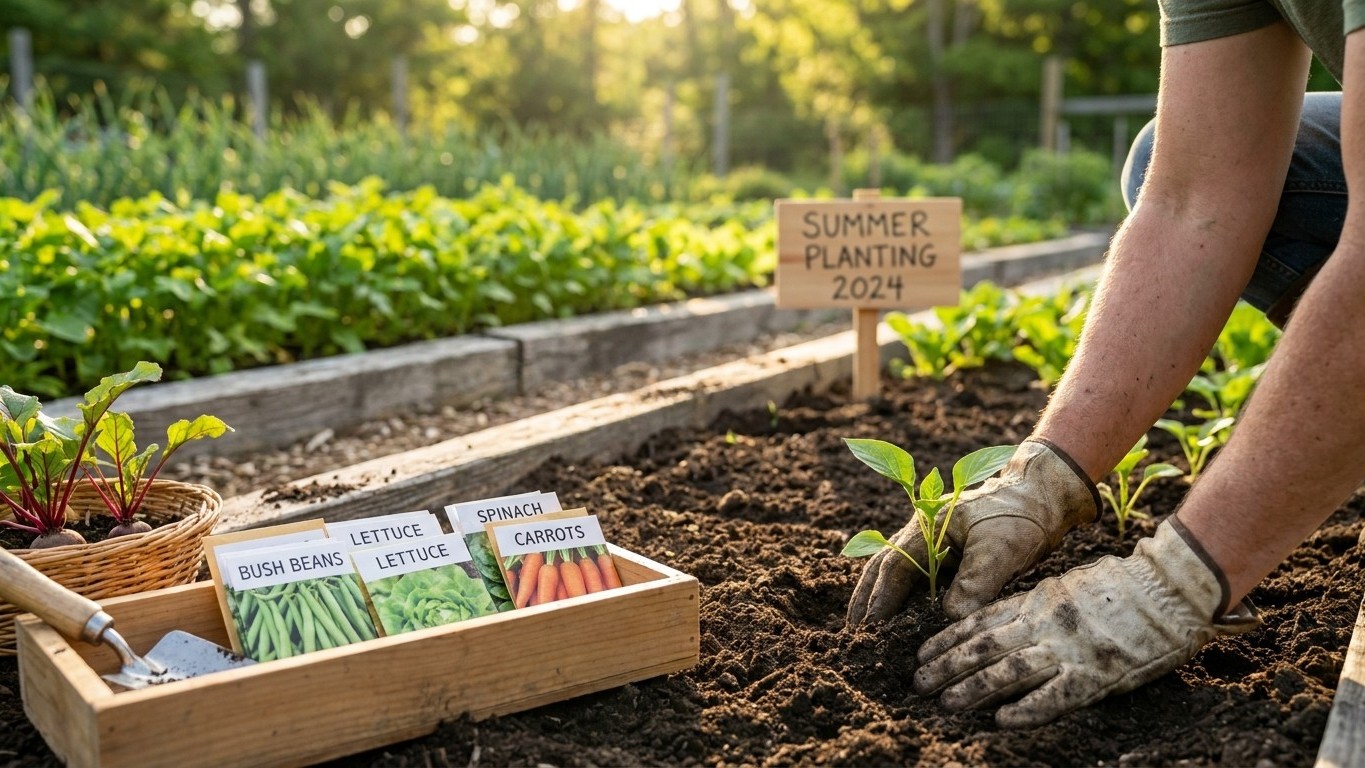

By July, Maine gardens are past the frost risk entirely, sitting weeks beyond the last spring freeze window of April 22 to May 1. That means the question isn’t whether you can plant, it’s what still has time to mature before the first fall frost arrives between October 9 and October 21. The answer: succession crops, fast-maturing greens, and a fresh round of beans and squash.
What goes in the ground in July

The frost math is what matters here, not the calendar page. With the first fall frost landing somewhere between October 9 and October 21 depending on where you garden, July plantings have roughly 70 to 110 days left outdoors. That window rules some things out and opens others wide.
Direct-sown bush beans still have time if planted in the first half of the month. So do summer squash and cucumbers, especially as a second planting to replace anything struggling with squash vine borer or powdery mildew. Quick greens are the workhorses of a Maine July garden: lettuce (choose heat-tolerant or bolt-resistant varieties), spinach for a fall crop, arugula, and mustard greens all mature in 30 to 45 days, leaving comfortable margin before frost.
Root vegetables for fall storage belong in the ground now too. Carrots and beets sown by mid-July will size up nicely by October, and beets in particular tolerate a light frost, which buys extra ripening time. Turnips and rutabagas, both fast growers, fit the same slot.
Cole crops for a fall harvest, meaning cabbage, broccoli, and cauliflower, can still go in as transplants early in the month, especially in the milder coastal zones. Further inland or north, where the growing season runs shorter, lean toward the fastest-maturing varieties and get them in during the first week or two rather than waiting.
Garlic and shallots are not a July task; those go in during fall for next year’s harvest. What you plant now is about filling the second half of the season, not starting it.
What to start under cover
Counting backward from the first fall frost, which lands between October 9 and October 21 depending on location, is the right way to time anything started indoors or under row cover in July. A fall cabbage or broccoli transplant that needs 60 days from seed to harvest, plus a few weeks of hardening off and transplant shock, means seed should already be started by early July at the latest for anywhere but the mildest coastal spots.
Lettuce and other quick greens can be started in trays through the month and moved out every couple of weeks for a rolling harvest into fall. Starting them under light shade cloth or in a cooler spot indoors helps germination, since lettuce seed can stall in hot soil.
The two failure modes to watch for run in opposite directions. Start fall brassicas too early in July’s heat and you risk leggy, stressed seedlings that bolt or stall once transplanted into warm soil. Start them too late, especially inland or in northern counties where frost arrives closer to October 9 than October 21, and there simply isn’t enough season left to reach harvest size before cold shuts things down.
A reasonable middle path: stagger transplant starts across two or three sowings spaced ten days to two weeks apart, rather than betting everything on one date. That spreads the risk and gives a longer fall harvest window instead of one all-or-nothing crop.
What is ready to pick
July is when the spring’s patience starts paying off. Garlic scapes are done or nearly done by early in the month, and the bulbs themselves are bulking up underground, though full harvest usually waits until scapes have been gone a few weeks and lower leaves start browning.
Peas hit their peak here, and the signal is simple: pods should feel full and firm to the touch, not flat. Once the heat sets in, pea vines decline fast, so this is a short window worth checking daily rather than every few days.
Strawberries wrap up their main harvest, with everbearing types continuing to trickle in. Early lettuce and spinach sown back in spring are likely bolting by now, sending up flower stalks and turning bitter, which is the cue to pull them and replace with a fresh planting rather than waiting for a comeback that isn’t coming.
Summer squash and cucumbers, if planted early enough, are starting to produce. The rule with summer squash is to pick young and often; a zucchini left two extra days can double in size and turn watery and seedy. Herbs like basil, dill, and cilantro are ready for cutting, and regular harvesting of basil especially keeps plants bushy instead of bolting to flower.
The jobs that matter this month
Water, mulch, and staking
Consistent watering matters more in July than almost any other month, since heat and longer daylight pull moisture out of soil fast. Deep, infrequent watering builds stronger root systems than a light daily sprinkle. Mulch laid down now locks in that moisture and keeps soil temperatures from spiking around shallow-rooted crops like lettuce and beans. Tomatoes and peppers that haven’t been staked or caged yet need it now, before the plants sprawl and branches snap under their own fruit weight.
Succession sowing and pest scouting
This is the month to keep the succession chain moving: pull a spent lettuce bed and drop in beans or a fast green rather than leaving the space bare. Every empty patch of soil in July is a missed harvest window.
Pest pressure builds fast in the heat. Japanese beetles show up on beans and roses, Colorado potato beetles work through potato and eggplant leaves, and squash bugs cluster on the undersides of squash leaves. Checking plants every few days and hand-picking or knocking pests into soapy water early prevents an infestation from taking over by August. Powdery mildew on squash and cucumbers also gets ahead of gardeners fast in humid stretches, so morning watering at the soil line, not overhead, helps keep leaves dry.
What not to do in July
The most common mistake is treating July heat as a green light for anything and everything, without checking how much season is actually left before the first fall frost lands between October 9 and October 21. Planting a long-season winter squash or a slow pumpkin variety this late is a gamble that rarely pays off north of the coast.
Feeding nitrogen-heavy fertilizer to tomatoes and peppers now is another classic error. At this stage, plants need phosphorus and potassium to push flowering and fruiting, not more nitrogen, which drives leafy growth at the expense of the harvest. If foliage looks lush but fruit set is sparse, the fertilizer is usually the culprit.
Letting garlic scapes linger too long is a smaller but real cost. Left uncut, scapes divert energy from bulb growth, resulting in smaller garlic at harvest. Snap or cut them once they curl.
Overwatering during a rainy stretch, particularly on raised beds with poor drainage, invites root rot and splits ripening tomatoes. Checking soil moisture with a finger before watering, rather than watering on autopilot, avoids both problems. And skipping pest checks because “it’s too hot to be out there” is exactly how a small squash bug cluster turns into a collapsed plant by month’s end.
Checking this against your own county
A statewide July guide is a starting point, not a fixed instruction. Maine’s hardiness zones span 3b to 6a under the USDA Plant Hardiness Zone Map, and that range alone tells you how differently a coastal Portland garden and a garden in Aroostook County behave in the same month. Elevation, distance from the coast, and local lake effect all shift frost timing by weeks in either direction, and the mild end of the state’s frost data reflects coastal conditions, not inland or northern Maine, which runs later in spring and earlier in fall.
For a planting calendar built around your specific county, the University of Maine Cooperative Extension is the reliable next stop.
Common questions
Is it too late to plant tomatoes in Maine in July?
Starting tomatoes from seed in July is too late for most of Maine, since they need a long season to fruit before the first fall frost. Buying an already-started transplant is the only realistic path this late.
Can I still plant corn in July in Maine?
It depends heavily on the variety and location. A fast-maturing sweet corn variety planted in the first week of July might just squeeze in before frost in coastal areas, but it’s a tight margin further inland or north.
Why is my lettuce bitter and bolting in July?
Heat triggers lettuce to bolt, sending up a flower stalk and turning the leaves bitter. This is a normal response to warm temperatures, not a disease, and the fix is to pull it and start a new heat-tolerant batch in a cooler or partly shaded spot.
Should I fertilize my vegetable garden in July?
Fruiting crops like tomatoes and peppers benefit from a phosphorus and potassium feed rather than more nitrogen at this stage, since excess nitrogen now pushes leafy growth instead of flowers and fruit.