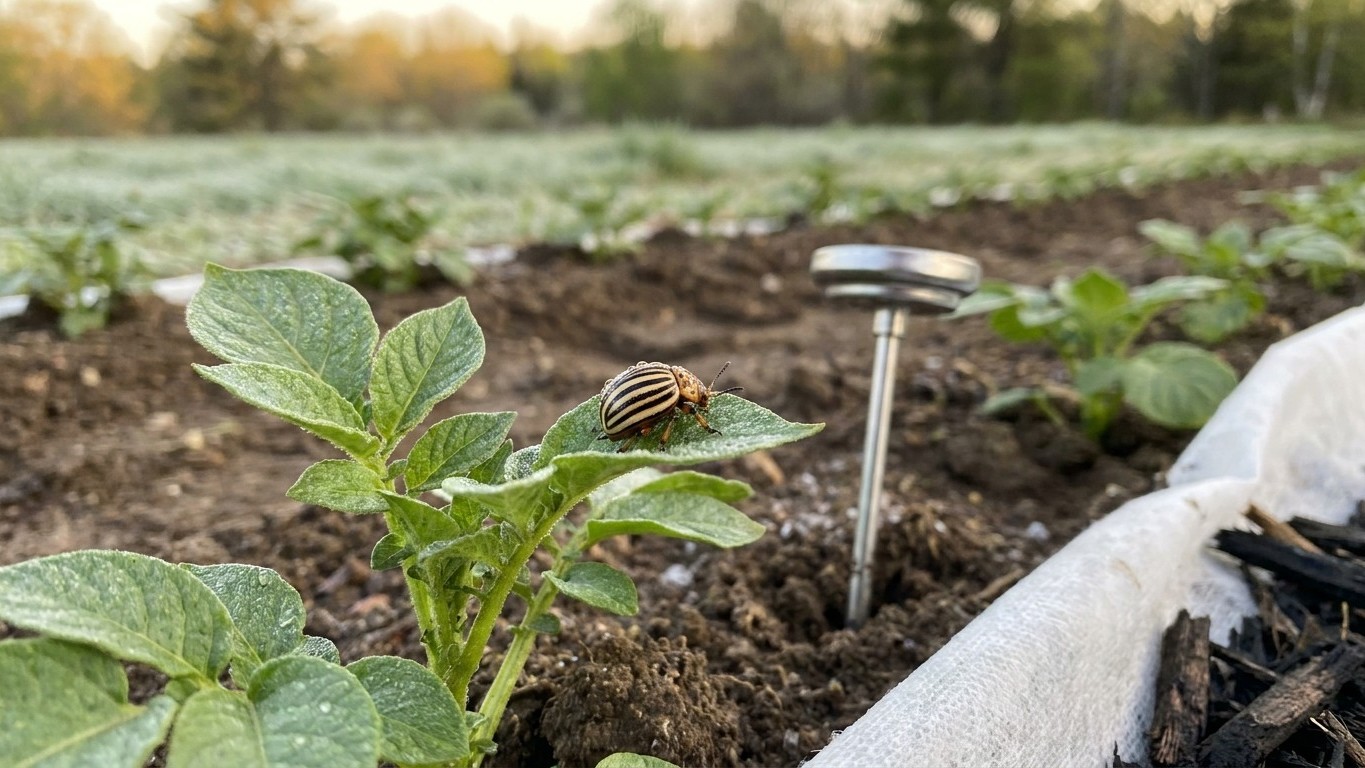

Colorado potato beetles typically break out of Maine soil between mid-May and early June, once ground temperatures climb past roughly 50°F. That timing lines up almost exactly with the first potato plantings in Aroostook County, which means the state’s biggest potato-growing region and the beetle’s wake-up call arrive on the same calendar page every year.
Stopping the beetle once it’s active comes down to a handful of proven tactics: rotating fields away from last year’s potato ground, physical barriers like straw mulch or row covers, targeted use of Bacillus thuringiensis var. tenebrionis, and careful rotation of insecticide classes to slow resistance. None of these work alone. Growers who rely on a single method usually lose the fight by midsummer.
When Colorado Potato Beetles Show Up in Maine

The adults that appear each spring aren’t newcomers. They’re the same beetles that burrowed 6 to 8 inches into the soil the previous fall, sat out the winter in a dormant state, and clawed their way back up once the ground warmed. Maine’s frost-heavy winters don’t kill them off the way some hopeful gardeners assume. The insect is built for cold snaps, and a below-zero January in The County does little to dent the population that reappears in May.
Soil temperature, not the calendar, triggers emergence. Once the top few inches of ground hold steady near 50°F for several consecutive days, adults dig out and start walking, sometimes covering surprising distances on foot before they ever take flight. This matters for Maine specifically because the state’s growing season is short and compressed compared to Idaho or the Mid-Atlantic potato belt, so the beetle’s entire life cycle has to squeeze into a narrower window.
By early June, those overwintered adults have usually found host plants and begun laying eggs. Females glue clusters of 20 to 40 bright orange-yellow eggs to the undersides of potato leaves, and a single female can produce several hundred eggs over her lifetime. That reproductive output is the real threat, not the initial handful of beetles walking in from field edges.
A Life Cycle Built for Speed, Even in a Short Season
Eggs hatch in roughly 4 to 9 days depending on temperature. The larvae that emerge are the real damage engine of this pest, far more destructive than the adults. They pass through four growth stages over about two to three weeks, and the last stage is the hungriest by a wide margin, capable of stripping a potato plant’s foliage in a matter of days when populations run high.
Once larvae finish feeding, they drop off the plant and burrow into the soil to pupate. Adults emerge from that pupal stage 5 to 10 days later, and depending on how warm the season runs, Maine typically sees one full generation with a partial second generation layered on top before fall. Compare that to states with longer, hotter growing seasons that can push through two or even three full generations, and you get a sense of why the Maine outbreak pattern looks different: it’s concentrated, front-loaded, and tends to peak hard in July before tapering off.
That compressed timeline actually works in a grower’s favor. A shorter window for reproduction means fewer total generations to manage per season, which is one reason Maine’s potato acreage hasn’t seen the same runaway population explosions documented in some warmer regions over the decades.
Why Aroostook County Takes This Bug Personally
Maine grows more potatoes than any other New England state by a wide margin, and Aroostook County alone accounts for the overwhelming majority of that acreage. Potatoes aren’t a side crop up there. They’re the backbone of the local economy, tied to seed potato certification programs, processing contracts, and a farming tradition that stretches back more than a century.
The Colorado potato beetle isn’t a minor nuisance in that context. Left unchecked, larval feeding can defoliate a field fast enough to cut yield by a significant margin, and severe infestations have historically forced growers into emergency spray schedules that cut into already thin margins. The pest also happens to be one of the most studied insects in North American agriculture, largely because it was among the first documented cases of an insect developing resistance to a synthetic insecticide back in the 1950s. That history isn’t trivia. It shapes how University of Maine Cooperative Extension and regional agronomists advise growers to manage chemical controls today, with a heavy emphasis on rotating modes of action rather than leaning on one product season after season.
What Actually Stops the Beetle
Start with cultural controls, not a spray tank
Crop rotation remains the single most effective first line of defense, and the reasoning is simple: overwintered adults emerge in or near last year’s potato field and then walk, rather than fly, to find new host plants. Moving potatoes to a field even a few hundred yards from the previous year’s planting forces beetles to travel farther, and that extra distance kills off a meaningful share of the population before they ever find a leaf to eat.
Straw mulch does double duty. It slows early-season beetle movement across bare soil, and it also builds habitat for natural predators like ground beetles and spined soldier bugs, which feed on both eggs and young larvae. Some growers combine mulch with a trap crop, planting an early strip of potatoes along the field edge that beetles find first, then treating that narrow strip aggressively while the main field stays cleaner.
Row covers work well on smaller plots, home gardens especially, but they require removal once plants start flowering so pollinators can reach the blossoms. That timing window is where a lot of backyard growers slip up, either leaving covers on too long or pulling them before the first wave of adults has passed through.
Biological and chemical tools, used in the right order
Bacillus thuringiensis var. tenebrionis, often sold under a Bt label specific to potato beetle, targets young larvae effectively and does minimal harm to beneficial insects. It works best applied early, against first and second instar larvae, before they’ve built up enough mass to shrug off the toxin.
Spinosad and other reduced-risk insecticides fill the gap for larger infestations, but the resistance history here is real and well documented. Colorado potato beetle populations in parts of the Northeast have shown reduced susceptibility to multiple insecticide classes over the years, which is exactly why extension guidance pushes growers to rotate chemistries rather than repeat the same active ingredient across a season. Spraying the same product three times in a row is close to handing the beetle a training manual on how to survive it.
Hand-picking still has a place, particularly for home gardeners managing a few rows rather than acres. Checking the undersides of leaves twice a week during peak egg-laying season and crushing egg masses before they hatch can keep small plots manageable without any spray at all.
Scouting: The Step Most People Skip
Regular field walks matter more than most growers give them credit for. Checking 10 plants at multiple points across a field, focusing on the undersides of leaves for egg clusters and young larvae, gives a much clearer picture than waiting until defoliation is obvious from the road. University of Maine Cooperative Extension recommends treatment thresholds based on larvae counts per plant rather than a blanket calendar spray schedule, since beetle pressure varies enough field to field that a fixed date rarely matches actual risk.
Weather plays into this too. A cool, wet spring can delay emergence by a week or more compared to a warm, dry one, which shifts the entire treatment window. Growers who track soil temperature alongside their own field notes tend to catch the first wave of adults before egg-laying ramps up, and that early catch is worth more than almost any spray applied later in the season.
One detail that surprises a lot of gardeners: adult beetles can survive brief exposure to near-freezing temperatures in early spring, tucking into soil crevices during cold snaps and re-emerging once conditions improve. That resilience is part of why a single hard frost after emergence rarely solves an infestation on its own, even though it might look like a clean kill for a day or two.
Related guides
- Colorado potato beetle in Manitoba: When It Shows Up and What Stops It
- Colorado potato beetle in Maryland: When It Shows Up and What Stops It
- Seedcorn maggot in Maine
- Colorado potato beetle in South Dakota: When It Shows Up and What Stops It
- Colorado potato beetle in Saskatchewan: When It Shows Up and What Stops It