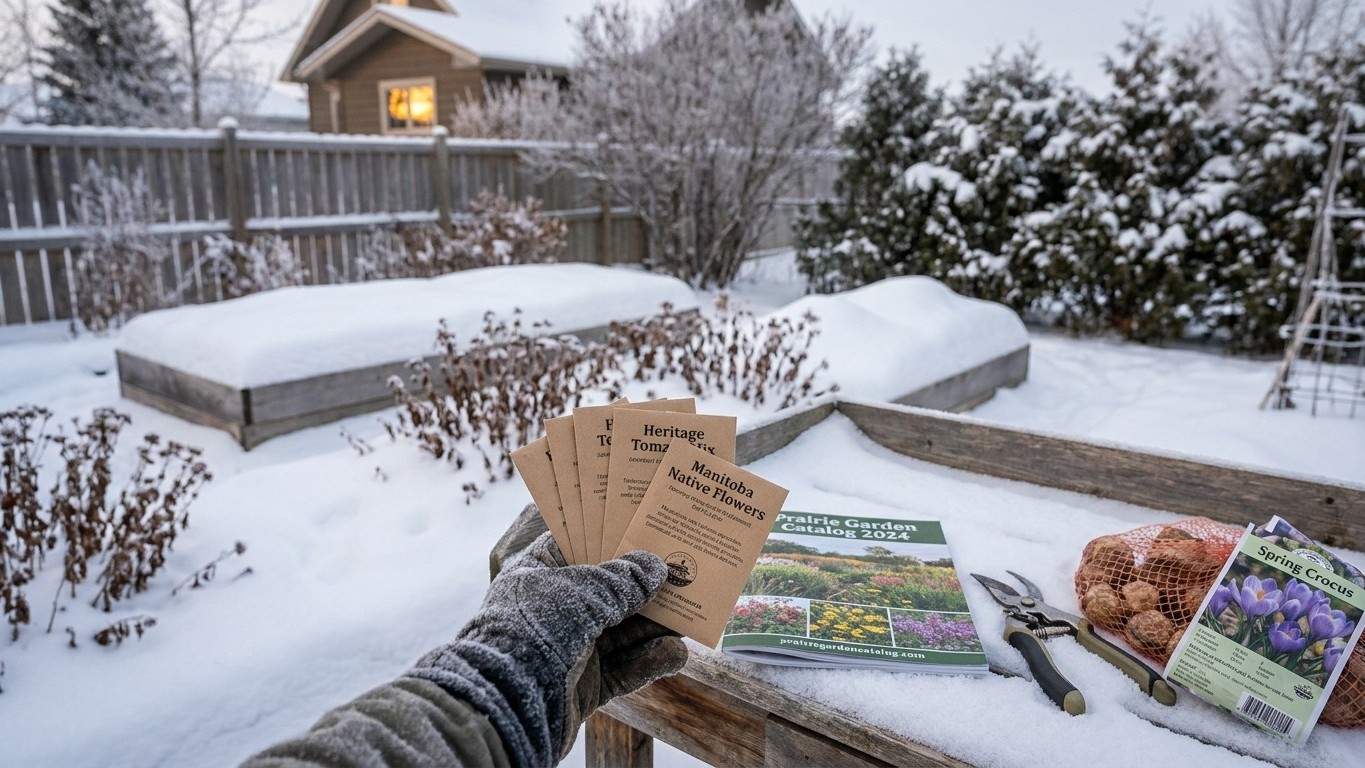

Nothing goes into open Manitoba ground in February. The soil is frozen a foot or more deep, snow cover is still building in most years, and the province’s average last spring frost doesn’t arrive until May 23 at Winnipeg. That single fact reshapes the whole month: instead of planting, February is for forcing, ordering, pruning, and getting ahead of a growing season that’s still three months from starting outdoors.
What goes in the ground in February

The decision here isn’t made by the calendar page, it’s made by soil temperature and the frost window behind it. Environment and Climate Change Canada’s 1981-2010 normals put Winnipeg’s average last spring frost at May 23, and that’s a midpoint, not a guarantee. In roughly half of all years, frost lands later than that date. February sits nearly three months on the wrong side of that window, with ground that’s frozen solid and usually buried under snow. So the honest answer for outdoor, open-ground planting is: none. No seed, no bulb, no transplant belongs in unprotected Manitoba soil this month.
That doesn’t mean the garden is off limits. Garlic and shallots, which are normally tucked into the ground in fall before freeze-up, are already in the soil by now if they went in on schedule : February isn’t a planting window for them, it’s a waiting window, and there’s nothing to do but let the mulch layer do its job. If a fall planting got missed, don’t try to force cloves into frozen ground now; hold them for spring instead.
Cold frames and low tunnels earn their keep this month, but as protection for what’s already established, not as a launch pad for new sowings. A frame with a foot of snow packed against its sides can buffer roots enough to keep overwintered spinach or hardy greens alive underneath, though germinating new seed inside one in February is a losing bet given how little daylight and heat it traps.
The other legitimate February activity is forcing dormant material indoors. Rhubarb crowns lifted and brought into a dark, cool basement will push pale, tender stalks within weeks, a genuine crop from a plant that’s otherwise still frozen in the yard. Belgian endive (witloof chicory) roots work the same way, forced in darkness to produce tight chicons. Bare-root fruit trees and cane fruit can be ordered and even received this month, but they get heeled into a sheltered spot or held in cold storage, not planted, until the ground thaws well past the last-frost window.
What to start under cover
Indoor sowing in February is a math problem, not a habit. Count backward from that May 23 average last frost, and remember it’s a midpoint, planning against it, rather than past it, gives some cushion. From February 1, that’s roughly 15 to 16 weeks out. From the end of the month, closer to 12 weeks.
Slow, long-season crops fit that window. Onions and leeks grown from seed typically want 10 to 12 weeks of indoor growth before transplanting, which lines up well with a late-February start. Celery runs on a similar timeline. These are the crops that reward an early indoor start in a short-season zone like Manitoba’s, because they simply don’t have time to mature if sown after the ground has already warmed.
Peppers are the trap. They generally need 8 to 10 weeks under lights before it’s safe to move them out, which points to a start in early-to-mid March, not February. Sow them now and by transplant time they’re rootbound, leggy, and stressed before they’ve even seen outdoor soil, the classic too-early failure. Tomatoes carry the same risk on a slightly shorter timeline. The opposite mistake, waiting too long on onions or leeks, leaves plants too small to bulb up or thicken properly before Manitoba’s short frost-free stretch closes again around September 22, the average first fall frost. Both ends of that mistake cost real yield, not just tidiness.
What is ready to pick
Outdoors, there’s little to nothing coming out of a Manitoba garden in February. Snow cover and frozen ground rule out any fresh harvest from open beds. Where a cold frame or heavy mulch layer protected hardy greens like kale or overwintered leeks, digging down to check them is worth doing on a mild day, leeks in particular can survive under snow and mulch and still be usable, pulled as needed rather than all at once.
Indoors is where February’s food actually comes from. Sprouts and microgreens grown on a windowsill or under a small light setup are fast, low-effort, and genuinely productive this month, ready to cut within one to three weeks of sowing depending on the type. Forced rhubarb and chicons from the crowns and roots brought in earlier also count as a February harvest, even though they started as a dormant root rather than a seed.
Stored crops need attention now more than at almost any other point in the season. Squash, potatoes, and onions held in a root cellar or cool basement should get a hands-on check: squash going soft at the stem end, potatoes sprouting or going soft, onions with a sour smell or wet spot are all signs to pull and use immediately before they spread rot to the rest of the batch. A five-minute check every couple of weeks saves far more of the stored crop than sorting it once everything’s already gone bad.
The jobs that matter this month
Pruning and structural work
Dormant pruning is the single biggest task February carries. Fruit trees and cane fruit like raspberries are leafless and structurally visible right now, which makes it far easier to see and remove crossing branches, damaged wood, and overcrowded growth without the guesswork that comes once leaves fill in. Pruning while wood is still dormant also avoids stressing the plant during active growth, and it’s timed to finish before sap starts rising as the season turns.
Ordering, planning, and soil work
Seed catalogs move fast, and the varieties best suited to a short, cool Manitoba season, quick-maturing tomatoes, early corn, cold-tolerant greens, are often the first to sell out. Ordering now, rather than waiting for outdoor planting season, is what actually secures those varieties. This is also the window to sketch next season’s crop rotation while the beds are empty and the layout is just lines on paper rather than plants already in the ground, and to pull soil samples for testing if the ground isn’t frozen too hard to sample; results come back in time to plan amendments before spring.
Maintenance that has nowhere else to go
Compost piles benefit from a turn if they’re not frozen solid, both to check moisture and to keep the pile from going anaerobic under snow load. Tools are due for cleaning, sharpening, and any repair, since a dull hoe or a cracked handle is far easier to deal with now than in the middle of spring planting. Raised beds, fencing, and trellis structures can be repaired or rebuilt while nothing is growing in the way. None of this is filler work. Skipping it now means doing it in April, competing with everything else that has to happen at once when the ground finally thaws.
What not to do in February
The most common mistake is starting warm-season seedlings, tomatoes, peppers, basil, too early because it feels productive to get going. In a Manitoba February, that means an 8-to-10-week seedling sitting under lights for 15 weeks by the time it’s safe to transplant outdoors near the May 23 average last frost. The plant ends up rootbound, stretched, and set back before it ever sees garden soil. The fix is simple: count backward from the frost window before sowing anything, and hold tender crops until early-to-mid March.
A second trap is reacting to a mild stretch. Manitoba can throw a run of unusually warm days in February, and it’s tempting to pull back mulch or row cover from overwintered crops to “let them breathe.” That mulch layer is buffering roots against a hard freeze that’s still coming; removing it early exposes plants to exactly the cold snap the mulch was placed to prevent. Leave winter protection in place until there’s a sustained thaw closer to the actual frost window, not a single warm week.
Fertilizing dormant plants is the third mistake worth naming. Nitrogen applied to dormant fruit trees or perennials in February doesn’t get used, since the plant isn’t actively growing, and it can sit in the soil or wash away before roots are drawing on it. Save feeding for when growth actually resumes.
Checking this against your own county
A province-wide frost window is a starting point, not a set of instructions for one specific yard. Manitoba’s climate isn’t uniform: elevation, proximity to lakes, and the long stretch between the province’s southern and northern districts can shift planting windows by weeks in either direction from the Winnipeg-based normals cited here. A garden near a large lake may lag behind a drier inland spot in spring, and northern districts run well behind the south all season. Before locking in dates from this page, check current conditions and local guidance through Manitoba Agriculture, which tracks regional variation across the province in more detail than a single station can.
Common questions
Can I plant garlic in Manitoba in February?
No. Garlic is planted in fall before freeze-up, and by February the ground is frozen and already holding whatever was planted months earlier. If fall planting was missed, hold the cloves for spring instead of forcing them into frozen soil now.
Is it too early to start tomato and pepper seeds indoors in February?
For most of the month, yes. Peppers generally need 8 to 10 weeks before transplanting near the average May 23 last frost, which points to an early-to-mid March start. Sowing in early February usually produces leggy, rootbound plants by the time it’s safe to move them outside.
What Canadian hardiness zone is Winnipeg in?
Winnipeg sits in Canadian hardiness zone 3b, based on Natural Resources Canada’s 1991-2020 data. This is the Canadian system, built on seven climate variables, and it does not convert directly to the USDA zone numbers used elsewhere; the two scales aren’t comparable one-to-one.
What can I actually harvest in a Manitoba garden in February?
Outdoors, essentially nothing. Indoors, sprouts and microgreens are ready within one to three weeks of sowing, and forced rhubarb or chicory roots brought in from cold storage will produce usable stalks or chicons within a few weeks of forcing in darkness.