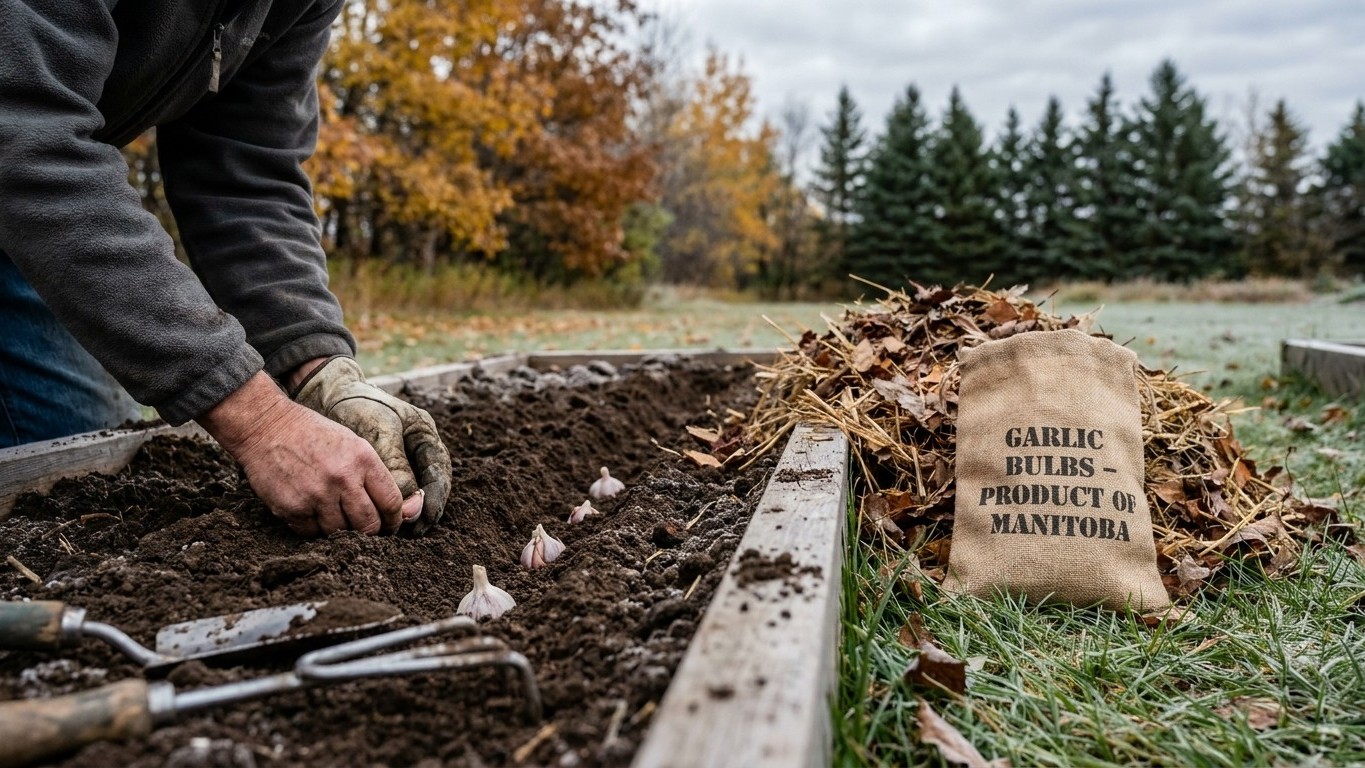

October in Manitoba means the growing season is closing, not opening. The average first fall frost lands around September 22, so by the time October starts most gardens have already taken a hit. What still goes into the ground now is a short list built around cold-hardy bulbs and crops that want a chill before winter, plus the jobs that set up spring.
What goes in the ground in October

The decision this month isn’t the calendar, it’s soil temperature and whether the ground still turns with a spade. Manitoba’s average first fall frost of September 22 means October usually opens after that threshold has already passed, sometimes weeks earlier depending on where in the province you garden. That single fact rules out almost everything except plants that actually want cold ahead.
Garlic and shallots are the anchor crop for this month. Cloves and sets go into loosened, well-drained soil while the ground still gives, then get buried under 4 to 6 inches of straw or shredded leaf mulch before hard freeze-up locks everything down. The mulch matters more than the planting date within reason: it buffers the freeze-thaw cycles that heave cloves out of loose soil over winter. Spring-flowering bulbs, tulips, daffodils, crocus, follow the same logic. They need roughly six to eight weeks of cold soil before ground freeze to root properly, and October is typically the last realistic window before that soil locks up for good.
Rhubarb crowns and other bare-root, dormant perennials can still go in if the ground is workable, and this is also the month to divide and move established perennials that resent spring disturbance, like peonies. None of this is a gamble the way sowing lettuce or peas outdoors would be. With the average frost already behind the calendar, direct-sown greens or alliums-from-seed have essentially no season left to mature. If a hard freeze has already set in where you are, skip the soil altogether and move to cold frames or containers you can protect, or simply hold bulbs and garlic in cool, dry storage until a thaw lets you back into the beds. There’s no upside to forcing a planting date against frozen ground.
What to start under cover
Almost nothing gets started indoors this month for outdoor transplanting. The math runs backward from the next frost-free window, and with an average last spring frost around May 23 (itself a midpoint, not a guarantee, since frost arrives later than that in half of all years), any seed started in October would sit for six or seven months before it could safely go outside. That’s long past useful for annual vegetables and most annual flowers; the plants would be rootbound, leggy, and exhausted well before the ground warmed up.
Where indoor starting does make sense in October is for crops you intend to grow entirely inside through winter: microgreens, sprouts, and windowsill herbs like chives or parsley moved in from the garden before frost killed them outright. Forcing is the other legitimate indoor project this month. Potted spring bulbs (tulips, hyacinths, paperwhites) can be chilled and brought into bloom weeks ahead of the outdoor season, and chicory roots lifted from the garden can be forced in a dark, cool spot for a crop of tender chicons through the darker months.
The failure mode to watch for isn’t starting too early, it’s starting anything meant for the outdoor garden at all. October seed starts for tomatoes, peppers, or brassicas will simply run out of useful life before spring transplant season arrives. Save that seed and that shelf space for late winter, when the arithmetic from the May frost window actually works in your favor.
What is ready to pick
Outdoor harvest is winding down fast, and by the back half of October there’s often little left standing. Frost-tolerant crops that were seeded in late summer, kale, spinach, and mature Brussels sprouts, can still be picked after light frost; cold actually sweetens their flavor by converting starches to sugars. Leeks left in the ground handle freezing soil reasonably well and can often be dug as needed until the ground turns to concrete.
Storage crops are the real harvest priority this month. Winter squash, pumpkins, and any potatoes or onions still in the ground need to come in before a hard freeze damages them, ideally cured and moved to a cool, dark, dry space. Once crops are in storage, the job shifts from harvesting to inspection: check squash and pumpkins weekly for soft spots or a sweet, fermenting smell, both signs of rot starting from the inside out. Sort onions and potatoes and pull anything that’s gone soft or started sprouting before it spreads to the rest of the bin.
If a cold frame or low tunnel is in place, it can keep spinach, arugula, and hardy lettuces producing well past what the open garden allows, sometimes into the following month depending on how far the cold frame is buffering the soil beneath it. Otherwise, October’s real harvest is happening in the pantry and root cellar, not the garden bed.
The jobs that matter this month
This is the month where the unglamorous work either gets done or gets skipped, and skipping it shows up as damage next spring. Dormant pruning of fruit trees and berry canes can begin once leaves have dropped and the plant is fully dormant; cutting now, rather than waiting for a late-winter thaw, reduces the wound’s exposure to disease organisms that are more active in wetter, warmer weeks. Raspberry and currant canes that fruited over summer should be cut back, and any damaged or crossing branches on apple or plum trees are easier to spot and remove once the canopy is bare.
Soil work belongs here too. A fall soil test gives an accurate read on pH and nutrient levels without the noise of active root uptake, and any lime or slow-release amendment applied now has the whole winter to work into the soil before spring planting. Beds that are done for the season benefit from a layer of compost or aged manure spread on top and left for the freeze-thaw cycle to incorporate, which saves a step in spring when the schedule is tighter.
Seed ordering is a task with a real deadline, not a suggestion. Popular varieties, especially short-season ones bred for a climate with a frost window as tight as Manitoba’s, sell out of seed companies’ catalogs by midwinter. Ordering in October means first pick rather than leftovers. Round out the month by cleaning and sharpening pruners and hoes before they sit unused, draining and storing hoses before a freeze splits them, checking fencing and raised bed frames for winter repairs, and turning the compost pile one more time before cold slows the whole process down.
What not to do in October
The most common mistake this month is trusting a mild afternoon over the calendar and the soil thermometer. A stretch of warm October days can feel like an invitation to leave tender plants uncovered or delay moving potted perennials into shelter, but the average first fall frost of September 22 means the season has typically already turned, and a single cold night can undo weeks of otherwise healthy growth. Treat any warm spell as a bonus, not a signal to relax protection.
Fertilizing with nitrogen this late is another one worth skipping entirely. Nitrogen pushes soft, leafy growth, which is exactly the wrong thing to encourage on perennials, shrubs, or fruit trees heading into dormancy. That new growth won’t have time to harden off before hard frost, and the plant ends up more vulnerable to cold damage than if it had been left alone. If anything is going into beds this month, it should be compost or a balanced amendment aimed at next season, not a quick-release feed aimed at growth right now.
Garlic planted too shallow, or left unmulched, is a frequent disappointment come spring, since exposed cloves are more likely to heave out of the soil during freeze-thaw cycles or suffer winterkill outright. And bulbs or garlic held too long in a warm garage while gardeners wait for “better” planting weather often dry out or start sprouting prematurely, which weakens the eventual planting. Once the ground is workable, plant. There’s little to gain by waiting for conditions to improve when the trend for the month only runs one direction.
Checking this against your own county
A province-wide frost window is a starting point, not a forecast for any one backyard. Manitoba’s average frost dates come from a single Winnipeg-area station, and northern districts, higher elevations, and areas near large lakes routinely run weeks behind or ahead of that reference point. A garden 100 miles north of Winnipeg or tucked into a low-lying frost pocket should expect its own local pattern to diverge from these averages, sometimes significantly.
For local planting calendars, soil test resources, and pest and disease bulletins tailored to specific regions of the province, Manitoba Agriculture is the reliable next stop.
Common questions
Is it too late to plant garlic in October in Manitoba?
Not usually, as long as the soil is still workable. Garlic planted in October still has time to establish roots before the ground freezes, provided it’s mulched with 4 to 6 inches of straw or shredded leaves to buffer winter freeze-thaw cycles.
Can I still start vegetable seeds indoors in October?
For outdoor transplanting, no. With the average last spring frost sitting around May 23, seed started in October would spend six or seven months indoors and become rootbound and weak long before it could go outside. Save indoor starts for microgreens, herbs, or winter windowsill growing instead.
What hardiness zone is Manitoba for planting purposes?
The reference city sits in Canadian hardiness zone 3b, based on Natural Resources Canada’s plant hardiness system, which uses seven climate variables rather than the single winter-minimum measure the USDA system uses. The two systems don’t convert directly, so a Canadian zone 3b shouldn’t be treated as equivalent to any single USDA zone.
What can I still harvest in October?
Frost-tolerant greens like kale and spinach, mature Brussels sprouts, and leeks left in the ground can often still be picked after light frost. Winter squash, potatoes, and onions should be lifted and moved to storage before a hard freeze, then checked regularly for soft spots or sprouting.
Gardeners who plant by the Moon can check the October 2026 moon planting calendar, a tradition rather than a proven method.
Related guides
Elsewhere? See what to plant in October in every state and province.