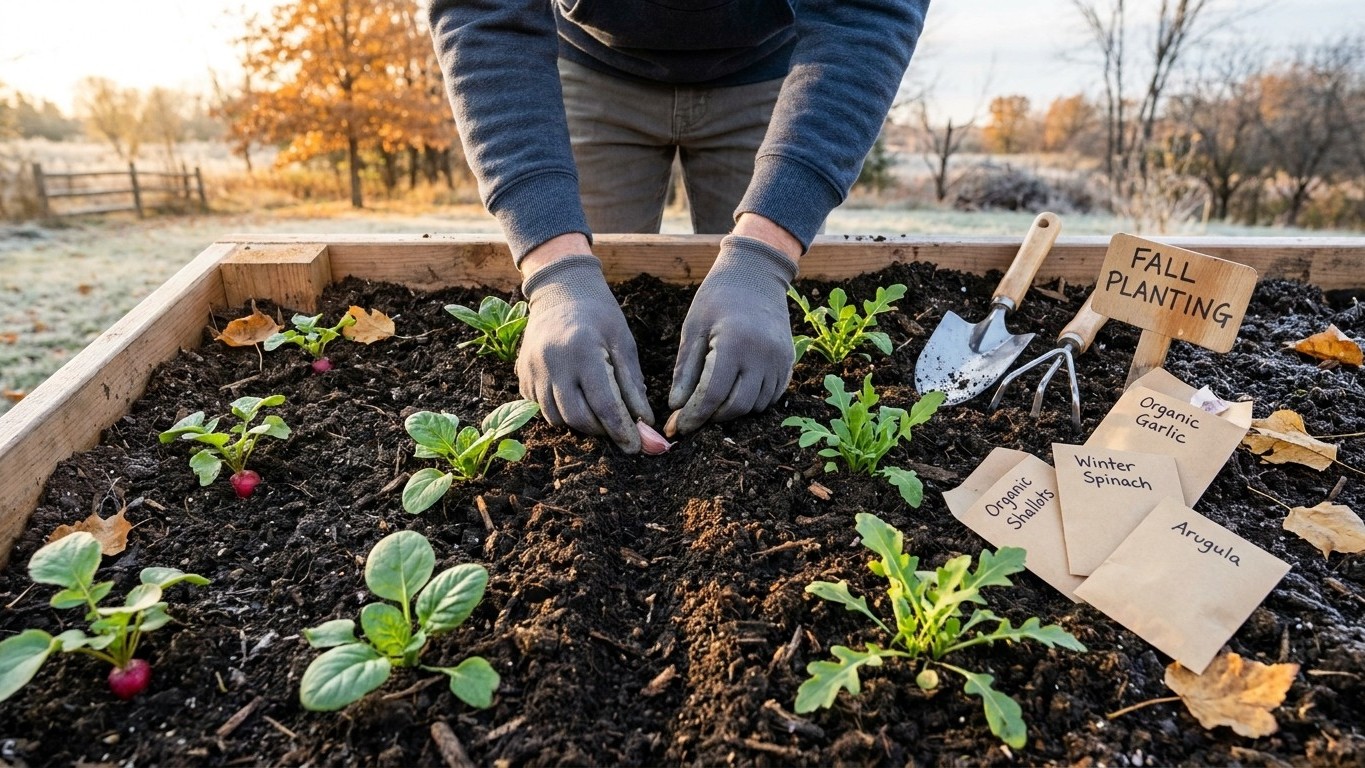

September in Minnesota is a race against the first fall frost, not a countdown to winter. Direct-sow hardy greens, radishes, turnips, and spinach now, get garlic and shallots into prepped beds before the ground firms up, and start pulling tender crops before that October frost window closes in.
What goes in the ground in September

The decision this month is not the calendar, it is the gap between today’s soil temperature and the first fall frost, which lands somewhere between October 11 and October 23 across the Twin Cities area, per NOAA’s 1991-2020 climate normals. Count backward from that window rather than forward from today’s date, and the picture gets simple fast: anything that needs 60 days to bulk up is a gamble past the first week of the month, anything that needs 30 days or less is still fair game through the third week.
Spinach, arugula, mesclun mix, and radishes are the safest direct-sown bets, since all four can go from seed to harvest in three to five weeks and tolerate a light frost without flinching. Turnips sown early in the month for their roots (not their greens) can still size up before the ground cools too far. Peas planted now for a fall crop are a narrower window, they want cool nights but not a hard freeze while flowering, so this only works in the first half of the month in most of the state.
Garlic and shallots are the exception to the “sow now, harvest now” logic. Minnesota gardeners plant garlic cloves in fall for a summer harvest the following year, and September is prep season more than planting season for most of the state, with actual planting typically landing after a few frosts have knocked back weed pressure. If the soil is workable and you’re eager, cloves can go in toward the very end of the month in the mild south, but most growers wait until the first hard frost has passed.
| Crop | Method | Frost tolerance |
|---|---|---|
| Spinach | Direct sow | High, survives light freezes |
| Radish | Direct sow | Moderate to high |
| Turnip (roots) | Direct sow | Moderate to high |
| Peas (fall crop) | Direct sow, early month only | Low while flowering |
| Garlic/shallots | Cloves, late month to post-frost | Planted dormant, fully hardy |
Skip anything warm-season. Beans, squash, cucumbers, and tomatoes started now will not mature before frost stops them cold, and a warm September afternoon does not mean the soil underneath has caught up.
What to start under cover
Under cover this month means cold frames, row covers, and unheated hoop tunnels, not a heated propagation setup. Work backward from that October 11 to 23 frost window: a cold frame typically buys two to four extra weeks of growing season depending on how tightly it’s sealed at night, so crops started now with 40 to 50 days to maturity have a real shot at a protected harvest before the season truly closes.
Lettuce, spinach, and mustard greens sown under a low tunnel in the first half of September can still be picked as baby greens six to eight weeks out, well inside the frost window even in the tighter northern counties. Kale and collard transplants moved under cover now will hold through several frosts once established, since both crops actually sweeten after a touch of cold.
The two failure modes here mirror each other. Start too early, cramming warm-season leftovers into a cold frame in denial that summer is ending, and you waste protected space on plants that were never going to finish anyway. Start too late, past the third week of the month in the coldest counties, and even frost-tolerant greens won’t get enough daylight and warmth to size up before growth stalls. The sweet spot is narrow, roughly the first two weeks of September for anything that needs more than five weeks to mature, stretching to the third week for the fastest microgreens and baby-leaf crops.
If you’re gambling on a stretch past the state’s average frost window, hedge it: keep a second layer of frost cloth ready to throw over the cold frame lid on the nights the forecast tightens.
What is ready to pick
September is the harvest bottleneck of the Minnesota garden year, the point where summer crops and fall crops overlap and the freezer fills up fast. Tomatoes, peppers, and summer squash are still coming in steadily through the first half of the month, and a sudden cold snap is the signal to strip the vines rather than hope for one more warm week.
Winter squash and pumpkins should come off the vine once the skin resists a fingernail scratch and the stem has started to dry and corky. Pulling them too early means soft flesh and a short storage life; leaving them out through a hard freeze cracks the skin and invites rot within weeks. Sweet corn, if you planted a late succession, is judging itself: silks brown and dry, ears feel full to the squeeze.
Apples ripen on their own schedule region by region, but the classic test travels well statewide: lift and twist gently, and a ripe apple separates from the spur with almost no resistance. Potatoes can stay in the ground a bit longer once the tops die back, since the soil itself is decent cold storage for a few extra weeks, but dig them before a hard freeze reaches root depth.
Check anything already in storage, root cellar, garage shelf, or basement bin, for the first soft spots. One bruised or nicked squash sitting against its neighbors is the fastest way to lose a whole shelf to mold before the month is out.
The jobs that matter this month
Frost prep tops the list, and it is not optional busywork. Tender bulbs like dahlias and gladiolus need to come out of the ground before a hard freeze hits the tubers, cleaned of soil, and cured somewhere dry and cool for winter storage. Wait until after the first frost blackens the foliage (that’s actually the cue that dormancy has started) but don’t wait past it by more than a few days.
Fall is genuinely one of the two best planting windows for trees and shrubs in Minnesota, alongside spring, because root systems still grow in soil that’s cooling gradually while air temperatures drop. September, before the ground stiffens, is the last comfortable stretch to get bare-root or container stock in with enough time to settle before winter.
Cover crops belong in any bed that’s finished producing for the season. A quick-growing cover like winter rye or crimson clover, seeded by mid-month, has time to establish enough root mass to hold soil through winter and add organic matter come spring, rather than leaving bare dirt exposed to erosion and weed seed.
Cut back disease-prone perennials and pull spent annual vines rather than composting them in place, since powdery mildew and blight spores overwinter happily in leftover plant debris. Turn the compost pile one more time while it’s still warm enough for the microbes to work. Test soil pH now if a bed underperformed, because fall amendments (lime, in particular) need months to shift pH before next season, not weeks. Clean and oil pruning tools before they sit idle, and order seed for spring while catalogs still show full stock; the popular varieties do sell out over winter.
What not to do in September
The most common misstep is trusting a warm afternoon over the soil thermometer. A 75-degree day in early September doesn’t mean the ground has caught up, and any warm-season transplant tucked in on that logic is dead within weeks once night temperatures drop, which they do fast this time of year in Minnesota. If it’s a crop that needs summer heat to finish, that window closed weeks ago.
Don’t fertilize with high-nitrogen products this late in the season. Nitrogen pushes soft, leafy new growth exactly when plants should be hardening off for winter, and that tender growth is the first thing a frost kills, sometimes taking stressed stem tissue down with it. If anything, switch to a low-nitrogen, higher-potassium feed for perennials and lawns to support root and hardiness development instead.
Resist uncovering cold frames or pulling row covers too eagerly after a mild stretch. A run of warm days in late September is common and it is not a signal that frost risk has passed, since the October 11 to 23 window is an average, not a guarantee, and years run earlier than that on the cold side.
Finally, don’t leave winter squash, pumpkins, or tender bulbs out “for one more week” once frost is forecast. A light frost can be fine for the plant but rough on the harvestable part, and a hard freeze does damage that shows up as rot two or three weeks later in storage, long after it’s too late to fix.
Checking this against your own county
A statewide month is a starting point, not an instruction. Minnesota spans USDA hardiness zones 3a to 5a, and elevation, lake effect, and simple latitude push planting and frost windows around by two to three weeks between the northern counties and the milder Twin Cities area used as the reference point here. A frost date that fits the south can arrive weeks early up north.
Check your own numbers against the University of Minnesota Extension, which publishes county-level guidance built for exactly this kind of variation.
Common questions
Is it too late to plant a vegetable garden in Minnesota in September?
Not entirely. Fast-maturing crops like spinach, radishes, and baby greens still have time to produce before the first fall frost (October 11 to 23 in the Twin Cities area), but anything needing 60 or more days to mature is a poor bet this late.
When should garlic go in the ground in Minnesota?
Most growers wait until after the first hard frost, which typically pushes garlic planting into October rather than September, though the mild south of the state can sometimes plant cloves in the final days of September if the ground is still workable.
What USDA hardiness zone is Minnesota?
Minnesota spans zones 3a to 5a on the USDA Plant Hardiness Zone Map, with the coldest zones in the north and the mildest around the Twin Cities and southern counties.
Should I fertilize my garden in September?
Avoid high-nitrogen fertilizer this late in the season, since it encourages soft new growth that frost damages easily. A low-nitrogen feed suits perennials and lawns better at this point in the year.
Gardeners who plant by the Moon can check the September 2027 moon planting calendar, a tradition rather than a proven method.